
 English
 中文
 日本語
 한국어
 العربية
 Русский
 Português
 Türkçe
 हिन्दी
 Tiếng Việt
 ไทย
 Indonesia
 Melayu
 ខ្មែរ
 ລາວ
 မြန်မာ
 Afrikaans
 Hausa
 Igbo
 Sesotho
 isiXhosa
 Yorùbá
 isiZulu
Over the past 20 years, I’ve walked through more restaurant and dining rooms than I can count. One thing never changes: the furniture buying process is where most owners get burned.
You pick a restaurant furniture supplier. You pay a deposit. Two months later, a container shows up with wobbly tables, chairs that scratch after a week, and booth seams already splitting.
We at Mingmeng Furniture learned this the hard way too — back when we helped a Canadian burger chain furnish 12 locations. Their first supplier sent chairs with seat foam that collapsed in 90 days. We had to rush-produce 600 replacement seats within 4 weeks. That experience taught us exactly what to check before signing anything.
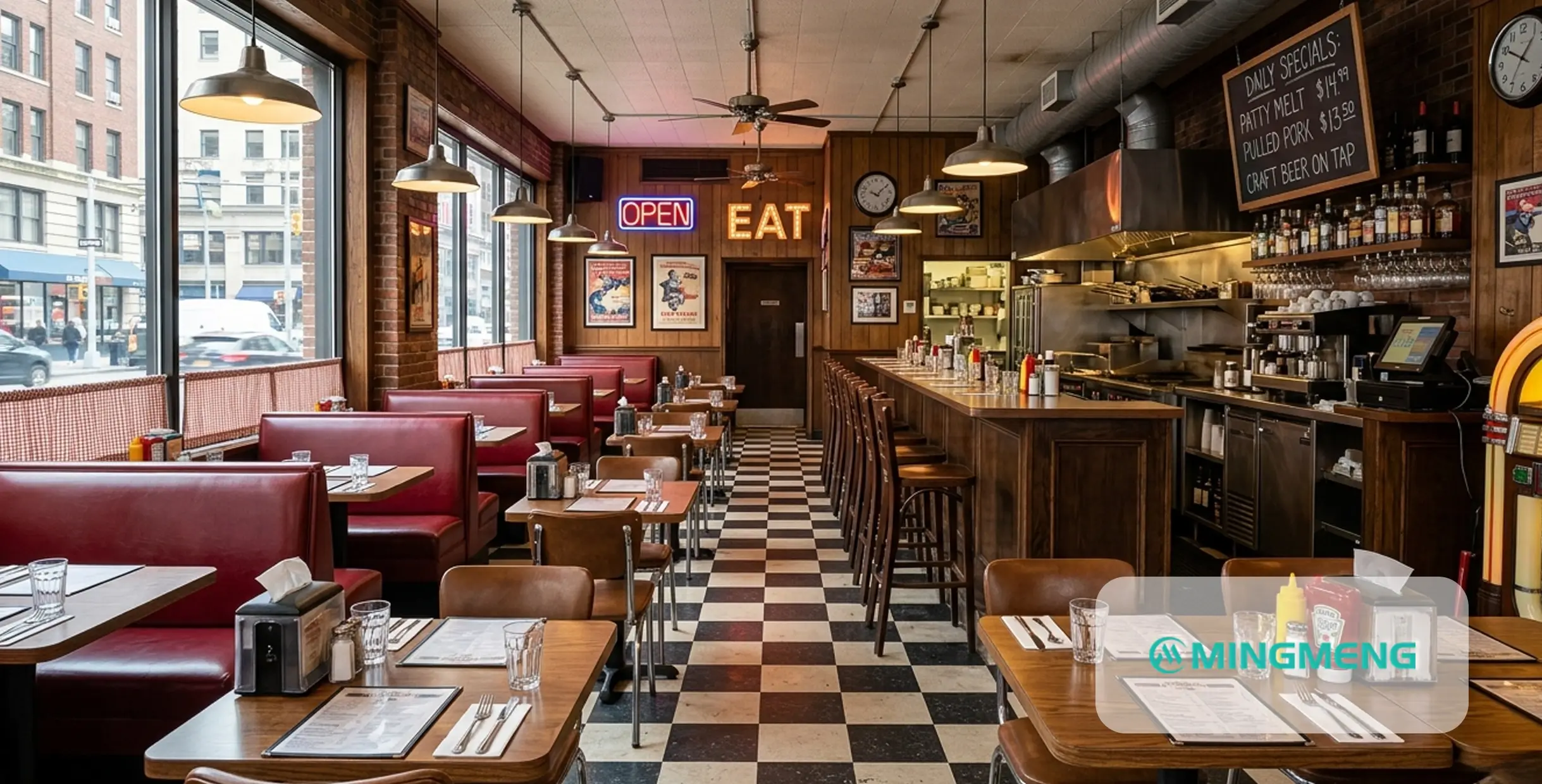
Below is the exact checklist we use internally to audit suppliers. Use it. Or better yet, print it out and force every supplier to answer every line.
Already looking for names? Start with our أفضل 6 موردي أثاث المطاعم في الولايات المتحدة الأمريكية, then run them through this checklist.
1. Who are you really dealing with?
Ask for their business license and export license. For Chinese restaurant furniture suppliers, check if they’re registered with the Chamber of Commerce. A red flag: they can’t name three US customers from the last two years.
What we do differently: We keep a folder of past US project invoices (redacted, of course) and share them with serious buyers. You should ask for the same.
2. Sample quality — don’t trust catalog photos
Order a physical sample. Not a small swatch. A full chair or a table top. Here’s what we check:
- Seat foam density: commercial grade should be 2.5–3.5 lbs per cubic foot. Anything below 2.0 lbs will flatten in 6 months.

- Frame thickness: tubular steel for chairs should be 1.5mm to 2.0mm wall thickness. 1.2mm is for residential — skip it.
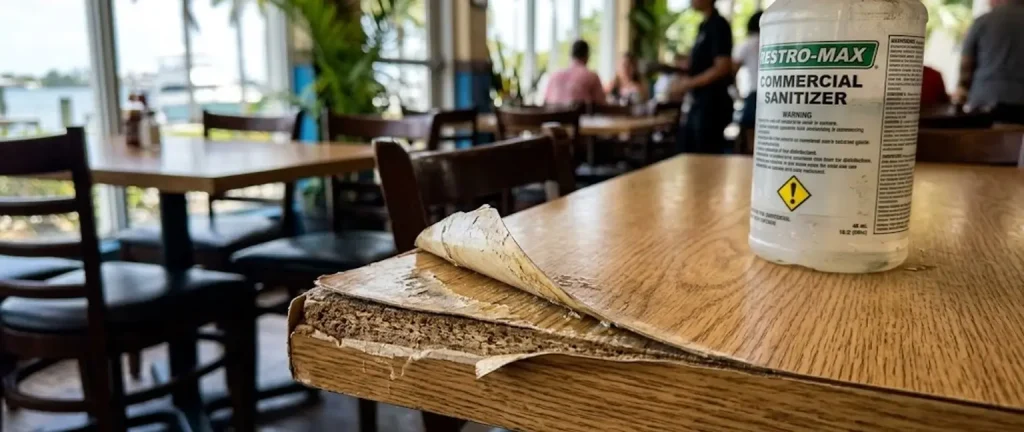
- Table top edge banding: ask for 2mm PVC or thicker. Thinner banding peels off after 200 wipe-downs.
مثال حقيقي: A Miami seafood restaurant ordered 200 oak-finish tables from a cheap supplier. The edge banding was 0.8mm. After one month of cleaning with standard disinfectants, 60 tables showed peeling. They switched to us. We use 2.5mm ABS edge banding with heat-sealed glue. Zero returns on that spec since 2019.
3. Customization — what’s actually possible?
Don’t let suppliers say “anything is possible.” Get specifics.
- MOQ for custom colors: Most factories require 200–500 pieces per SKU. We go down to 50 pieces per design for standard modifications (swap fabric, change leg finish). Full custom (new mold) starts at 300 pieces.
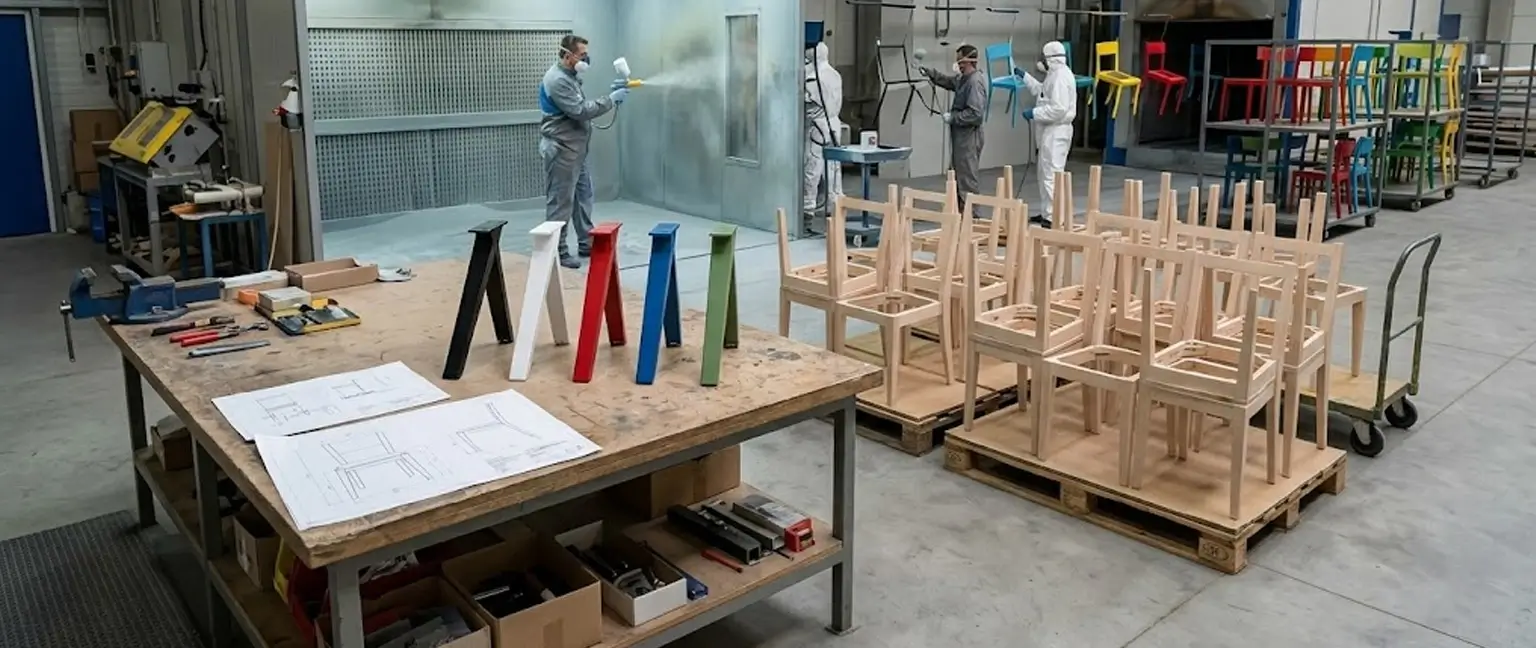
- Lead time for custom: Sampling 15–20 days. Bulk production 35–45 days after sample approval. Sea freight to US ports 30–35 days. Total door-to-door 80–100 days. Anyone promising 45 days total for custom? Walk away.
- What to put in your contract: “Supplier must provide production samples at 30%, 70%, and 100% completion for buyer’s approval.”
4. Logistics — where most projects die
Here’s a real timeline from our last Los Angeles hotel project (250 custom bar stools):
- Sample approval: Feb 10
- Bulk production complete: March 28
- Loaded on vessel from Shenzhen: April 5
- Arrived Long Beach port: May 10
- Delivered to client warehouse: May 18
Total: 98 days from deposit to doorstep. This is normal for overseas custom. Budget for it. If a supplier claims 60 days total for fully custom furniture, they’re either lying or shipping low-quality air freight (which costs 4x more).
Get this in writing: delay penalty of 0.5% of order value per week after the committed ship date. Most موردي أثاث المطاعم will counter with 0.1%. Meet at 0.25%. It shows good faith on both sides.

5. Warranty — the difference between “commercial” and “residential”
Ask: “What exactly does your warranty cover, and for how many years of daily restaurant use?”
Minimum acceptable terms for commercial:
- Frame/welds: 5 years
- Upholstery fabric: 2 years (vinyl/leather) or 1 year (fabric)
- Foam/cushioning: 2 years
- Moving parts (swivel bases, hinges): 2 years
We once replaced 300 bar stool swivel mechanisms for a brewery in Oregon because the original supplier’s warranty was “1 year limited” — which actually covered nothing except manufacturing defects found within 30 days. Read the fine print.
Supplier Scorecard — print this
Copy this table into Excel. Score each supplier 1 to 5. Anything below 3.5? Move on.
| فئة | وزن | Supplier A | Supplier B | Supplier C |
|---|---|---|---|---|
| License + references | 15% | |||
| Sample quality (specs above) | 20% | |||
| Customization MOQ + lead time | 15% | |||
| Logistics transparency | 15% | |||
| شروط الضمان | 20% | |||
| Contract clarity (no hidden fees) | 15% | |||
| Weighted total | 100% | /5 | /5 | /5 |
Our rule: Below 3.0 is a hard pass. 3.0–3.8 is risky but possible with stricter contract. 3.9+ is a partner we’d work with.
Four traps that still catch experienced buyers
Trap 1: “Sample quality guaranteed for bulk”
Without a sealed reference sample, you have no proof. We take a photo of the sample next to a ruler and a color chart, then sign it into the contract as “Exhibit A”. Do this.
Trap 2: “Prices include all fees” — then they don’t
We’ve seen suppliers add mold fees ($500–2000), documentation fees ($150), and even “inspection fees” ($300) after the deposit. Ask upfront: “List every possible fee besides the per-unit price and shipping.” If they hesitate, they’re hiding something.
Trap 3: “Just 2 weeks delayed” repeated four times
Write into your contract: “Buyer may cancel the order without penalty if shipment is delayed beyond 30 days from the contracted ship date.” Watch how fast they become realistic about lead times.
Trap 4: “We have US support” — where exactly?
Ask for the US address and phone number. Call it. If it’s a residential house or a virtual office, they don’t have real support.

FAQ — real questions from restaurant owners
Q: What’s the real minimum order for a small restaurant opening first location?
A: For stock items (no customization), many suppliers will do 20–50 pieces total mix-and-match. For custom colors or fabric, expect 50–100 pieces per SKU. We personally accept 30 pieces per design for upholstery changes only. If you need less than that, buy stock and add custom touches yourself (replacement cushions, local refinishing).
Q: How much should I budget for shipping from China to a US warehouse?
A: Rough rule: $3–5 per kilogram for sea freight (LCL), plus $200–400 for customs clearance and truck delivery. A full container (20ft, about 500–600 chairs) runs $3,500–5,500 total. Get three freight quotes yourself — don’t let the supplier mark it up 40%.
Q: Can I inspect production before shipment?
A: Yes and you should for orders above $20,000. Hire a third-party like SGS or Bureau Veritas for $300–500 per inspection. They’ll check random samples, take photos, and issue a report. Put in the contract: “Buyer has the right to one pre-shipment inspection at supplier’s facility. Supplier must fix any defects identified before loading.”
Q: What’s the typical lifespan of commercial vs. residential furniture in a restaurant?
A: Residential chairs: 12–18 months before joints loosen, fabric fades, or foam flattens. Commercial-grade (1.5mm+ steel frame, 3lb foam, commercial vinyl): 5–8 years with daily use. The price difference is usually 30–50% more upfront but saves you three replacement cycles.
Q: You keep mentioning Mingmeng Furniture. Why should I trust your checklist?
A: You shouldn’t blindly trust any supplier. That’s the point of this checklist — use it on us too. Ask for our past US client contacts, order a sample, check our warranty, and negotiate the contract. If we pass your audit, great. If not, find someone who does.
Ready to put a supplier on the spot?
Send this checklist to any potential partner. If they refuse to answer line by line, you’ve saved yourself months of pain.
Need a shortlist to start with? Here are six we’ve already vetted — but run your own audit anyway.
For a free second opinion on a supplier you’re considering, drop us a line through our صفحة الاتصال. We don’t charge for quick audits.