

 English
 中文
 日本語
 한국어
 العربية
 Русский
 Português
 Türkçe
 हिन्दी
 Tiếng Việt
 ไทย
 Indonesia
 Melayu
 ខ្មែរ
 ລາວ
 မြန်မာ
 Afrikaans
 Hausa
 Igbo
 Sesotho
 isiXhosa
 Yorùbá
 isiZulu
What does a guest actually touch in a hotel room? The bed. The nightstand. The desk chair. The luggage bench. The closet rod. The light switch. The drawer pull. The remote control. The bedside lamp. Everything else in the room — the wall color, the flooring, the artwork, the ceiling fixture — is experienced visually. Furniture is the layer that guests touch, sit on, lean against, open, close, and sleep on. It is the difference between a room that photographs well and a room that guests want to return to.
But here is what most FF&E specifiers do not realize: the furniture specification decisions made at the procurement stage determine 80% of the guest room’s operational performance over the next 10–15 years. A nightstand drawer that cannot survive daily housekeeping will generate maintenance requests within 18 months. A desk chair that lacks lumbar support will generate guest complaints within the first quarter. A bed frame assembled with cam locks instead of metal bolts will start squeaking after the 500th guest.
This guide functions as a comprehensive reference manual for arịa ụlọ oriri na ọṅụṅụ ụlọ oriri na ọṅụṅụ specification: the 12 furniture categories, the specification standards for each category, the durability and compliance requirements that separate commercial-grade from relabeled residential, and the tier-appropriate specification framework that aligns product choice with property positioning.
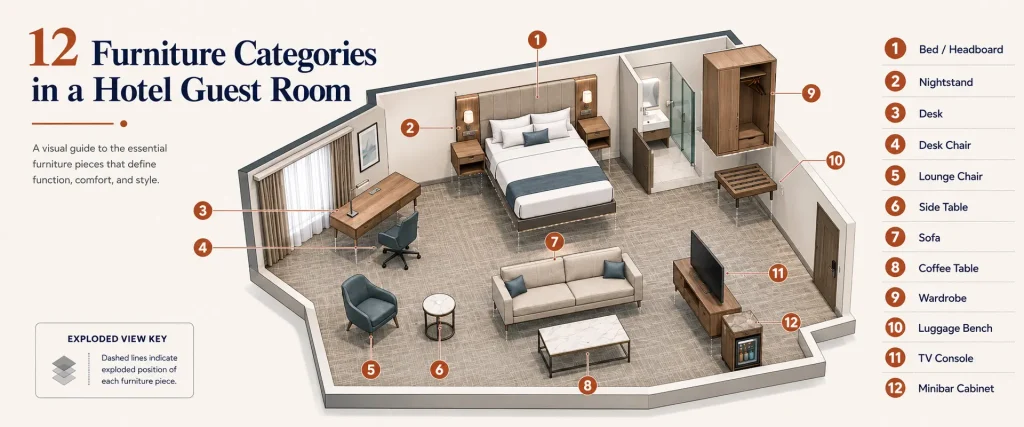
The 12 Furniture Categories in a Hotel Guest Room
Akụkụ ọ bụla arịa ụlọ oriri na ọṅụṅụ ụlọ oriri na ọṅụṅụ falls into one of 12 functional categories. Each category has its own specification logic, durability thresholds, and tier-appropriate standards. This section provides the specification framework for each.
Nkeji 1: akwa na isi oche
The bed is the focal point of every guest room. It is the piece that guests photograph, the piece that dominates online reviews, and the piece that generates the most maintenance requests when it fails. The specification of the bed frame, headboard, and mattress platform determines the room’s perceived quality and its operational longevity.
Bed frame specification standards:
| Akụkụ | Ụkpụrụ azụmahịa | Standardkpụrụ obibi | Ihe Mere O Ji Dị Mkpa |
|---|---|---|---|
| Ihe etiti | Metal platform or solid hardwood with metal-to-metal connections | Particleboard or MDF with cam-lock assembly | Metal bolts survive repeated disassembly/reassembly; cam locks loosen after 10–15 cycles |
| Sistemụ slat | Solid wood slats or metal grid, spaced ≤ 3″ (7.6 cm) | slat na-agbanwe agbanwe ma ọ bụ grid waya | Tight spacing prevents mattress sagging; wide spacing creates pressure points |
| Nkwado etiti | Required for all queen/king beds; 3–5 legs minimum | Often absent in residential beds | Without center support, the frame sags under 500+ lb loads within 2 years |
| Elu site na ala | 6–8″ (15–20 cm) clearance under frame | Ọtụtụ mgbe atụmatụ ịmakụ n'ala | Clearance allows housekeeping vacuum/mop access; floor-hugging designs trap dust and debris |
| Ike ibu | Minimum 500 lb dynamic load rating | 250-300 lb nkịtị | Hotel beds accommodate two adults plus luggage weight; dynamic load accounts for movement |
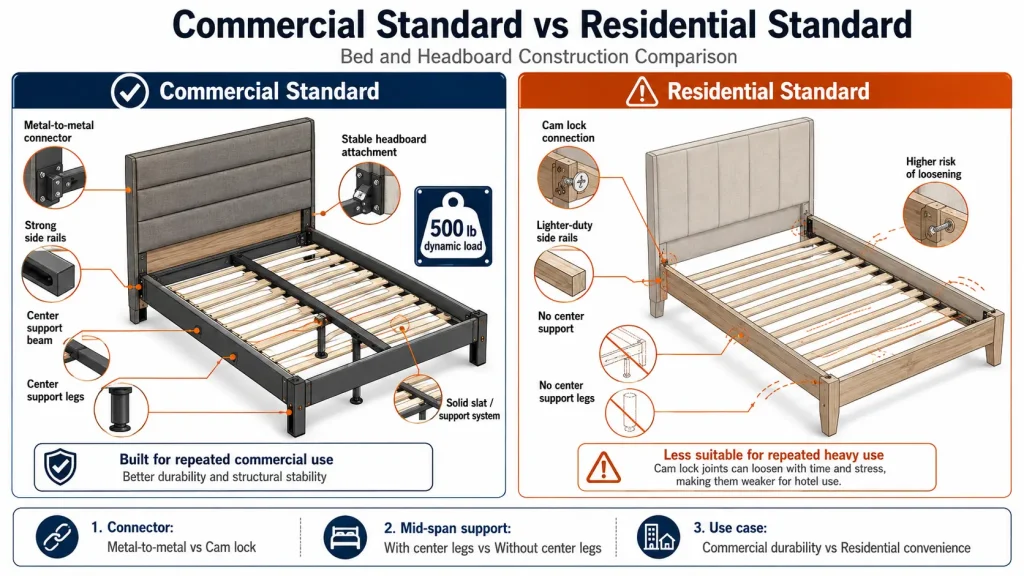
Headboard specification standards:
| Njirimara | Nkọwapụta | Ihe kpatara ya |
|---|---|---|
| Ogologo | 48–60″ (122–152 cm) from floor | Creates visual focal point; proportions correctly with 9–10 ft ceilings |
| Ihe onwunwe | Solid wood, plywood core, or upholstered panel over plywood | Particleboard warps in humid environments |
| Ịkwanye | Wall-mounted with concealed cleat system OR floor-anchored frame | Freestanding headboards shift and mark walls; anchored systems stay put |
| Ihe mkpuchi | Commercial-grade fabric (≥ 30,000 Wyzenbeek) OR vinyl-coated surface | Daily guest contact; must survive head oils, hair products, cleaning agents |
| Profaịlụ Edge | Rounded or eased edges; no sharp corners | Liability and wear; sharp corners chip and present injury risk |
Tier-appropriate headboard specifications:
| Ụlọ oriri na ọṅụṅụ | Ụdị isi oche | Elu Elu | Ihe onwunwe | Ndụ ije ozi a tụrụ anya ya |
|---|---|---|---|---|
| Ọrụ Economy / Limited | Vinyl-wrapped panel or laminate-over-MDF | 48 ″ (122 cm) | Engineered core with commercial finish | 5-7 afọ |
| Select Service / Upper Midscale | Ogwe ejiri akwa akwa | 54 ″ (137 cm) | Plywood core with commercial fabric | 7-10 afọ |
| Ulo elu / Ụzọ ndụ | Upholstered panel with tufting or panel detail | 54–60 ″ (137–152 cm) | Solid wood frame, premium commercial fabric | 10-15 afọ |
| okomoko | Custom-designed panel, integrated lighting | 60 ″ (152 cm)+ | Hardwood frame, bespoke finish, premium textile | 15-25 afọ |
Category 2: Nightstands and Bedside Tables
Nightstands are the second most-touched surface in the guest room after the bed. Guests reach for them in the dark, place phones and chargers on them, and open the drawer multiple times per stay. Nightstands are also the piece most often struck by luggage.
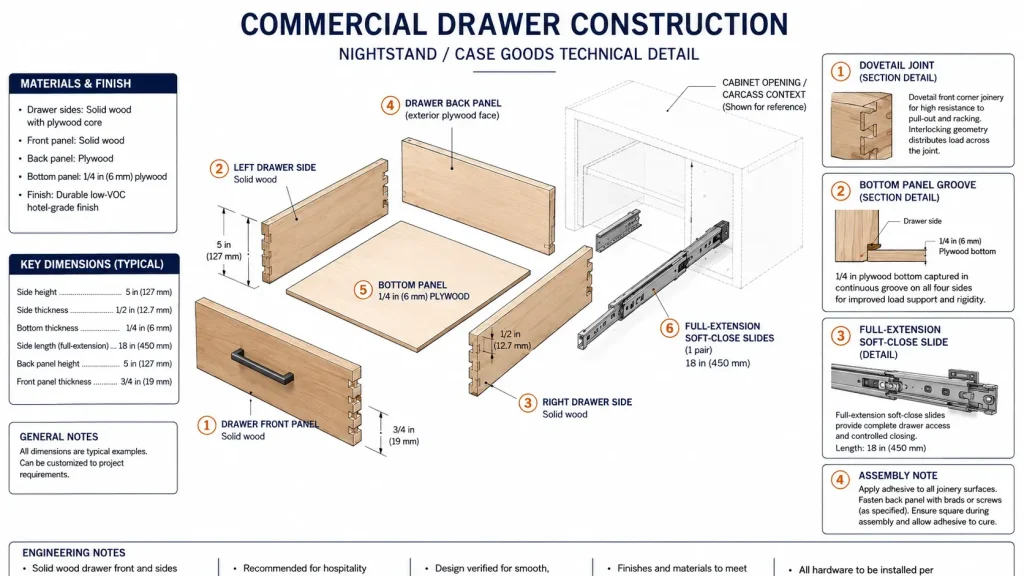
Ụkpụrụ nkọwapụta:
| Njirimara | Ụkpụrụ azụmahịa | Ihe Mere O Ji Dị Mkpa |
|---|---|---|
| Ihe owuwu drawer | Fully enclosed drawer box with 1/4″ plywood bottom and dovetail or French dovetail joints | Open-frame drawers trap debris; thin bottoms fail under daily use |
| Drawer mwụgharị | Full-extension, soft-close, 100 lb rated | Guests pull drawers fully open; partial-extension glides create frustration |
| Ihe dị n'elu | High-pressure laminate (HPL), solid surface, or wood veneer with commercial-grade lacquer | Luggage scuffs, water rings, cleaning agents; standard finishes chip within 2 years |
| Ngwakọta eletrik | Minimum two AC outlets and two USB ports per nightstand | Guest expectation in 2026; outlets integrated into nightstand reduce cord clutter |
| Ogologo | 24–28″ (61–71 cm) from floor; within 2″ of mattress top | Nightstand significantly lower or higher than the mattress is awkward for reaching |
| Mwepu | Minimum 6″ (15 cm) under cabinet for vacuum access | Housekeeping must be able to clean under the nightstand without moving it |
Nhọrọ njikọta ọpụpụ:
| Ụdị njikọta | Uru | Ọdịmma | Kachasị mma maka |
|---|---|---|---|
| Mpempe mpụta nwere n'elu | Ịnweta dị mfe, a na-ahụ anya | A na-ahụ nhịkọ eriri | Economy, họrọ ọrụ |
| Mwepu drawer | Ụdọ ezoro ezo | Moving parts, potential maintenance | Nke dị elu, okomoko |
| Mwepu akụkụ-akụkụ | Easy access, partially concealed | Ọnụọgụ ọpụpụ nwere oke | Ọkwa niile |
| Wireless charging pad built-in | Oge a, enweghị eriri | Requires compatible devices; higher cost | Nke dị elu, okomoko |
Category 3: Desk and Work Surface
The desk is where guests work, eat, sort mail, and place luggage. In most guest rooms, it is the only horizontal work surface larger than the nightstand. The desk specification determines whether the room functions for business travelers or merely contains furniture.
Ụkpụrụ nkọwapụta:
| Njirimara | Ụkpụrụ azụmahịa | Ihe Mere O Ji Dị Mkpa |
|---|---|---|
| Obosara elu | Minimum 36″ (91 cm); 42–48″ (107–122 cm) preferred | Laptop + phone + notepad + beverage; anything smaller is cramped |
| Omimi elu | Minimum 20″ (51 cm); 24″ (61 cm) preferred | Depth allows keyboard at proper distance from screen; shallow desks create neck strain |
| elu elu | 28–30″ (71–76 cm) standard; adjustable height in upscale/luxury | Standard desk height; adjustable height increasingly expected in upscale tier |
| Profaịlụ Edge | Rounded or eased edge; NOT sharp 90° corner | Sharp corners damage luggage and present liability risk |
| Ihe onwunwe | High-pressure laminate (HPL), solid surface, or quartz in luxury | Wood veneer chips under luggage contact; HPL and solid surface resist scuffs |
| Nhazi ụkwụ | Panel leg OR metal leg with floor glides; avoid four individual wood legs | Individual legs obstruct chair movement and are prone to splitting at floor contact |
Njikọ oche oche:
The desk is incomplete without its chair. A desk specified for commercial use paired with a residential-grade chair is a common procurement mistake. The chair specification must match the desk in scale and exceed the desk in durability.
| Njirimara oche | Ụkpụrụ azụmahịa | Standardkpụrụ obibi |
|---|---|---|
| Ogologo oche | Adjustable 16–21″ (41–53 cm) | Edozi ma ọ bụ kpachapụrụ anya |
| Nkwado Lumbar | Required; adjustable preferred | Ọtụtụ mgbe anọghị ya |
| Njupụta oche oche | Ọfụfụ HR kacha nta 2.0 lb/ft³ | 1.2–1.5 lb/ft³ nkịtị |
| Ntọala | 5-star metal base with casters | 4-kpakpando ma ọ bụ plastic base nkịtị |
| Ike ibu | Oke kacha nta 250 lb | 200 lb nkịtị |
| Ihe mkpuchi | Commercial-grade ≥ 30,000 Wyzenbeek | Residential fabric 15,000 Wyzenbeek |
Category 4: Lounge Seating and Accent Chair
Not all guest rooms include lounge seating, but in rooms that do, the accent chair is the piece that signals the room’s design intent. It is the furniture element that elevates a room from “place to sleep” to “place to stay.”
Ụkpụrụ nkọwapụta:
| Njirimara | Ụkpụrụ azụmahịa | Ihe Mere O Ji Dị Mkpa |
|---|---|---|
| Frame | Hardwood with dowel-and-glue or mortise-and-tenon joints | Stapled joints loosen; upholstered frames fail within 3 years in hotel use |
| Ụfụfụ oche | Minimum 2.0 lb/ft³ HR foam with ILD 30–40 | Lower-density foam compresses within 18 months; seat loses comfort and shape |
| Azu ụfụfụ/jupụta | 1.5–2.0 lb/ft³ HR foam OR fiber-wrapped foam core | Loose fill compresses and shifts; foam core maintains shape |
| Ihe mkpuchi | Commercial-grade fabric ≥ 30,000 Wyzenbeek OR Crypton/vinyl | Residential fabric shows wear within 12 months of daily use |
| Nhazi ụkwụ | Tapered wood legs OR metal legs with floor protectors | Thin tapered legs split under repeated scooting; metal legs survive |
| Ike ibu | Oke kacha nta 300 lb | Guests of all sizes; weight capacity ensures frame longevity |
Tier-appropriate lounge seating:
| Ụlọ oriri na ọṅụṅụ | Ụdị oche ezumike | Ihe mkpuchi | Ndụ ije ozi a tụrụ anya ya |
|---|---|---|---|
| Ọrụ Economy / Limited | Ọtụtụ mgbe anọghị ya | N/A | N/A |
| Họrọ Ọrụ | Ọkọlọtọ armchair, osisi osisi | Akwa azụmahịa ma ọ bụ vinyl | 7-10 afọ |
| Ulo elu / Ụzọ ndụ | Designer accent chair, higher back | Premium commercial fabric or leather | 10-15 afọ |
| okomoko | Custom or designer piece, full upholstery | Akwa akwa ma ọ bụ akpụkpọ anụ adịchaghị | 15-20 afọ |
Nkeji 5: Bench ibu
The luggage bench is the piece guests use when they do not want to open the closet, do not want to bend to the floor, and do not want to place their suitcase on the bed. It is a convenience piece that reduces wear on the bed and closet, but only if specified correctly.
Ụkpụrụ nkọwapụta:
| Njirimara | Ụkpụrụ azụmahịa | Ihe Mere O Ji Dị Mkpa |
|---|---|---|
| Obosara | Minimum 36″ (91 cm); 42–48″ (107–122 cm) preferred | Must accommodate standard checked bag (26–30″ / 66–76 cm) with margin |
| Omimi | Opekempe 18 ″ (46 cm) | Must accommodate bag depth plus margin for stability |
| Ogologo | 18–20 ″ (46–51 cm) | Must be lower than bed height; higher bench makes luggage unstable |
| Frame | Osisi siri ike ma ọ bụ etiti ígwè | Particleboard or MDF frames split under luggage weight |
| Ihe mkpuchi | Commercial-grade fabric ≥ 30,000 Wyzenbeek OR vinyl | Luggage contact damages standard fabric; commercial fabric resists abrasion |
| Ike ibu | Ibu static kacha nta 150 lb | Standard checked bag + contents; dynamic loads from placement |
Category 6: Case Goods (Dresser, Media Console, Armoire)
Case goods are the storage furniture in the guest room. In rooms without closets, the armoire or wardrobe is the primary garment storage. In rooms with closets, case goods provide drawer storage for folded items. Both types must survive daily drawer use, housekeeping cleaning, and luggage contact.
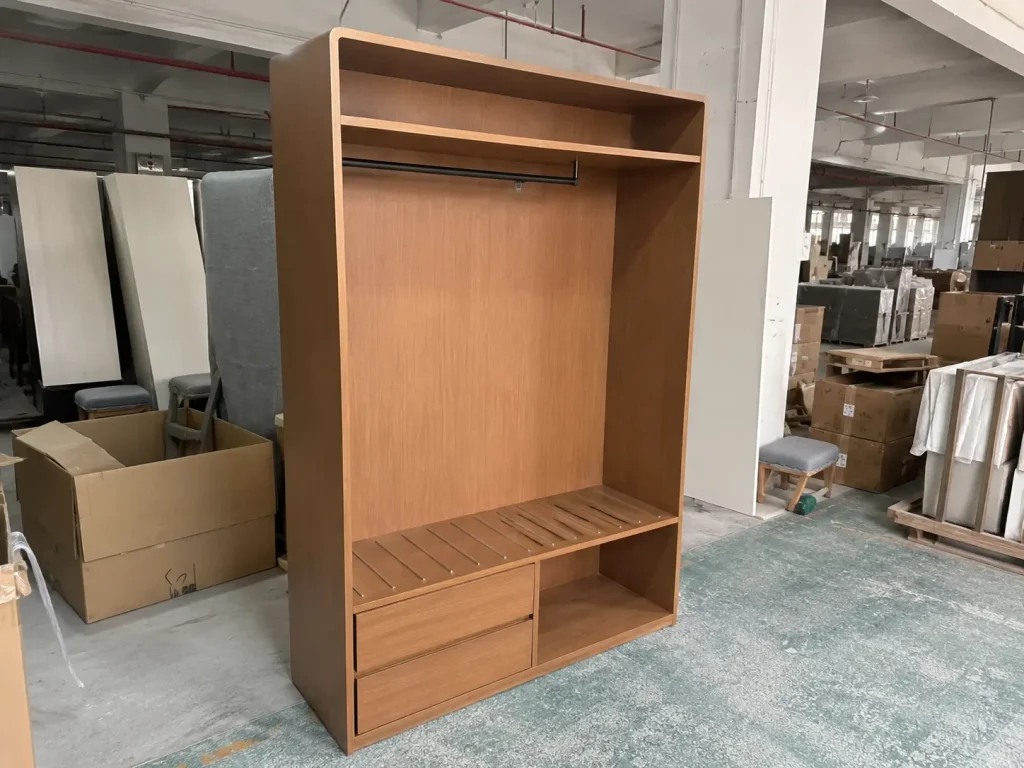
Ụkpụrụ nkọwapụta:
| Njirimara | Ụkpụrụ azụmahịa | Ihe Mere O Ji Dị Mkpa |
|---|---|---|
| Igbe drawer | 1/2″ plywood or solid wood sides, 1/4″ plywood bottom, dovetail joints | MDF or particleboard drawers fail under daily use; thin bottoms sag |
| Drawer mwụgharị | Full-extension, soft-close, 100 lb rated | Guests expect full access; soft-close prevents slamming damage |
| Ikpe kabinet | 3/4″ plywood or MDF core with commercial veneer or laminate | Thinner panels warp; standard veneer chips at edges |
| Akụrụngwa | Metal pulls with commercial finish (brushed nickel, matte black) | Plastic or thin metal pulls break; commercial finishes resist tarnish |
| Elu | High-pressure laminate or commercial-grade veneer with UV-cured lacquer | Standard finishes scratch and fade; commercial surfaces resist daily cleaning |
| Ntinye TV | Cable management, ventilation, and fixed or swivel mount | TV consoles must accommodate standard TV sizes; ventilation prevents overheating |
Nkeji 7: Sistemụ Mkpuchi
The closet system is where guests store hanging garments. In many hotel rooms, the closet is not a separate room but a shallow alcove with a rod and shelf. The specification of the rod, shelf, and organizational elements determines whether the closet functions or merely exists.
Ụkpụrụ nkọwapụta:
| Njirimara | Ụkpụrụ azụmahịa | Ihe Mere O Ji Dị Mkpa |
|---|---|---|
| Ihe mkpanaka | Solid steel or brass, minimum 1″ (2.5 cm) diameter | Chrome-plated or hollow rods bend under weight of multiple garments |
| Nkwado mkpanaka | Center support required for spans ≥ 36″ (91 cm) | Unsupported rods sag under weight; center support prevents failure |
| Ihe nchekwa | 3/4″ plywood or MDF with commercial finish or wire grid | Particleboard shelves sag; wire grid allows visibility |
| Omimi shelf | Minimum 12″ (30 cm) for folded items | Shallower shelves cannot accommodate folded stack |
| Nhazi ọnụ ụzọ | Bi-fold, sliding, or open alcove | Bi-fold and sliding doors save space; open alcove increases perceived room size |
| Ọkụ | Integrated LED rod light or shelf light in upscale/luxury | Dark closets frustrate guests; integrated lighting is expected at upscale tier |
Tier-appropriate closet specifications:
| Ụlọ oriri na ọṅụṅụ | Nhazi | Ụdị mkpanaka | Atụmatụ ndị ọzọ |
|---|---|---|---|
| Akụ na ụba | Mepee alcove, mkpanaka + shelf | Steel rod, wall-mounted at both ends | Ọ dịghị |
| Họrọ Ọrụ | Open alcove or sliding door, rod + shelf + lower shelf | Mkpanaka ígwè nwere nkwado etiti | Lower shelf maka akpụkpọ ụkwụ |
| Ọnụ ọgụgụ dị elu | Enclosed closet with door, rod + shelf + drawer unit | Brass or steel rod, premium finish | Drawer unit, full-length mirror |
| okomoko | Walk-in or deep closet, multiple rods, drawer units | Solid brass rod, custom hardware | Built-in lighting, multiple storage zones, valet rod |
Category 8: HVAC Enclosure and Valance
In rooms where HVAC units are located under the window, the valance or enclosure is the furniture piece that conceals the unit and directs airflow. It is often the most poorly specified piece in the room — treated as a necessary cover rather than an integral furniture element.
Ụkpụrụ nkọwapụta:
| Njirimara | Ụkpụrụ azụmahịa | Ihe Mere O Ji Dị Mkpa |
|---|---|---|
| Ihe onwunwe | 3/4″ plywood or MDF with commercial finish matching case goods | Thinner panels warp under heat and humidity cycling |
| Ogwe nnweta | Removable or hinged panel for filter access and service | Fixed enclosures require full disassembly for HVAC service |
| Nhazi ikuku | Louvered or perforated front panel; minimum 50% open area | Insufficient airflow causes unit to short-cycle, increasing energy cost and wear |
| Ogologo | Minimum 6″ (15 cm) clearance between unit top and window sill | Insufficient clearance restricts airflow and creates maintenance access issues |
| Mechaa | Commercial-grade lacquer or laminate matching case goods | Standard finishes yellow under heat exposure |
Nkeji 9: Ọgwụgwọ mpio
Window treatments are not furniture in the traditional sense, but they are part of the FF&E specification and they affect the furniture layout. Curtain rods, traverse rods, and blackout systems must be specified for durability and function.
Ụkpụrụ nkọwapụta:
| Njirimara | Ụkpụrụ azụmahịa | Ihe Mere O Ji Dị Mkpa |
|---|---|---|
| Ihe mkpanaka | Steel or aluminum traverse rod with commercial hardware | Lightweight residential rods bend under curtain weight; commercial rods are rated for 50+ lb loads |
| Ibu ákwà mgbochi | Minimum 12–16 oz face weight for blackout | Lighter fabrics allow light penetration; heavy fabrics provide true blackout |
| Ụdị isiokwu | Pinch pleat or grommet on commercial-grade heading tape | Tab-top and rod-pocket headings are residential; commercial headings are designed for daily opening/closing |
| Usoro njikwa | Wand control or motorized in upscale/luxury | Cord controls are liability risk; wands and motors are safer and more durable |
| Ogologo | 1/2 ″ (1.3 cm) n'elu ala | Floor-touching curtains trap dust and create housekeeping burden; too-short curtains look inadequate |
Nkeji 10: Igwe
Mirrors are the furniture elements that expand the perceived space of the room and serve functional purposes for grooming. In hotel rooms, mirrors must be specified for safety, durability, and placement.
Ụkpụrụ nkọwapụta:
| Njirimara | Ụkpụrụ azụmahịa | Ihe Mere O Ji Dị Mkpa |
|---|---|---|
| Ụdị iko | Minimum 1/4″ (6 mm) annealed or tempered glass | Thinner glass is prone to breakage; tempered glass is safety-rated |
| Frame | Metal frame, wood frame, or frameless with polished edge | Unframed glass with raw edge is liability risk; frames protect edges |
| Ịkwanye | Wall-mounted with concealed cleat or Z-bar; safety-rated anchors | Surface-mounted mirrors without safety anchors can fall; concealed mounts are cleaner aesthetically |
| Ndokwa | Full-length mirror near closet; vanity mirror above desk or designated vanity area | Guests expect full-length mirror for dressing; vanity mirror for grooming |
| Ọkụ | Integrated LED backlight or flanking sconces in upscale/luxury | Unlit mirrors in dark corners are frustrating; integrated lighting adds function and perceived quality |
Category 11: Artwork and Decorative Accessories
Artwork and decorative accessories are the finishing layer. They are not furniture in the structural sense, but they are part of the FF&E specification and they affect the room’s perceived quality.
Ụkpụrụ nkọwapụta:
| Njirimara | Ụkpụrụ azụmahịa | Ihe Mere O Ji Dị Mkpa |
|---|---|---|
| Ịgbago nka nka | Security hangers or locked mounting systems | Unsecured artwork is stolen or displaced; security mounting prevents loss |
| Ihe etiti | Metal or wood frame with commercial finish | Plastic frames yellow and crack; commercial finishes resist fading |
| Glass | Acrylic or tempered safety glass | Standard glass breaks; safety-rated materials reduce liability |
| Ngwa mgbakwunye | Adhesive or screw-mounted for items > 2 lb | Unsecured accessories become projectiles in seismic events; mounting prevents displacement |
| Ntọala oriọna | Weighted base with non-slip pad | Lightweight lamps tip; weighted bases stay in place |
Category 12: Technology Integration
Modern guest room furniture must integrate technology. Power outlets, USB ports, wireless charging, and cable management are no longer optional — they are expected. Furniture that does not integrate technology creates guest frustration and generates complaints.
Specification standards by furniture piece:
| Iberibe ngwá ụlọ | Minimum Technology Integration | Njikọ elu / okomoko |
|---|---|---|
| Ebe nchekwa abalị | 2 ọdụ ụgbọ mmiri AC + 2 ọdụ ụgbọ mmiri | Wireless charging pad, additional AC outlets, bedside lamp with USB port |
| Oche | 2 AC outlets + 2 USB ports, cable grommet | Integrated power strip with surge protection, cable management trough, adjustable desk outlet |
| Ntọala oriọna | Standard AC nkwụnye | USB port in lamp base, wireless charging surface in lamp base |
| Mgbasa ozi njikwa | Cable gromet, ventilashion | Integrated power strip, cable management, ventilation with filter |
| Ụlọ ezumike oche | Ọ dịghị | USB port in side table, wireless charging surface in armrest (premium) |
Tier-Appropriate Specification Framework
The specification standards above are commercial minimums. Hotels at different tiers apply these standards differently — emphasizing certain categories, upgrading materials, or adding features based on guest expectations and competitive positioning.
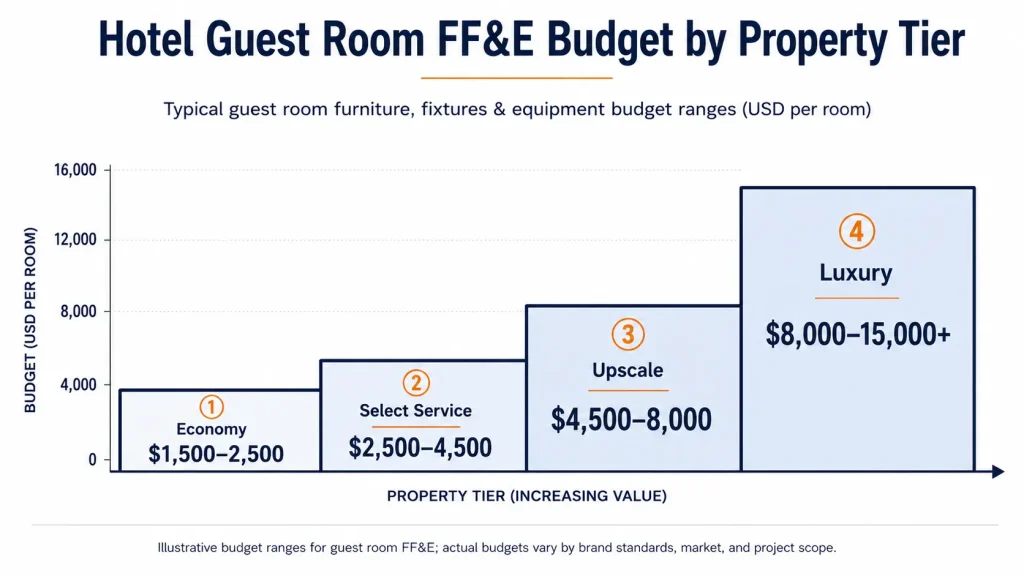
Ọrụ Economy / Limited
Nkwado arịa ụlọ ndị ọbịa: Durability and ADA compliance. Case goods in laminate finishes. Minimal technology integration (standard outlets). Lounge seating often absent.
Ụdị mmefu ego FF&E a na-ahụkarị: $1,500–$2,500 per room (furniture only)
| Otu | Ọkwa nkọwapụta | Ebumnuche Ndụ Ọrụ |
|---|---|---|
| Akwa na headboard | Vinyl-wrapped or laminate headboard, metal platform bed | 5-7 afọ |
| Ụlọ oriri na ọṅụṅụ (2) | Laminate case goods, standard drawer, basic outlet | 5-7 afọ |
| Desktọpụ na oche | Laminate desk, basic task chair | 5-7 afọ |
| Ebe ezumike | Ọtụtụ mgbe anọghị ya | N/A |
| Oche akpa | Often absent or basic wood bench | 5-7 afọ |
| Sistemu ime ụlọ | Open alcove, steel rod, wire shelf | 7-10 afọ |
Select Service / Upper Midscale
Nkwado arịa ụlọ ndị ọbịa: Brand consistency, perceived quality, functional technology integration. Fabric-upholstered headboards, integrated outlets, lounge seating in suites.
Ụdị mmefu ego FF&E a na-ahụkarị: $2,500–$4,500 per room (furniture only)
| Otu | Ọkwa nkọwapụta | Ebumnuche Ndụ Ọrụ |
|---|---|---|
| Akwa na headboard | Fabric-upholstered headboard, metal or hardwood platform bed | 7-10 afọ |
| Ụlọ oriri na ọṅụṅụ (2) | Wood veneer or laminate case goods, full-extension drawer, integrated AC/USB | 7-10 afọ |
| Desktọpụ na oche | Wood veneer desk, commercial task chair with lumbar support | 7-10 afọ |
| Ebe ezumike | Oche mkpuchi isi na suites | 7-10 afọ |
| Oche akpa | Upholstered bench, commercial fabric | 7-10 afọ |
| Sistemu ime ụlọ | Open alcove or sliding door, steel rod with center support, shelf + shoe shelf | 7-10 afọ |
Ulo elu / Ụzọ ndụ
Nkwado arịa ụlọ ndị ọbịa: Design intent, material quality, technology convenience. Designer accent chairs, integrated charging, custom headboard designs.
Ụdị mmefu ego FF&E a na-ahụkarị: $4,500–$8,000 per room (furniture only)
| Otu | Ọkwa nkọwapụta | Ebumnuche Ndụ Ọrụ |
|---|---|---|
| Akwa na headboard | Custom or designer headboard, upholstered panel with tufting or detail, hardwood platform bed | 10-15 afọ |
| Ụlọ oriri na ọṅụṅụ (2) | Premium case goods, full-extension soft-close drawer, wireless charging, integrated lighting | 10-15 afọ |
| Desktọpụ na oche | Premium desk, designer task chair, adjustable height option | 10-15 afọ |
| Ebe ezumike | Designer accent chair, premium commercial fabric or leather | 10-15 afọ |
| Oche akpa | Premium upholstered bench, designer fabric | 10-15 afọ |
| Sistemu ime ụlọ | Enclosed closet, premium rod and hardware, drawer unit, integrated lighting | 10-15 afọ |
okomoko
Nkwado arịa ụlọ ndị ọbịa: Bespoke design, premium materials, longevity. Custom-designed furniture, integrated technology throughout, material specifications for decades of service.
Ụdị mmefu ego FF&E a na-ahụkarị: $8,000–$15,000+ per room (furniture only)
| Otu | Ọkwa nkọwapụta | Ebumnuche Ndụ Ọrụ |
|---|---|---|
| Akwa na headboard | Custom-designed headboard, integrated lighting, premium upholstery, hardwood frame | 15-25 afọ |
| Ụlọ oriri na ọṅụṅụ (2) | Bespoke case goods, full-extension soft-close drawer, wireless charging, integrated lighting, premium hardware | 15-25 afọ |
| Desktọpụ na oche | Custom desk, designer chair with adjustable height, premium leather upholstery | 15-25 afọ |
| Ebe ezumike | Designer or custom accent chair, premium leather or textile, premium frame construction | 15-20 afọ |
| Oche akpa | Custom upholstered bench, premium leather or textile | 15-20 afọ |
| Sistemu ime ụlọ | Walk-in or deep closet, multiple rods, drawer units, built-in lighting, valet rod, full-length mirror | 20-25 afọ |
Compliance and Testing Requirements
Ha niile arịa ụlọ oriri na ọṅụṅụ ụlọ oriri na ọṅụṅụ must meet fire, safety, and accessibility requirements. These are non-negotiable. The specific requirements vary by jurisdiction, but the following standards apply to most North American, European, and Asian hotel markets.
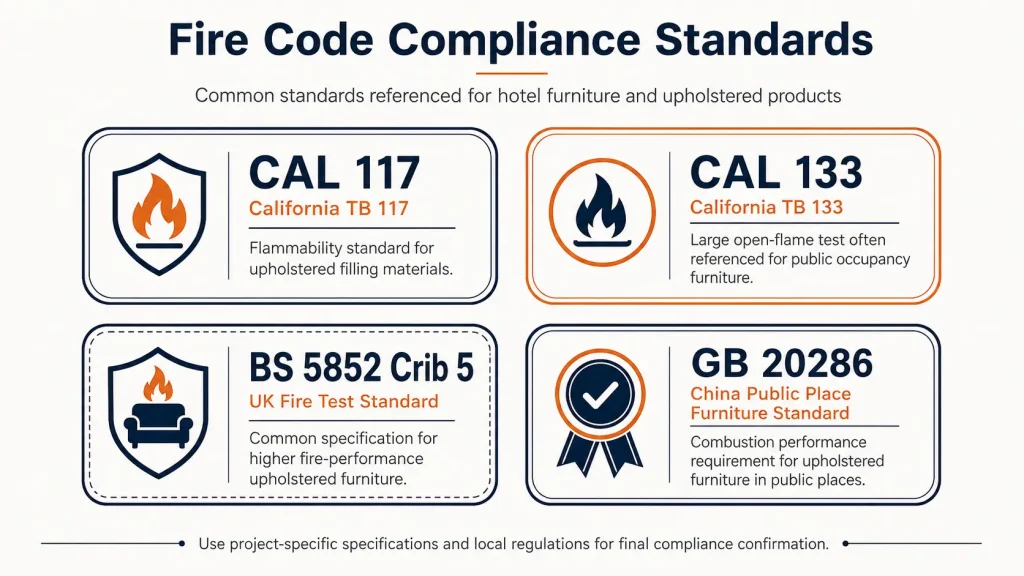
Nrube isi koodu ọkụ
| Ọkọlọtọ | Ngwa | Ihe achọrọ |
|---|---|---|
| CAL 117 (California Bulletin 117) | All upholstered furniture sold in the United States | Smolder resistance test for upholstery materials |
| CAL 133 (California Bulletin 133) | Public areas of hotels in California; increasingly adopted by other jurisdictions | Full-scale furniture fire test |
| BS 5852 (Crib 5) | United Kingdom, Europe, and many international markets | Source ignition test; Crib 5 is the commercial hospitality standard |
| GB 20286-2006 | China | Flammability of commercial furniture |
Nyocha: Request third-party test certificates from the furniture supplier. Do not accept supplier self-certification.
Accessibility (ADA) Requirements
| Ihe achọrọ | Ọkọlọtọ | Ngwá ụlọ emetụtara |
|---|---|---|
| Mkpuchi ikpere | 27″ (69 cm) minimum under desks, tables, lavatories | Desktọpụ, tebụl, njikwa mgbasa ozi |
| Mwepu mkpịsị ụkwụ | 9″ (23 cm) minimum under desks, tables | Tebụl, tebụl |
| Ogologo okpokoro | 28–34 ″ (71–86 cm) | Tebụl, tebụl |
| Kpochapụ oghere ala | 30″ × 48″ (76 × 122 cm) per seating position | Ebe niile |
| mkpanaka kaboodu nwere ike ịnweta | 48 ″ (122 cm) kacha elu | Sistemu ime ụlọ |
| Akụrụngwa | Enwere ike iji aka mechiri emechi rụọ ọrụ | Drawer pulls, cabinet hardware |
Nnwale ibu na ibu
| Nwalee | Ụkpụrụ azụmahịa | Usoro ule |
|---|---|---|
| Nnwale ibu ihe ndina | Ibu ike kacha nta 500 lb | ASTM F1858 |
| Oche static ibu ule | Ibu static kacha nta 300 lb | BIFMA X5.1 |
| Nnwale okirikiri drawer | 25,000 mepere/emechi okirikiri | BIFMA X5.6 |
| Nnwale ibu shelf | 50 lb kwa square ụkwụ | ANSI/BIFMA X5.9 |
Summary: The Guest Room Furniture Specification Checklist
Use this checklist to verify that every piece of guest room furniture meets commercial standards before procurement.
Akwa na isi oche:
- [ ] Metal-to-metal connections on frame; no cam locks
- [ ] Center support for queen/king beds
- [ ] Headboard height 48–60″ (122–152 cm) from floor
- [ ] Upholstery ≥ 30,000 Wyzenbeek if upholstered
Ebe nchekwa abalị:
- [ ] Fully enclosed drawer box with plywood bottom
- [ ] Full-extension, soft-close drawer glides
- [ ] Minimum 2 AC outlets + 2 USB ports per nightstand
- [ ] Height within 2″ of mattress top
Desktọpụ na oche:
- [ ] Surface minimum 36″ (91 cm) wide × 20″ (51 cm) deep
- [ ] High-pressure laminate or solid surface top
- [ ] Chair with adjustable height, lumbar support, 5-star base
- [ ] Chair foam ≥ 2.0 lb/ft³ HR foam
Ebe ezumike (ọ bụrụ na ọ dị):
- [ ] Hardwood frame with dowel-and-glue or mortise-and-tenon joints
- [ ] Seat foam ≥ 2.0 lb/ft³ HR foam
- [ ] Upholstery ≥ 30,000 Wyzenbeek or Crypton
- [ ] Weight capacity ≥ 300 lb
Bench akpa (ọ bụrụ na ọ dị):
- [ ] Width minimum 36″ (91 cm)
- [ ] Solid wood or metal frame
- [ ] Commercial-grade upholstery or vinyl
- [ ] Weight capacity ≥ 150 lb
Ngwaahịa:
- [ ] 1/2″ plywood or solid wood drawer box with dovetail joints
- [ ] Full-extension, soft-close drawer glides, 100 lb rated
- [ ] High-pressure laminate or commercial veneer surface
- [ ] Metal hardware with commercial finish
Sistemu mkpọchi:
- [ ] Solid steel or brass rod, minimum 1″ (2.5 cm) diameter
- [ ] Center support for spans ≥ 36″ (91 cm)
- [ ] 3/4″ plywood or MDF shelf
- [ ] Enclosed closet in upscale/luxury
Njikọ teknụzụ:
- [ ] Minimum 2 AC + 2 USB per nightstand
- [ ] Minimum 2 AC + 2 USB per desk
- [ ] Cable grommet on desk and media console
- [ ] Wireless charging in upscale/luxury nightstands
Nkwenye:
- [ ] CAL 117 certificate for all upholstered furniture
- [ ] CAL 133 certificate for public area furniture (if required by jurisdiction)
- [ ] BS 5852 Crib 5 certificate for international projects
- [ ] ADA compliance verified for accessible room furniture
The furniture in a hotel guest room is not decoration. It is infrastructure. Every piece is a 10–15 year decision that compounds into either operational efficiency and guest loyalty, or maintenance costs and negative reviews. The specifications in this guide are your reference framework. Use them before signing any FF&E purchase order.
Nzọụkwụ ọzọ: For project-specific specification support, download the Guest Room FF&E Specification Template from MingMeng Hospitality or request a procurement consultation with our commercial furniture specialists to review your furniture schedule against commercial standards.


