

 English
 中文
 日本語
 한국어
 العربية
 Русский
 Português
 Türkçe
 हिन्दी
 Tiếng Việt
 ไทย
 Indonesia
 Melayu
 ខ្មែរ
 ລາວ
 မြန်မာ
 Afrikaans
 Hausa
 Igbo
 Sesotho
 isiXhosa
 Yorùbá
 isiZulu
Send a restaurant furniture RFQ with one photo and one quantity, and you will get a price back. You just will not get a price you can compare. Most buyers assume the job is to describe the furniture as completely as possible. The harder part is describing what has not been decided yet — because a factory that cannot see an open decision will quietly close it for you.
This checklist is the pack to send before that happens: a field-by-field quote request checklist for restaurant furniture, one numbering system that ties the plan to the quantities and the images, an open-item register, and a copy-and-paste template you can send to several suppliers unchanged. It also sets out what to ask each supplier to write back, so the replies arrive in the same shape and can be placed side by side.
Ntugharị igodo
An RFQ is not a request for a number. It is a request for a number with its assumptions attached. Ask for both in the same document, on the first pass.
RFQ guides often cover a broad procurement process. A general restaurant furniture procurement checklist tends to run from the first sketch all the way to receiving and sign-off — useful, but spread across months of work. This one stops at a single moment: the minute before you press send. It is a preparation guide, not a buying guide.
That also fixes its place among the other pages on this site. A dimensions guide settles what size to buy. A layout guide settles how the room is arranged. A booth guide settles how to choose fixed seating. This page is the last step in that sequence: turning those decisions into one document a supplier can price without guessing. It does not re-argue any of them.
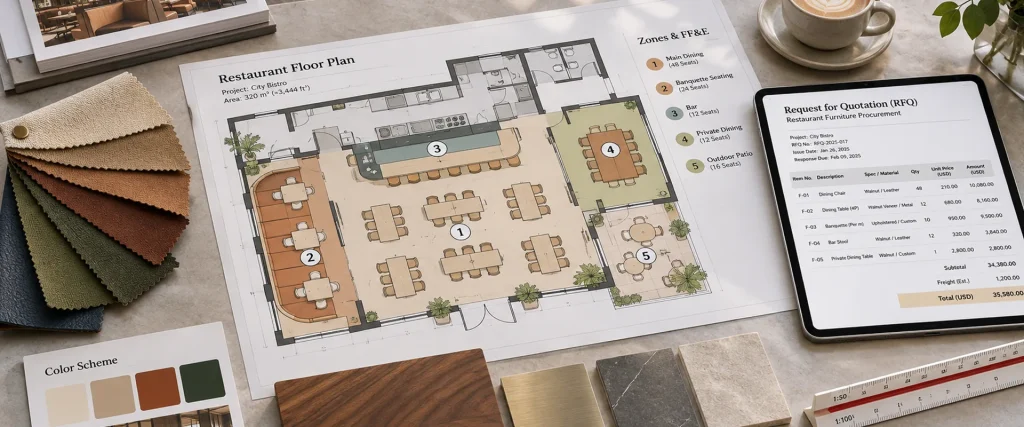
1. What a Factory Actually Prices From
Put yourself on the other side of the desk for a moment. A request arrives: “chairs, tables and booth seating for a new restaurant, please quote.” Before a costing sheet can be opened, somebody has to decide what the chair is made of, whether the seat is upholstered and in which grade, whether the frame is welded or knock-down, and whether the quoted figure stops at the factory gate or continues to a named address. None of that was in the email. All of it will be in the price.
Export packing and container loading should be addressed separately in the RFQ. The supplier should propose suitable carton dimensions, protective materials, package markings and a loading plan based on the furniture design. However, responsibilities for packing, physical loading, transport costs and risk depend on the agreed delivery terms and sales contract. Ask the supplier which services are included, who performs loading, and where delivery and risk transfer occur. Do not assume the factory is responsible for every loss or damage during international transit.
A vague request may yield a quick price, but that price is difficult to verify against another quote. A supplier working from thin information has two rational options: price a safe, over-specified interpretation and look expensive, or price a lean interpretation and look competitive. Neither is wrong, and neither is comparable with a competitor who guessed differently.
The practical consequence is that detail is not the goal. Explicit uncertainty is. Telling a supplier “the finish is not chosen yet — please quote your standard option and list two alternates” produces a more useful number than inventing a finish code you will change next month. A restaurant furniture RFQ that separates settled facts from open decisions lets the factory price what it knows and flag what it does not.

Common Mistake
Sending a “final” specification that is actually a wish list. When a buyer marks an undecided item as confirmed, the supplier stops asking — and the first conversation about that item happens after production has started.
There is also a commercial reason to be careful here. Every assumption the supplier writes down becomes a line in the eventual order confirmation. If you did not see it at quote stage, you will meet it later as a change order, a revised price, or a finish that is not the one you pictured. The cheapest place to fix an assumption is the first email.
2. Three Documents, One Numbering System
For a multi-zone fit-out, a practical RFQ package is usually three coordinated documents. A straight replacement order against fixed item codes may need only the second; a complex custom project may add elevations, technical drawings and a finish schedule. What matters is not the count but that every attached document points at the same item codes and the same revision state.
- A marked floor plan — zones, boundaries and access routes drawn on it.
- A quantity schedule — one row per item or assembly.
- A reference image set — photos, catalogue pages or sketches, one file per item code.
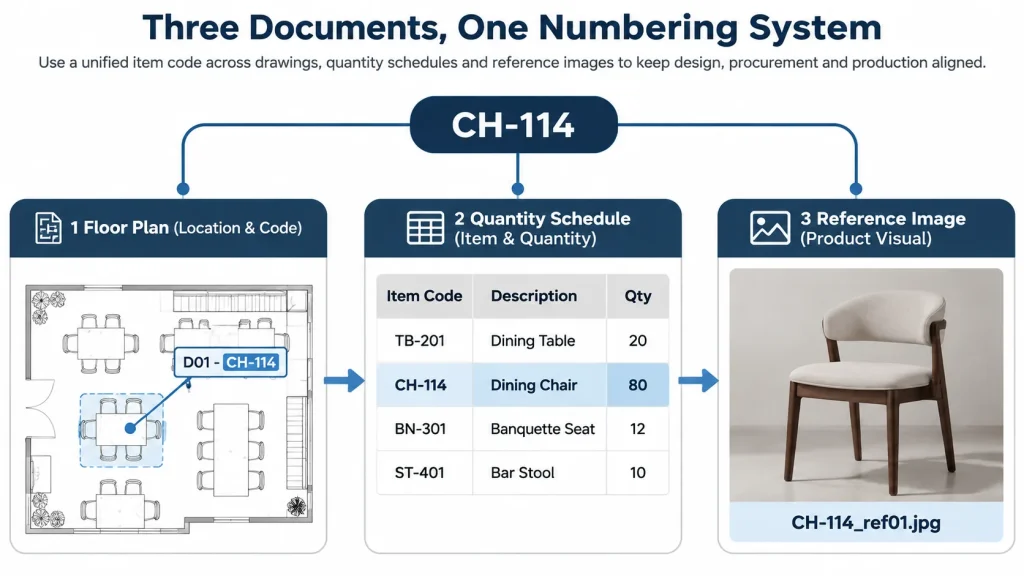
What holds them together is a numbering system. Give every zone a code (D01 main dining, B01 bar, T01 terrace, P01 private dining), every product or finish combination an item code (CH-114, TB-220, BN-402), and name every reference file after the code it belongs to. Then use those same codes in the plan, the schedule, the image filenames and the quotation request.
The codes and quantities below are illustrative: one fictional fit-out, used consistently throughout this page so the method can be shown rather than described. They are not a MingMeng project record and not a numbering scheme to adopt — replace them with your own before sending.
| Mpaghara | Item code | Reference file | What the code connects |
|---|---|---|---|
D01 Main dining | CH-114 | CH-114_ref01.jpg | Chair on the plan → image → quote line |
D01 Main dining | TB-220 | TB-220_top.pdf | Table top + base decision → quote line |
B01 Bar | BS-307 | BS-307_ref01.jpg | Counter-height stool → seat-height note |
P01 Private dining | BN-402 | BN-402_elevation.pdf | Fixed banquette → site-measured length |
This looks like administration. It is not. The same code travels from your drawing to the factory’s shop drawing, to the sample label, to the carton marking, to the receiving checklist. Break the chain once — say, three chair rows in the schedule but only one photo, with no indication which row it belongs to — and the sample, the production run and the delivered goods can each be correct on their own while disagreeing with each other.
For early pricing, a factory may be able to work from a clear dimensioned sketch. What makes the pack unreliable is when its documents do not point at one another. If you send nothing else consistently, send the codes consistently.
Ndụmọdụ Pro
Put the item code in the filename, not only in the email body. Attachments get forwarded, saved into shared drives and separated from their context; a self-identifying file survives that journey.
3. Copy-and-Paste RFQ Information Checklist
Here is the full field map. The Status column indicates whether a field belongs in the requested RFQ, while Confirmed / Direction / Open describes whether its value is settled. Achọrọ means the information is needed for the quotation stage; if a value is unknown during an early budgetary inquiry, keep the field visible and mark its value Open. If applicable means include the field when the project scope requires it. Confirmed is fixed, Direction is a preference, and Open is undecided but declared, with an owner and a request for the supplier’s pricing assumptions, exclusions and proposed deviations. These are separate controls, not interchangeable labels.
An Open value is legitimate for an early or budgetary RFQ if the supplier identifies the basis it priced. Before accepting a firm final quotation, resolve any item that materially changes the specification, quantity, delivery scope or cost. If no decisions remain open, write No Open Items in the register; do not invent questions just to populate the form.
| # | Field | Status | What to send | Usual omission |
|---|---|---|---|---|
| 1 | Project identity | Achọrọ | Project name, city and country, venue type, new build or refresh | Whether it is a new fit-out or a replacement order |
| 2 | Marked floor plan | Required for new fit-outs or multi-zone projects | Zones, boundaries, doors, columns, counters, access route, drawing status | The drawing’s revision state (concept / coordinated / final) |
| 3 | Quantity schedule | Achọrọ | One row per item, quantity, unit (pieces or assemblies), zone code | Whether a table line includes its base |
| 4 | Use conditions | Achọrọ | Indoor, covered terrace or exposed outdoor; cleaning routine; daily service intensity | Cleaning chemicals and whether chairs must stack |
| 5 | Materials and finish direction | If known | Material families, colour direction, sheen, any sample or finish code | Which details are fixed and which are only a look |
| 6 | Customisation scope | Required if customisation is requested | Which attributes may change; which require a sample first | Who approves a substitution |
| 7 | Delivery destination | Achọrọ | City, country, postcode, destination port if known, site access notes | Whether freight and local delivery should be quoted |
| 8 | Dates | Achọrọ | Target opening date na desired on-site date, kept separate | Which of the two is the hard constraint |
| 9 | Open-item register | Required; state No Open Items if applicable | Undecided fields, decision owner, what the supplier must write back | Any request for assumptions and exclusions |
| 10 | Quotation format and return date | Achọrọ | Currency, unit price per item code, line totals, quotation validity, Incoterm with its edition and named place, inclusions and exclusions, warranty, sample and tooling charges, reply deadline | Asking only for a total, with no breakdown or common return date |
Three notes on using the table. First, it is deliberately a pre-quote list: restaurant furniture specifications for suppliers belong here as directions and references, not as a fully engineered specification pack. Second, row 10 is different in kind — it is a format you require from the supplier’s reply, not a buyer input to fill in. Third, an unsettled value is not a reason to delay a budgetary RFQ. Send what you have, mark the rest Open, and ask for written assumptions; resolve the price-affecting ones before requesting a final comparable quotation.
The one thing not to do is pad the pack to look thorough. A large collection of mood images without a quantity schedule can generate a less useful reply than a concise, coded list with a marked plan and clearly identified open decisions.
4. Floor Plan and Zones: What to Mark
You do not need a CAD file. A dimensioned sketch that shows the truth of the room is more useful than a beautiful rendering that hides the columns. Mark zone boundaries and give each zone the code from §2. Then mark the physical constraints that decide what can be built and delivered: door openings, columns, the bar counter and service stations, aisle widths, floor level changes, power outlets that affect fixed seating, and the route from the street to the room.
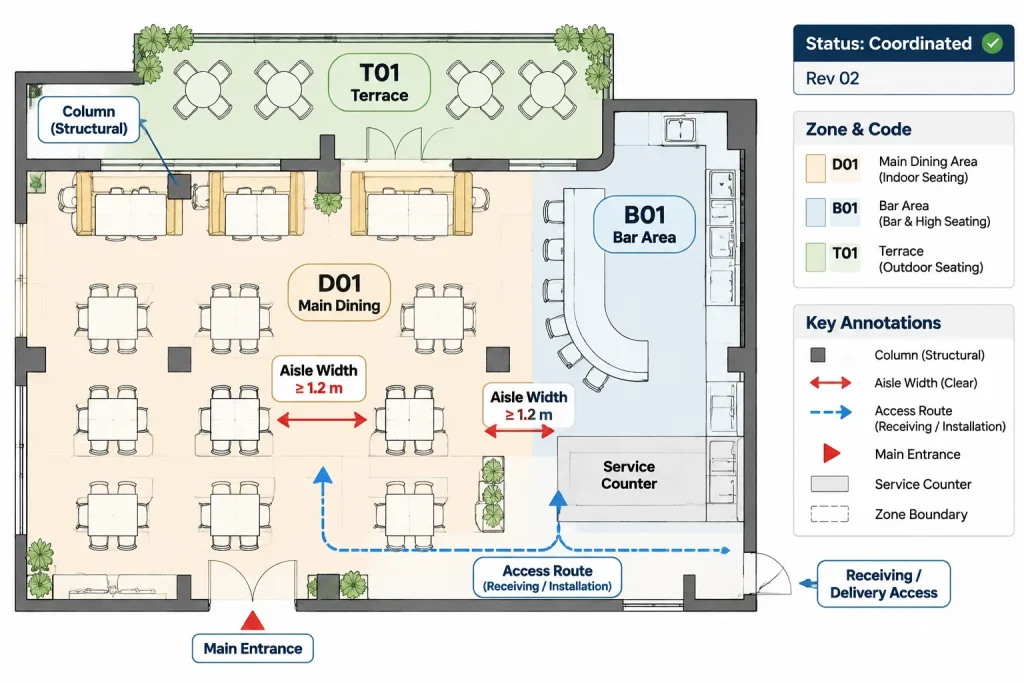
Access deserves its own line. Note the delivery entrance width, whether there is a loading dock or only a curb, lift dimensions if there is one, the floor the goods land on, and any restricted delivery hours. These are not logistics trivia — they decide whether a banquette arrives as one assembled section or as components to be joined on site, and therefore what the factory quotes. Our Ntuziaka nhazi oche oche ụlọ oriri na ọṅụṅụ covers how zone mix and spacing drive cover capacity; the RFQ only needs the resulting zone map.
Always state the drawing’s status. Label it concept, coordinated ma ọ bụ final. A concept plan invites the supplier to propose alternatives; a final plan gives the current reference for pricing. However, a final floor plan does not automatically authorize manufacturing. Production should follow the agreed specifications, approved shop drawings, any required sample approvals and a written production release. Without a stated revision and status, the factory must guess how literally to interpret the drawing.
Ntugharị igodo
A drawing status and revision tell the supplier which dimensions are current and which remain under review. Neither should be mistaken for written production approval.
If your layout is still moving, say which zones are stable and which are not. Pricing a fixed bar counter and an unsettled terrace in the same undifferentiated list is how a single late layout change ends up repricing the entire order.
5. Quantity Schedule: Count Pieces, Not Seats
The most common counting error is mixing seats with pieces. A four-seat table group is one table and four chairs — three lines if the top and base are quoted separately — not “four settings”. Write one row per item or assembly, and state the unit in the row: pieces, sets, linear metres, or sections.
| Item code | Ihe | Qty | Unit | Mpaghara | Status |
|---|---|---|---|---|---|
CH-114 | Dining chair, upholstered seat | 48 | pcs | D01 | Confirmed qty; model open |
TB-220 | Table top, square, size to confirm | 12 | pcs | D01 | Size open |
TB-220-B | Table base, dining height | 12 | pcs | D01 | Confirm compatible |
BN-402 | Banquette, site-measured length | 3 | sections | P01 | Length to be surveyed |
CH-114-S | Spare chair | 4 | pcs | D01 | Optional — price separately |
Notice the last two rows. Optional and spare quantities belong on separate lines, never folded into the base count, because they change the total without changing the unit price. Fixed seating is its own case: banquettes and Ụlọ oriri na ọṅụṅụ are usually priced by section or by measured run, with an access condition attached, so record the survey status rather than a guessed dimension. Our Commercial Restaurant Table Dimensions guide settles which sizes are standard; the RFQ only needs the size you chose, or an Open row if it is not chosen yet.
Keep product families grouped so the supplier can price each one on its own terms — chairs, booths, Restaurant Furniture table groups, oche oche mmanya and outdoor items. A single “dining set × 20” line hides the fact that the chairs and the tables may have different materials, different approval routes and different replacement needs.
Common Mistake
Reusing one item code for two variants. IfCH-114appears in both a wood and an upholstered version, the quote, the sample label and the carton will all be ambiguous. Give each finish or construction variant its own code.
Different furniture categories call for different questions even within the same restaurant. Use this short cross-check before sending the quantity schedule:
| Restaurant zone | Furniture category | RFQ question that affects the quote |
|---|---|---|
| Isi nri | oche iri nri akwadoro | Which frame construction, upholstery reference and finish are required? |
| Isi nri | Table tops and bases | Are top and base priced separately, and has mounting compatibility been confirmed? |
| Ogwe | Counter-height bar stools | What seat height, footrest design and floor-contact details are required? |
| Private dining | Fixed banquettes | Is the measured run confirmed, and can each section pass the delivery route? |
This is an illustrative category check, not an approved specification or a substitute for measured drawings.
Finally, write the status beside each row. A quantity can be confirmed while the model is still open; that distinction is exactly what the open-item register in §9 is for.
6. Materials, Finishes and Use Conditions
At this stage you are giving a direction, not issuing a specification. Name the material family (solid wood, veneer, metal frame, moulded plywood, upholstered), the colour direction, the sheen, and any finish or fabric code you already hold. If you have a physical sample, give it a reference number and say which items it governs. If you do not, say so.
Use conditions change the answer more than aesthetics do. State whether each zone is indoor, covered terrace or fully exposed; mention coastal exposure, underfloor heating, or a wash-down cleaning routine where relevant; say whether chairs need to stack or be moved daily. These notes decide frame construction, adhesives, glides and top surfaces. A chair that survives a dining room will not necessarily survive a terrace with the same finish.
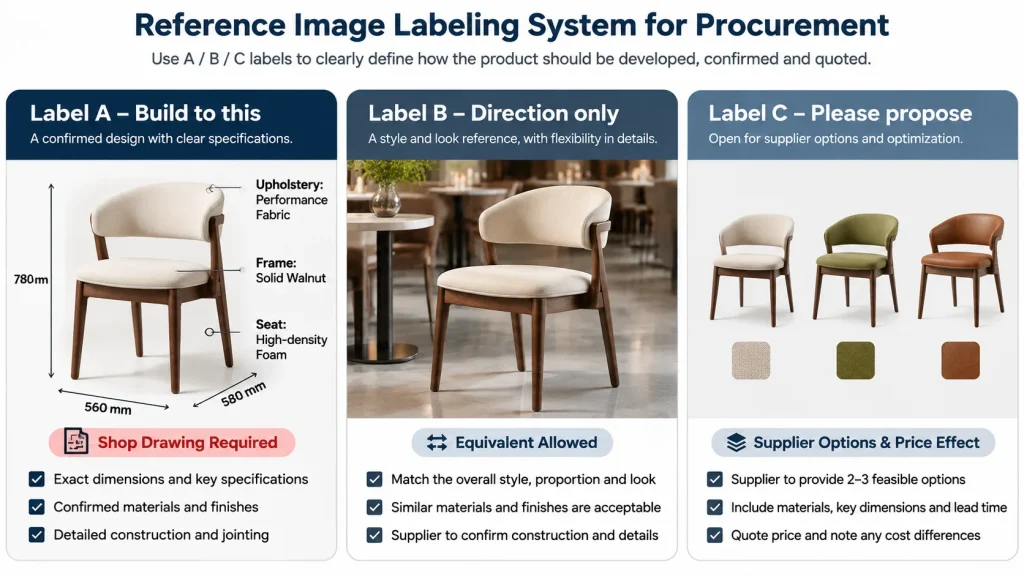
Reference images need the same discipline as the numbering system. One photo can tell a factory what a silhouette looks like. It cannot tell it the frame material, the foam density, the joinery or the exact dimensions. Sort every reference into one of three labels:
| Label | What it means | What the supplier should return |
|---|---|---|
| A — Build to this | Shape, proportions and visible details are required | Confirm feasibility, then a shop drawing for approval |
| B — Direction only | The look matters; construction is flexible | Propose an equivalent and list what differs |
| C — Please propose | No fixed preference | Recommend options with the price effect of each |
Label B is where most disputes begin. A buyer sends an image as inspiration, the factory treats it as a target to match at the lowest cost, and the difference only becomes visible when the sample arrives. Writing the label into the schedule removes the ambiguity for both sides.
Where fire, egress or accessibility requirements apply to your venue, say which jurisdiction the project sits in and ask what documentation the supplier can provide for that location. Do not assume a certificate mentioned in a catalogue covers your use. Requirements vary by locality and are confirmed by your local code official, not by a price list.
7. Define the Customisation Boundary
“Custom” is not one decision. It is at least five, and they carry very different consequences for tooling, samples and approval. Declare each one as fixed, adjustable, ma ọ bụ supplier to propose:
- Akụkụ — overall width, depth, height, seat height, tabletop height, banquette run.
- Nhazi — frame material, joinery, reinforcement, knock-down versus welded.
- Ihe mkpuchi — fabric or leather family, grade, foam, stitching, removable covers.
- Mechaa — wood species or veneer, stain, lacquer sheen, metal colour, edge profile.
- Identity and hardware — logo application, glides, fixings, connectors, labels.
The boundary matters because only some changes can be approved from drawings alone. A colour change may be reviewed using a finish sample. Changes affecting seat height, frame construction, comfort or frequently handled surfaces may require a physical sample, prototype or additional technical review, depending on complexity and risk. Identify which items need physical approval, which can be reviewed through drawings or material samples, and who signs off. Our Omenala oru ngo page shows the range of project-based work; the RFQ needs to establish where the freedom to change the design stops.
From the factory’s side, the risk is not that a buyer wants changes. It is that a change arrives without a record. A revision number, a date and a named approver cost almost nothing at quote stage and prevent a chat message from quietly replacing an approved drawing three weeks later. Build that habit into the schedule now: one column for status, one for revision.
Brand POV
We would rather receive an RFQ with twelve open items clearly labelled than a “complete” specification with three hidden assumptions. The first can be priced. The second will be re-priced.
8. Delivery Address, Opening Date and Site Access
Give the city, country and postcode, and the destination port or airport if you already know it. State explicitly whether you want the supplier to quote freight and local delivery, or only the goods — the two answers are not comparable figures. Add the receiving conditions from §4: dock or curb, lift, floor, delivery window, and whether there is storage on site before installation.
Then write two dates, not one:
- Target opening date — the day the venue serves its first guest.
- Desired on-site date — the day the furniture needs to be in the building.
They are different constraints, and collapsing them into one line is how a quotation gets built around the wrong deadline. Say which is fixed and which has flexibility. If the opening date is a lease commitment and the on-site date is a preference, write that. If a contractor’s handover sets the on-site date, name the dependency.
What you should not do is fill in the transit time yourself. How many days a shipment takes depends on the port pair, the service, transshipment and the vessel schedule, and it belongs in the supplier’s and forwarder’s written reply — not in a buyer’s guess. The same applies to how long production will take: ask which document and which approval start the clock, and which stages the quoted period covers. Those are questions for the RFQ, not numbers for it.
Ndụmọdụ Pro
Ask the supplier to restate both dates in its quotation. If its reply mentions only the opening date, the schedule has not actually been accepted — it has just been acknowledged.
Site access also belongs in the quote, not in a later email. Inside delivery, stair carry, assembly and removal of packing are separate services, and a figure that omits them is not a cheaper figure.
9. The Open-Item Register
This is the part most RFQs skip, and the part that determines whether the answers are worth comparing. An open-item register is a short table of everything you have not decided, with a status and an owner, plus a standing instruction: for each open row, the supplier must write back what it assumed, what it excluded, and what it would propose instead.
| Open item | Level | Owner | Supplier must write back |
|---|---|---|---|
CH-114 upholstery grade | Open | Interior designer | Assumed grade; two alternates with price effect |
TB-220 top size | Direction | Operator | Assumed size; revision trigger if plan changes |
BN-402 run length | Open | Site surveyor | Whether the quote is per section or per measured metre |
| Freight and local delivery | Open | Buyer | Included or excluded; which services are priced |
| Finish sample availability | Open | Onye nrụpụta | Which samples are required before production release |
Three columns in the reply, every time:
- Assumption — what the supplier priced where your row was blank.
- Exclusion — anything the price does not cover.
- Deviation — anywhere it proposes something different from your direction, and why.
That structure converts a restaurant furniture RFQ from a request into a controlled comparison. Two suppliers may quote the same chair at different prices; once their assumptions sit side by side, you can see whether one included export packing and the other did not. It also creates the record you will need later. When a finish changes in week six, the register tells you which quotation lines it touches and who owned the decision.
Ntugharị igodo
An undecided field is not missing information. It is a question you have not yet asked. Put every one of them in the register and require a written answer on the same row.
Keep the register with the quotation, the approved samples and the final schedule in one folder. Give it a revision date. The discipline is unglamorous, but it is what separates a project file from an email thread.
Illustrative example — not a project record
A 48-chair dining floor has its upholstery grade still open. Supplier A prices its standard fabric, Supplier B an upgraded one, and both totals look competitive until the register forces each to name the grade it assumed. With that row answered, the buyer can ask both to re-quote on the same grade — or decide the upgrade is worth the difference. No price is invented here. The point is that an open row only earns its place when the reply says what was priced.
10. Four Supplier Confirmations: State, Then Confirm
Four supplier confirmations belong in almost every RFQ: minimum order requirements, production and delivery periods, payment terms, and applicable compliance documentation. The buyer states the requirement — the quantity needed, the on-site date, the preferred terms, the jurisdiction. The supplier confirms what it can offer, what is included, and where exceptions apply. What neither side should do is invent supplier-specific figures: a guessed minimum, a guessed transit time or a guessed payment split becomes an expectation somebody has to defend later.
MOQ or minimum order requirements. State the quantities you need by item code. Then ask what minimum applies to each line, and where a line falls short, what consolidation or substitution is available. A supplier’s minimums vary by material, finish and construction; the numbers belong in its reply.
Lead time and its starting point. State the on-site date you need and which constraint is fixed. Then ask: from which document and which approval does the quoted period start, which stages does it include, and which does it leave out? A period counted from sample approval and one counted from order confirmation are not the same promise. Ask too what must be signed before production can be released. This single question prevents more schedule disputes than any buffer you could add yourself.
Payment terms. You may state the structure you prefer and the milestones that matter to your project. Ask the supplier to confirm whether it can work to them, and to name the document or milestone attached to each stage. You are collecting a comparable basis, not closing the negotiation.
Compliance documentation. State the jurisdiction and the requirement as you understand it. Then ask which test reports or conformity documents the supplier can actually provide for that location, and verify the requirement with your local code official. What is held, what applies and what is acceptable are three different questions.
Brand POV
The buyer states the project requirements; the supplier confirms feasibility, pricing assumptions, exceptions and available evidence on the same basis and in writing. That is what makes a restaurant furniture RFQ comparable.
This page deliberately provides no supplier-specific MOQ, lead-time, payment or certification figures. Minimums, schedules, payment structures and documentation depend on the confirmed scope and are stated in the supplier’s written reply and the eventual order confirmation — not in a general guide. If a quotation arrives without these four answers, the fastest next step is not to compare its price; it is to ask for the missing rows.
Required supplier quotation format
Asking good questions is only half of a restaurant furniture RFQ. Tell every supplier to return its quotation in the same shape, using your item codes, so the replies can be placed side by side. At minimum, ask each to state:
- Unit price and extended line total for every item code, and the total project price.
- Quotation currency and the validity period of the quote.
- Minimum order requirements per item code, and any quantity-based price changes.
- Sample, tooling, packaging and other setup charges, and whether they sit inside the quoted figure.
- The applicable Incoterm, its edition and the named delivery place.
- Which freight, insurance, import and installation charges are included or excluded.
- The production period, the shipping estimate, and the event that starts each quoted period.
- Payment milestones, warranty terms, and available test reports or conformity documents for the project jurisdiction.
- Assumptions, exclusions and proposed deviations for every open row in §9.
Incoterms® rules are published by the International Chamber of Commerce. Incoterms® 2020 entered into force on 1 January 2020. Ask for the chosen rule, its edition and a precise named place or port; “FOB” alone does not identify the port of shipment. The named location does not have the same role under every rule: under DAP, it specifies the agreed delivery destination, whereas under CFR, CIF, CPT and CIP, the named destination relates to carriage arranged by the seller even though risk transfers earlier at the delivery point specified by the rule. Confirm both the cost scope and risk-transfer point rather than comparing three-letter abbreviations in isolation.
Set a quotation return date in the RFQ so all suppliers answer inside the same window, and ask each to restate the target opening date and desired on-site date. A quote that omits these rows is not necessarily cheaper; its scope is incomplete. Standardising the reply makes comparisons more structured and defensible, while quality, warranty, delivery commitments and commercial risk still require judgment.
11. Compare Two Quotes on the Same Basis
Only after the registers come back should you put prices next to each other. Work down the rows, not across the totals.
| Field | Onye na-eweta A | Onye na-eweta B | Comparable? |
|---|---|---|---|
| Item codes match your schedule | Ee | Two lines merged | Mba — split before pricing |
| Quantity and unit (pcs / sections) | Matches | Chairs counted as settings | Mba |
| Material and finish grade | Named | “Equivalent” | Mba until the equivalent is specified |
| Quotation currency | USD | USD | Yes — same currency |
| Price basis: unit price + line total per code | Itemised | One lump sum | Mba — request itemised lines |
| Samples | gụnyere | Excluded | Mba |
| Export packing and physical loading | Packaging included; loading scope stated | Packaging excluded; loading scope unclear | Mba |
| Incoterm, edition and named place | DAP named restaurant site, Incoterms® 2020 | EXW named factory, Incoterms® 2020 | Mba — different delivery obligations |
| Main carriage to the restaurant site | Included under the stated DAP quotation | Excluded under the stated EXW quotation | Mba |
| Import clearance, duties and taxes | Excluded; buyer handles | Excluded; buyer handles | Yes — both excluded, but confirm actual arrangements |
| Unloading at destination | Excluded; buyer handles | Not covered by factory collection quotation | Mba — delivery scopes differ |
| Quotation validity | Stated | Not stated | Mba |
| Payment milestones | Stated | Not stated | Mba |
| Mkpuchi akwụkwọ ikike | Stated | Stated | Compare exclusions and remedies |
| Production and delivery schedule | Production and transport stages stated | Production period only | Mba |
| Open items answered in writing | All rows | Two rows blank | Mba |
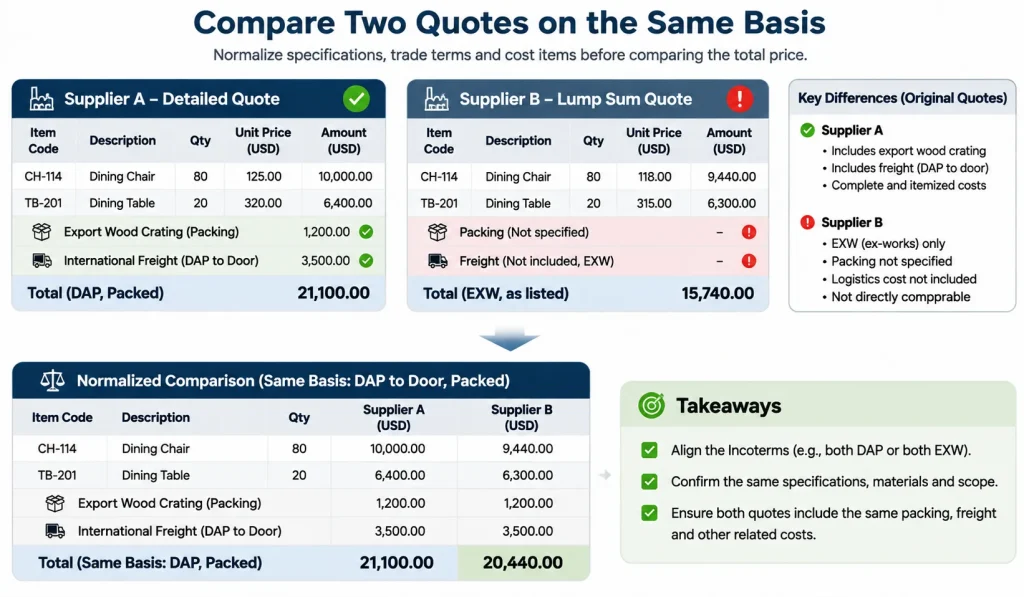
A lower unit price may reflect a different specification or omitted service. Once the scope is aligned, price differences become easier to interpret — but the final decision should still consider quality, warranty coverage, delivery commitments and commercial risk. The lowest initial line price is a poor early filter when suppliers have priced different obligations.
Common Mistake
Negotiating the total before normalising the rows. You end up bargaining over a number that describes two different orders.
The upholstery example in §9 ends here: re-quote both suppliers on the same grade, put the two replies back onto the table above, and the difference that remains is the one worth negotiating. Keep the normalised table with the project file. If the order changes later, you can see at once which lines need repricing instead of reopening the whole quotation.
12. Send the Pack to MingMeng
MingMeng Furniture (Guangzhou Mingmeng Furniture Co., Ltd.) supplies commercial restaurant furniture — chairs, booths, tables, table bases, bar and lounge seating — built for daily service, with project-based customisation of dimensions, upholstery and finish. We work from a marked plan, a quantity schedule and a set of reference images, which is exactly the pack described above.
Send your opening date, marked floor plan and seat count by zone, together with the quantity schedule, and our team can review the inquiry and identify the specifications or commercial details that need clarification before a project-specific quotation can be prepared. The pack is yours, so you can send the same one to every supplier you are considering and compare what comes back on the same rows. Use the Contact page to attach the plan and schedule.
Send us your RFQ pack
Guangzhou Mingmeng Furniture Co., Ltd.
Email: eiko@mingmeng07.com
Ekwentị: +86 13632456645
WhatsApp: +86 15812400982
FAQ
Can I request a quote before the drawings are final?
Yes — provided the drawing’s status is stated. Label the plan concept, mark which zones are stable, and put the unsettled dimensions into the open-item register with an owner. A supplier can price a concept plan by naming its assumptions; what it cannot do is price a plan that is presented as final and then changes. Sending early is fine. Sending early without saying so is what creates revisions.
Is one reference photo enough to specify a chair?
No. A photo communicates silhouette and visible detail; it says nothing about frame material, joinery, foam, glides, exact dimensions or the finish under your lighting. Label it A, B ma ọ bụ C from §6 so the supplier knows whether to match it, use it as a direction, or propose an alternative. For changes affecting comfort, structure or touch, confirm whether a physical sample, prototype or further technical review is required before production release.
What happens if I only give my opening date?
The supplier has to convert it into an on-site date using its own assumptions about approvals and transport, and those assumptions may not match yours. Give both dates and say which is fixed. Then ask which document starts the quoted period. Without that, a date on an email is not a schedule — it is a target with an invisible calculation behind it.
Won’t asking about minimums and schedules slow the quote down?
It usually shortens the whole process. You are not asking the supplier to commit to a figure in the first reply; you are asking it to state the basis on which any figure would be calculated. Four short questions produce comparable answers. Four unasked questions produce a round of clarifications after you have already started comparing prices.
Should indoor and outdoor zones go in separate RFQs?
For a coordinated restaurant project, keeping indoor and outdoor items in one RFQ pack but separate item groups often makes it easier to control finishes, exposure requirements and item codes. Separate RFQs can also be appropriate when different suppliers, procurement phases or approval teams are involved. If you split the requests, retain one master item schedule so the documents remain consistent.
Your Copy-and-Paste RFQ Template
Paste the block below into your email or project sheet. Replace the brackets, adapt any non-applicable sections to your project, and keep every unresolved Open item visible. If there are none, write No Open Items.
SUBJECT: RFQ — [project name], [city, country] — [target opening date]

1. PROJECT
   Name / city / country: [...]
   Venue type: [new build / refresh]  |  Zones: [D01 ..., B01 ..., T01 ...]

2. ATTACHMENTS (item codes must match every attached document)
   [ ] Marked floor plan, if applicable — status: [concept / coordinated / final], rev [...]
   [ ] Quantity schedule — one row per item, unit stated
   [ ] Reference image set — filenames = item codes, labelled A / B / C

3. QUANTITY SCHEDULE
   Item code | Item | Qty | Unit | Zone | Status | Reference file
   [ ... ]  | [...] | [..] | [..] | [..] | [Confirmed/Direction/Open] | [...]

4. USE CONDITIONS
   Indoor / covered terrace / exposed outdoor: [...]
   Cleaning routine and chemicals: [...]  |  Stacking or daily movement: [...]

5. MATERIALS AND FINISH DIRECTION
   Material families: [...]  |  Colour / sheen: [...]  |  Held sample codes: [...]
   Reference labels: A = build to this / B = direction / C = please propose

6. CUSTOMISATION BOUNDARY
   Dimensions [fixed / adjustable / propose]  |  Structure [...]  |  Upholstery [...]
   Finish [...]  |  Identity and hardware [...]
   Items requiring a sample before production release: [...]
   Approval owner: [...]

7. DELIVERY AND DATES
   Address / postcode: [...]  |  Destination port if known: [...]
   Quote freight + local delivery? [yes / no]
   Site access: dock / curb / lift / floor / delivery window / storage [...]
   Target opening date: [...]  |  Desired on-site date: [...]  |  Fixed constraint: [...]

8. OPEN-ITEM REGISTER
   Open item | Level | Owner | Supplier assumption | Exclusion | Deviation
   [ ... ]   | [...] | [...] | [to be completed by supplier] | [...] | [...]
    If no unresolved decisions exist: No Open Items

9. PLEASE STATE IN YOUR QUOTATION
   - Unit price and line total per item code; total project price and currency
   - Quotation validity period  |  Requested return date: [...]
   - Minimum order requirement per item code; quantity-based price changes
   - Sample, tooling, packaging and other charges: included or separate
   - Incoterm, Incoterms edition and named delivery place
   - Export packing method and container loading plan (supplier to state)
   - Freight, insurance, import charges and installation: included or excluded
   - Production period, shipping estimate, and what starts each quoted period
   - Payment milestones and warranty terms
   - Test reports or conformity documents available for this jurisdiction
   - Assumptions, exclusions and deviations for every Open row above

Please restate the target opening date and desired on-site date.
Return the completed open-item register with your quotation.
Sixty seconds before you press send:
- Every item code matches the applicable plan, schedule and reference file.
- The drawing carries a status label and a revision.
- Optional and spare quantities sit on their own rows.
- Both dates are present, and the fixed one is named.
- Every open row asks for an assumption, an exclusion and a deviation.
Final check
Could someone who did not prepare this RFQ identify each furniture item, verify its quantity and locate the correct reference file without asking for clarification? If not, record the missing decision in the pack before sending.


