
 English
 中文
 日本語
 한국어
 العربية
 Русский
 Português
 Türkçe
 हिन्दी
 Tiếng Việt
 ไทย
 Indonesia
 Melayu
 ខ្មែរ
 ລາວ
 မြန်မာ
 Afrikaans
 Hausa
 Igbo
 Sesotho
 isiXhosa
 Yorùbá
 isiZulu
Furnishing an Indian restaurant in the USA involves a decision chain that most owners compress into two questions: how much does it cost, and how fast can it arrive. Those are the wrong questions to lead with. After completing projects for contemporary Indian restaurants across Canada, the UK, and the US — including Zynnia in Canada, a modern Indian dining concept where we supplied the full seating package including upholstered dining chairs, booth banquettes, and bar stools — the pattern is consistent: operators who specify correctly on the front end spend significantly less on replacements in year two and three.
The right questions are: what foam density do I need for 90-minute meal durations, what joint construction survives 300 covers a day, and what is my realistic door-to-door timeline from a China manufacturer? This guide answers all three, from a manufacturer’s perspective, with the technical detail a procurement manager actually needs.
If you are comparing commercial restaurant furniture suppliers for Indian restaurants in the USA, bookmark this page. We are going to cover specifications that most supplier sales decks deliberately omit.
Seating Durability: What “Contract-Grade” Actually Requires
The term “commercial-grade” is used loosely by almost every furniture supplier online. The actual industry benchmark in the US market is BIFMA X5.4 — the Business and Institutional Furniture Manufacturers Association standard for seating durability. A chair that passes BIFMA X5.4 has survived a minimum of 250,000 drop cycles at 225 lbs load, plus front leg and back leg static load tests.
Why does this matter specifically for Indian restaurants? Two reasons. First, Indian dining culture skews toward longer meal durations — your chairs experience sustained load stress rather than the quick-turnover pattern of fast-casual. Second, Indian restaurant aesthetics frequently call for fully upholstered seating, which adds complexity: the frame, the foam, and the fabric each have their own durability specification, and failure in any one of them drives replacement cost.
For upholstered izitulo zokutyela zokutyela, the fabric abrasion benchmark is the Martindale test. Contract-grade minimum for restaurant use is 30,000 Martindale rubs. For booth banquette seating — where guests slide laterally across the fabric every time they enter or exit — specify 50,000 rubs minimum. Anything below that will show wear within 18 months of high-traffic service.
Ask every supplier you evaluate: what is the Martindale rating on the fabric you are quoting? If they cannot give you a number, that is your answer.
Foam Density & ILD: The Spec That Determines Your 2-Year Cost
This is the section most procurement guides skip entirely, which is why so many restaurant operators replace their seating within two years of opening.
Foam is specified by two independent measurements. Density (lb/ft³) tells you how much material is in the foam — this determines how long it holds its shape. ILD (Indentation Load Deflection) tells you firmness — this determines how the seat feels under occupant weight. Both matter. A high-density foam can still be too soft for extended commercial use if the ILD is wrong.
For Indian restaurant seating, here is the practical breakdown:
- Below 1.8 lb/ft³: Residential-grade. Starts losing shape within 6–8 months of daily commercial use. Common in budget supplier quotes. Do not accept this for any seating that will see more than 100 covers per day.
- 1.8–2.0 lb/ft³: Entry-level commercial. Acceptable for low-traffic locations or occasional seating. Not appropriate for primary dining chairs in a busy Indian restaurant.
- 2.2 lb/ft³ and above: Contract-grade commercial standard. This is what we specify for booth banquettes and primary dining chairs in high-traffic hospitality environments. At this density, the foam maintains its ergonomic silhouette through sustained daily use.
On ILD: for dining chairs, 35–40 ILD is the target range. Firm enough to support posture over a 90-minute meal, not so hard that guests shift uncomfortably after 20 minutes. Booth seating can run slightly softer — 30–35 ILD — because the back support from the banquette compensates for seat firmness.
Standard practice when requesting quotes: ask for the foam spec sheet in writing, showing both density (lb/ft³) and ILD rating. If a supplier tells you only that the foam is “high density” or “thick,” push back. Those are not specifications.
Booth Construction: What’s Inside the Banquette Matters
Restaurant booths for Indian dining spaces typically use one of two internal construction approaches, and the difference is visible within 12 months of service.
Webbing + foam construction is the baseline. Elastic webbing spans the seat frame, foam sits on top. This is cost-effective and adequate for moderate-traffic booths. The webbing will stretch and sag with sustained heavy use — in a busy Indian restaurant running dinner service six nights a week, expect noticeable compression within 18–24 months.
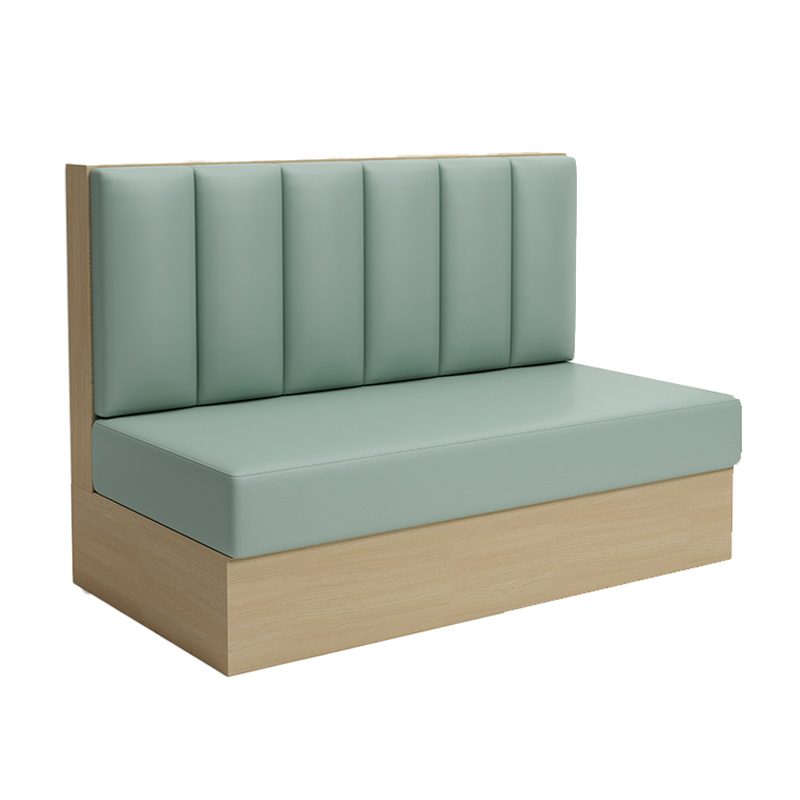
Sinuous spring (serpentine spring) + foam construction is the contract-grade standard for commercial booth banquettes. Steel sinuous springs run front-to-back across the seat frame, providing consistent load distribution and significantly better long-term resilience. Combined with 2.2 lb/ft³ high-density foam, this construction maintains its profile through years of commercial service. All Mingmeng booth banquettes use sinuous spring construction as standard — because we have replaced enough webbing-based booths for operators who bought on price the first time.
The back cushion of a booth banquette is often overlooked. Back cushion foam can run slightly lower density than seat foam (1.8–2.0 lb/ft³ is acceptable for backs), but the attachment method matters. Back cushions that are stapled directly to the frame without a removable cover cannot be reupholstered — when the fabric wears, the entire back unit requires replacement. Specify removable back cushion covers with hidden zipper closure. This one detail can extend the usable life of your booth investment by three to five years.
Khangela eyethu restaurant booth range for full construction specifications by model.
Frame Joinery: Tenon-and-Mortise vs. Dowel Under Commercial Stress
For solid wood dining chairs — a popular choice in Indian restaurant interiors for their warmth and visual weight — the joint construction is the primary determinant of commercial lifespan.
Dowel joints are faster to produce and lower cost. A dowel is a cylindrical wooden pin inserted into aligned holes in both frame members, held by adhesive. Under static load, dowels perform adequately. Under the dynamic stress of commercial use — guests tilting back on rear legs, children shifting weight laterally, staff stacking and moving chairs during setup — dowel joints develop micro-movement that loosens the adhesive bond. In our experience, dowel-joint chairs in high-traffic environments begin to show wobble within 12–18 months.
Tenon-and-mortise joinery is the traditional furniture construction standard and significantly more resistant to dynamic stress. The tenon (a shaped projection on one frame member) fits into the mortise (a corresponding cavity in the other), creating a mechanical interlock that does not rely on adhesive alone. Combined with corner blocks glued and screwed across the interior seat rail joints, this construction resists racking — the lateral deformation that causes chairs to wobble — far more effectively than dowel construction.
At Mingmeng, all solid wood dining chairs use tenon-and-mortise construction with beech wood corner blocks on seat rails. It adds production time. It also means we are not fielding warranty calls from operators at the 18-month mark.
US Fire Compliance: CAL 117, NFPA 260, and What to Put in Your PO
Fire compliance for upholstered restaurant seating varies by US jurisdiction, and assuming compliance without documentation is a procurement risk that creates liability exposure for the restaurant operator.
California: I-CAL 117-2013 (California Technical Bulletin 117) governs smolder resistance of upholstered furniture filling materials. If you operate in California, or if you are procuring for a multi-location group with California presence, CAL 117-2013 compliance is non-negotiable. Request the test report — not a supplier’s verbal assurance.
Other US states: Many jurisdictions reference NFPA 260 or NFPA 261 for contract seating in public occupancies. Check with your local fire marshal before finalizing your furniture specification, particularly if your restaurant exceeds 50 occupants.
The correct way to handle this in procurement: include a line item in your purchase order that reads: “All upholstered seating must comply with [relevant standard]. Supplier to provide third-party test report prior to production approval.” This shifts documentation responsibility to the supplier and creates a paper trail.
Style Selection for Indian Restaurant Aesthetics in the US Market
Indian restaurants in the USA span a wide aesthetic range, from fast-casual to upscale contemporary. The furniture specification changes meaningfully across these tiers.
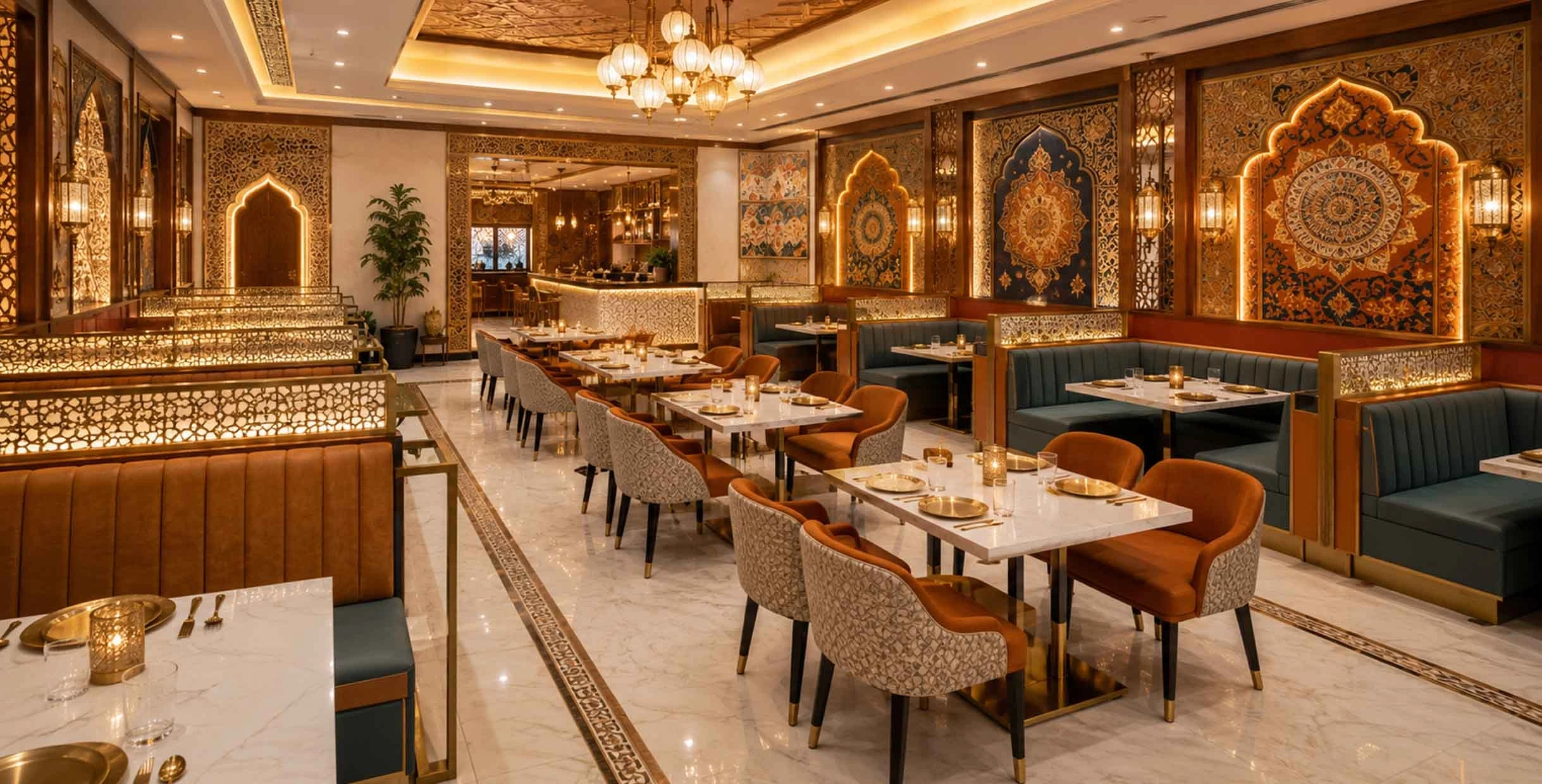
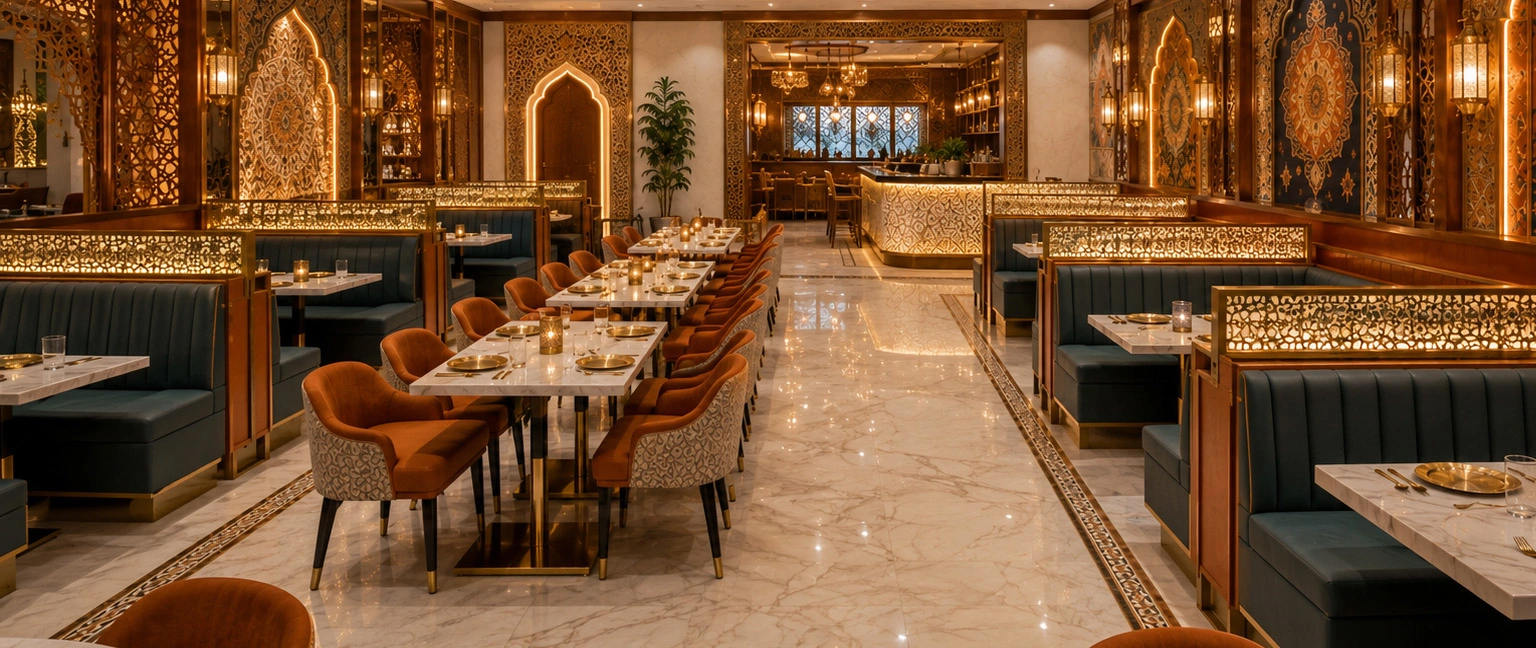
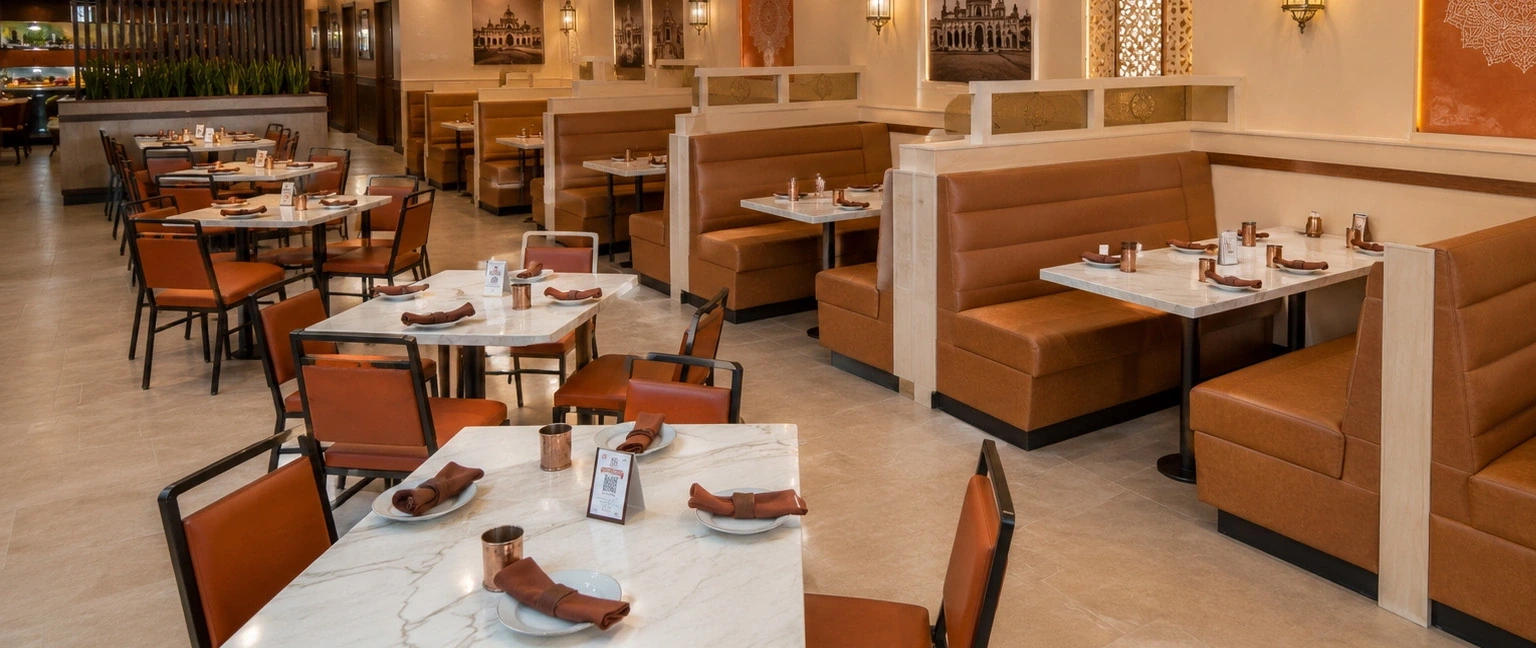
Contemporary Indian fine dining — the Zynnia model — typically combines fully upholstered dining chairs in bold accent colors (deep green, burnt orange, terracotta) with neutral booth banquettes in cream or warm beige. The contrast between vivid chair upholstery and restrained booth fabric creates visual rhythm in the dining room without overwhelming the space. Tables run toward natural stone or stone-effect surfaces — rock slab or sintered stone — which carry warmth while being highly practical for food service.
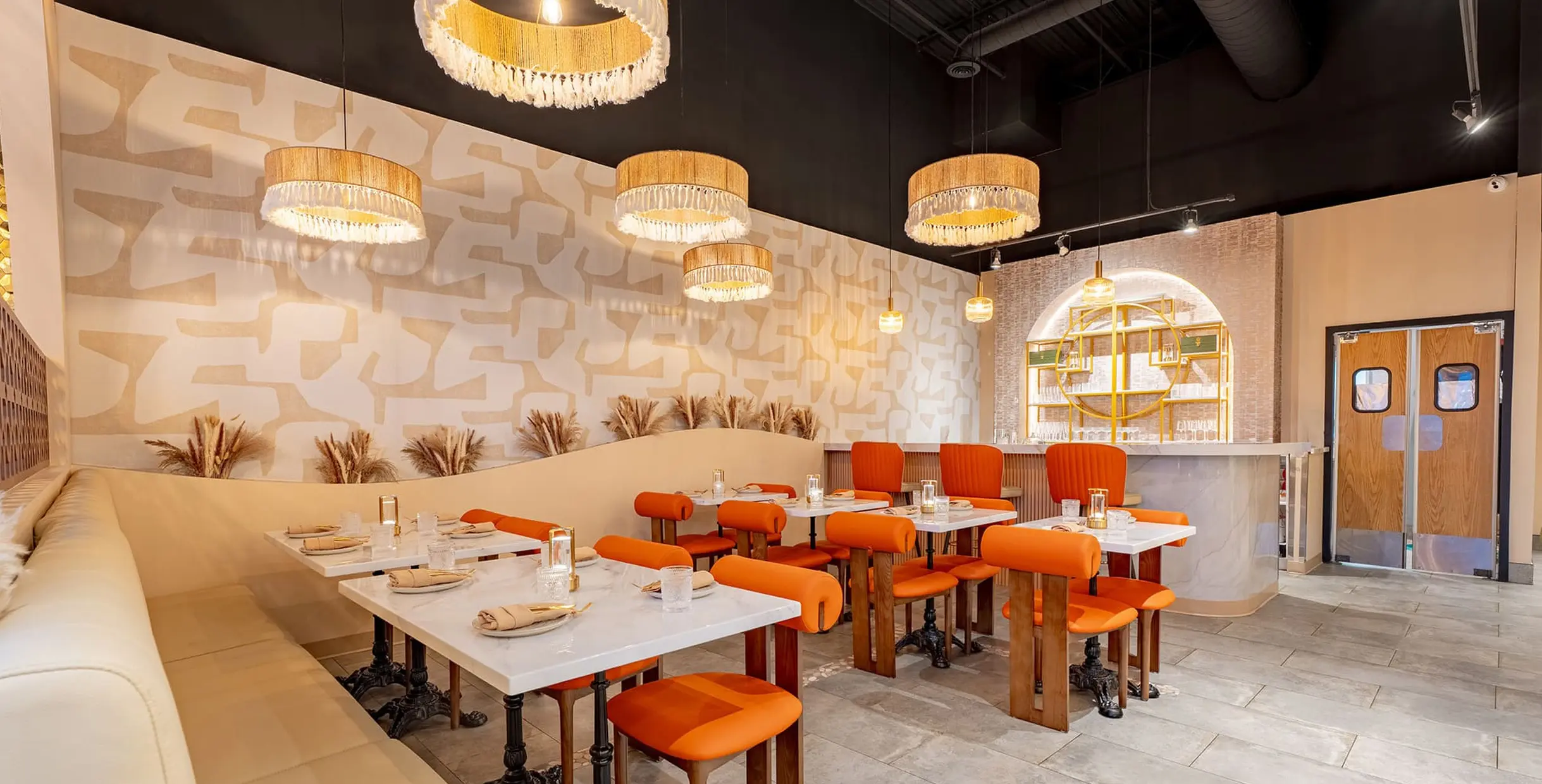
Family casual Indian dining — the dominant format in suburban US markets — prioritizes durability and ease of cleaning over visual drama. Metal frame chairs with vinyl or faux-leather upholstery are the practical choice here: Martindale-rated fabric is less critical because vinyl does not pill or fray, and spill resistance is genuinely superior. Booth banquettes in commercial vinyl with sinuous spring construction handle the family-dining abuse pattern well.
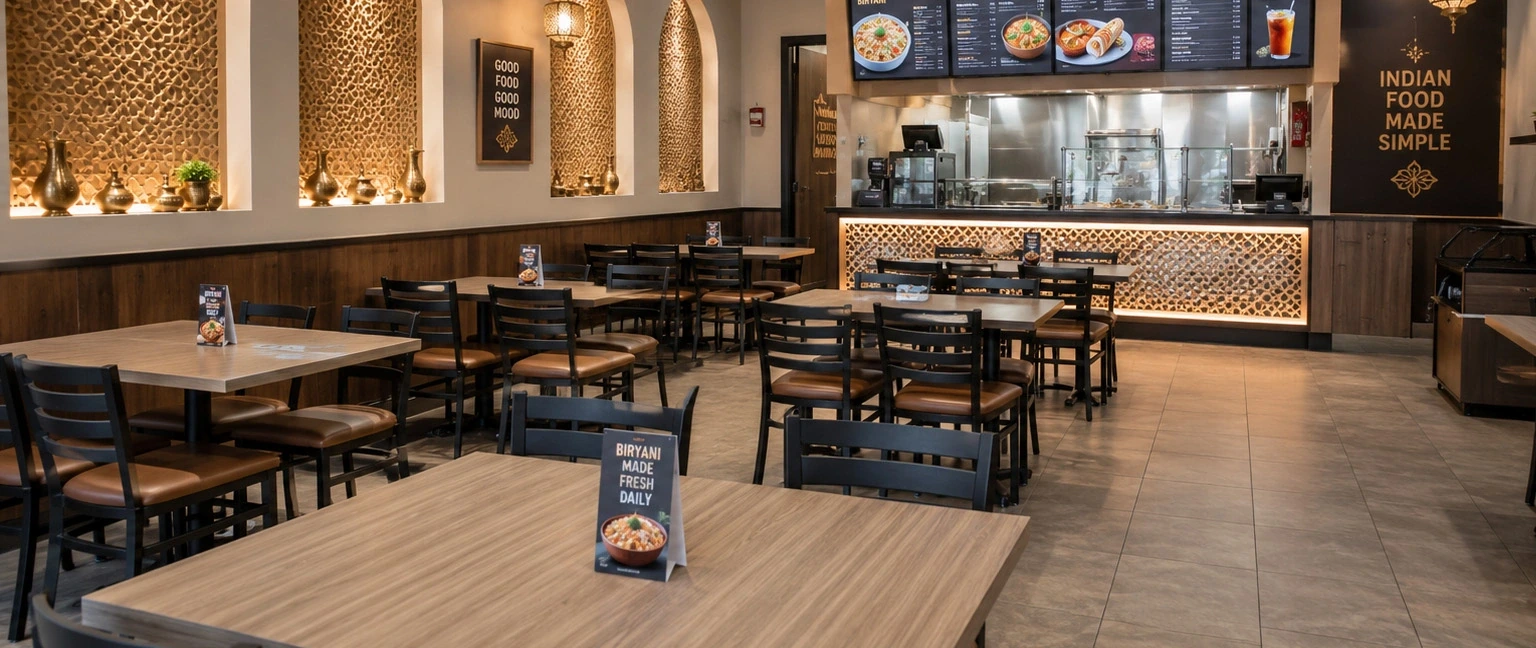
Fast-casual Indian — growing rapidly in urban US markets — often uses stackable metal side chairs, laminate-top tables, and limited or no booth seating. Procurement here is primarily a cost-per-unit and logistics problem rather than a specification problem.
The most common mistake we see in Indian restaurant furniture procurement: choosing upholstery fabric based on showroom appearance rather than Martindale rating. Velvet and boucle upholstery looks exceptional in a contemporary Indian dining room. It also pills, traps food particles, and degrades under cleaning chemicals within 12 months of service. If you want the texture, specify a Martindale 50,000+ contract-grade version — they exist, they cost more, and they are worth it.
Sourcing from China: 4 Procurement Risks and How to Mitigate Them
1. Moisture damage in transit
Solid wood and MDF furniture is vulnerable to humidity variance during ocean transit, particularly on East Coast routes passing through tropical zones. A 35–40 day sea voyage can expose container interiors to significant humidity swings, causing wood to expand, joints to stress, and MDF components to swell at edges.
Specify in your PO: PE film wrap per piece, silica gel desiccant packs inside each export carton, and kiln-dried timber at 8–12% moisture content before production. Request a moisture content report with your pre-shipment inspection documentation.
2. Color and finish variance between sample and bulk
The sample you approved was produced under controlled conditions from a specific material batch. Bulk production may run from a different fabric dye lot or wood stain batch — particularly on large orders where material is sourced across multiple supplier runs. The variance can be subtle or significant depending on the material.
Mitigation: require pre-production samples cut from the actual bulk material batch, approved in writing before production begins. Include a color tolerance clause in your PO (typically ±2–3% for fabric, ±5% for wood stain) so both parties have clear acceptance criteria.
3. Packaging inadequate for LCL sea freight
Less-than-container-load (LCL) shipments — common for single-location Indian restaurant orders — are consolidated with other cargo and handled multiple times during transit. Furniture packed for FCL (full container load) conditions, where minimal handling is assumed, frequently arrives with corner damage and upholstery scuffs when shipped LCL.
Specify LCL-grade packaging: reinforced export cartons, foam corner protectors on all frame extremities, and stretch wrap over cartons before consolidation. Ask your supplier to confirm their standard packaging is rated for LCL handling. If they cannot confirm this, it is not.
4. Underestimating total lead time
Production at Mingmeng runs 30–45 days depending on customization complexity. Sea freight from China to US West Coast ports (Los Angeles, Long Beach) runs 20–25 days transit. East Coast ports (New York, Savannah) add 10–15 days. US customs clearance and final inland delivery: 5–7 days.
Realistic door-to-door timeline: 60–75 days from order confirmation. For restaurant openings or renovation completions with fixed dates, order a minimum of 90 days out. Buffer for Chinese public holidays (Golden Week in early October, Chinese New Year in January/February) which can add 2–3 weeks to production timelines if your order falls around those periods.
Spec Sheet: Typical 60-Seat Indian Restaurant Order
Based on completed projects for Indian restaurants across the US, Canada, and the UK, here is a baseline specification for a standard 60-seat contemporary Indian restaurant:
- Dining chairs: 44–50 units. Mix of upholstered side chairs (70%) and arm chairs (30%). Specify 2.2 lb/ft³ foam density, 35–40 ILD, Martindale 50,000+ fabric, tenon-and-mortise frame construction. — View commercial restaurant chairs
- Booth banquettes: 8–12 sections (single or double-sided). Sinuous spring + 2.2 lb/ft³ foam seat construction, removable back cushion covers, commercial vinyl or Martindale 50,000+ fabric. — View restaurant booth options
- Dining tables: 15–18 units. Mix of 4-top (60%) and 6-top (40%). Rock slab, sintered stone, or high-pressure laminate tops depending on budget tier. — View dining tables
- Table bases: 15–18 units. Cast iron pedestal bases, weight-matched to table top material. Cast iron is the only base material that reliably prevents table rock under sustained commercial use.
MOQ starts at 10 pieces per item. Mixed orders (chairs + booths + tables) can be consolidated into a single LCL shipment. For a detailed quote including foam specifications, fabric options, and lead time confirmation, contact the Mingmeng procurement team with your seat count and preferred style direction.
FAQ
What foam density should I specify for Indian restaurant booth seating?
Specify a minimum of 2.2 lb/ft³ density for booth seat cushions, with 30–35 ILD firmness. Indian dining involves longer meal durations than fast-casual formats — lower density foam (below 1.8 lb/ft³) will compress and lose its profile within 6–8 months of high-traffic service. Always request the foam spec sheet in writing from your supplier.
What is the minimum order quantity and lead time for Indian restaurant furniture from China?
MOQ at Mingmeng starts from 10 pieces per item, which works for single-location restaurants. Total door-to-door lead time is 60–75 days: 30–45 days production, plus 20–40 days sea freight depending on destination port, plus 5–7 days customs and delivery. Order a minimum of 90 days before your opening date.
Do I need BIFMA-certified chairs for my Indian restaurant in the USA?
BIFMA certification is not legally mandated for restaurant seating in the US, but BIFMA X5.4 is the industry benchmark for contract-grade durability. Specifying BIFMA X5.4 compliance (or requesting test documentation to that standard) ensures your chairs are built to withstand commercial load cycles — 250,000 drop cycles at 225 lbs. Suppliers who cannot provide documentation to this standard are typically selling residential-grade product at commercial prices.
How do I prevent moisture damage to wood furniture during sea freight from China?
Specify in your purchase order: kiln-dried timber at 8–12% moisture content, PE film wrap per piece, and silica gel desiccant packs inside each export carton. Request a pre-shipment inspection report with moisture content documentation. LCL shipments require additional packaging reinforcement — confirm your supplier’s standard packaging is rated for LCL consolidation handling.