English
 中文
 日本語
 한국어
 العربية
 Русский
 Português
 Türkçe
 हिन्दी
 Tiếng Việt
 ไทย
 Indonesia
 Melayu
 ខ្មែរ
 ລາວ
 မြန်မာ
 Afrikaans
 Hausa
 Igbo
 Sesotho
 isiXhosa
 Yorùbá
 isiZulu
Restaurant furniture lead time is not one number. It is three clocks running in sequence — sample, production and delivery — and most opening-day schedules put only one of them on the page. If you are working out when to order restaurant furniture for a new restaurant, that single-number habit is exactly where the miss begins.
Furniture schedules rarely fail in production. They fail at approval.

One of our published project records makes the point better than any argument. It is a run of 250 custom bar stools for a hotel in Los Angeles, and the dated chain runs from sample approval on 10 February to warehouse delivery on 18 May: 97 calendar days. Only 46 of them were production.
We are re-reading that record here, not presenting a new case. It first appeared in our supplier audit checklist, where the same sequence is described as “98 days from deposit to doorstep”. The difference cannot be fully reconciled from the published record because the original deposit date is not documented. This guide therefore uses the verifiable 97-day sequence from sample approval to warehouse delivery and clearly identifies both endpoints. This article uses the dated chain and labels its start point precisely — because that discipline is the entire subject of the guide.
It also matters what that 97 days is not. It is sample approval → warehouse delivery, which includes production, ex-works handling, the ocean leg, customs and drayage.It should not be directly compared with the 80–110-day supplier-side planning range published elsewhere on our site. That range includes sampling, production, packing, and sea freight but excludes destination customs, inland delivery, and installation. The 97-day project record begins after sample approval and continues through warehouse delivery, so the two figures have different starting and ending points.Keeping those apart is the whole problem with restaurant furniture lead time — one number gets quoted, three clocks are actually running.
This guide builds a restaurant furniture project timeline for factory-direct orders shipped internationally: an order-by formula, a critical path from a real project, a serial milestone map, and four tactics for when the date moves. It is written for operators, designers, contractors and procurement managers furnishing a new restaurant or a full renovation.
Bài học chính
- Three clocks, not one. Phát triển mẫu 10–20 days (10–15 in our channel comparison, 15–20 in our supplier audit); bulk production 35–50 ngày after approval; ocean transit 25–35 ngày on published U.S. East Coast services. The published total — 80–110 days order to delivery — covers sampling, production, packing and sea freight. It does not include your pre-order work, destination customs, drayage or installation.
- Order-by date = opening day − (supplier-side lead time + destination customs and drayage + receiving and installation buffer). A conservative planning example uses 110 + 21 + 14 = 145 days. Setting the order-confirmation gate at T-21 provides 147 days, including two additional days of contingency.
- The 97-day project is sample approval → warehouse delivery, not order to delivery. Different endpoints, different number.
- East Coast and West Coast are not interchangeable. The published 25–35 day band is an East Coast planning figure; the 35-day Shenzhen–Long Beach leg is one shipment’s record, not a coast-wide standard.
- Get three dates in writing: order confirmation, ex-works, ETA. Everything else is an estimate.
Why Furniture Timelines Fail at Approval, Not Production
A factory can only start when it has a complete, approved order. Quantity, frame finish, seat material, wood stain or powder-coat colour, height, shipping address and payment terms — all settled. Until then the order sits in a queue of almost-orders.
Most schedules miss this. They treat “we chose the chairs in June” as the start date. But choosing a chair is not ordering it. Between the two sit a site measure, a specification freeze, a quotation, a deposit and — for anything upholstered or custom — a physical sample.
The result is a schedule that looks comfortable and is three weeks short. Production gets blamed for a delay that happened in the design phase.
Common Mistake Circulating a fabric shortlist for “final comments” after the order was supposedly placed. Every day that shortlist stays open is a day the production slot is not reserved — and a day added to the back end, where you have the least room.
The fix is not a better estimate. It is a different plan: schedule the decisions, not just the production.
Three Clocks, Not One: Sample, Production, Doorstep
Restaurant furniture lead time causes so many missed openings because three different numbers hide behind that one phrase. Before any date can be planned, they have to be kept apart.
| Clock | Published range | What it measures | What it does not include |
| 1. Sample and approval | 10–20 days | Building the sample, shipping it, your review, sign-off | Sản xuất số lượng lớn |
| 2. Bulk production | 35–50 ngày sau đó approval | Materials, cutting, upholstery, assembly, inspection | Freight, customs |
| 3. Total order to delivery | 80–110 days | Sampling + production + packing + sea freight | Pre-order work, destination customs, drayage, install |
Two notes on the numbers, because our own published pages use slightly different scopes and it is better to say so than to smooth it over:
- các 80–110 day envelope comes from the factory-direct vs wholesale comparison. Our supplier audit checklist gives 80–100 days door to door. We plan against 80–110 — the larger range — because a conservative gate costs a week of calendar space, while an optimistic one costs an opening date.
- The sample range combines 10–15 days from the channel comparison and 15–20 days from the supplier audit. The production range combines 40–50 Và 35–45 on the same two pages. These are planning envelopes, not conflicting promises.
The 80–110 day figure already contains the first two clocks. That is the line that matters. When a supplier quotes a 45-day lead time for a custom order, ask which endpoints that number covers — sampling, production, inspection, packing and international delivery, or just one of them. Quotations are only comparable when the start and end points match.
A second split matters just as much:
- Your pre-order clock — layout, specification, quotation, deposit. You control this, and it is usually where the lost weeks are.
- The supplier’s cycle — sampling, production, inspection, freight. You influence it only through the approval date and a change freeze.
Mẹo chuyên nghiệp When a quote gives you a single lead-time figure, ask for its scope in one sentence: “Does that include sampling and sea freight, or is it production only?” The answer can move your order-by date by five weeks.
The Order-By Formula
A restaurant furniture ordering timeline starts with one line of arithmetic — though most project schedules do it in their head, badly:
Order-by date = opening day − (total lead time + destination customs & drayage + receiving and installation buffer)
Use the top of the range, not the middle. The bottom is what you get when nothing goes wrong, and “nothing goes wrong” is not a plan.
| Scenario | Supplier Lead Time | Customs & Drayage | Installation Buffer | Total Planning Time | Practical Order Gate |
|---|---|---|---|---|---|
| Custom factory-direct | 110 days | 21 days | 14 days | 145 days | T-21 |
| Special order (non-stock finish) | 45 days | 21 days | 14 days | 80 days | T-12 |
| Stock items | 20 days | 21 days | 14 days | 55 days | T-8 |
The 21-day customs and drayage window is a conservative planning allowance, not an industry standard. In the published 250-stool project, the interval between arrival at Long Beach and delivery to the client’s warehouse was eight days. Actual clearance and inland delivery requirements depend on the destination port, customs procedures, inland distance, and shipment conditions.
For stock items and special orders, the published lead-time ranges do not consistently identify the final delivery endpoint. Confirm whether the quotation covers factory dispatch, destination port arrival, or delivery to site before adding customs and drayage allowances. Where a quoted delivery schedule already includes these stages, do not count them twice. The Incoterm defines delivery responsibilities but does not, by itself, establish which transit stages are included in the quoted number of days.
What can run in parallel with construction, and what cannot:
| Can happen while the room is still being built | Must wait for the room |
| Seat count by zone, from the layout | Final dimensional confirmation (needs set-out) |
| Fabric and finish shortlisting | Colour approval under the venue’s lighting |
| Table height vs seat height as one system | Floor-level glide selection |
| Deposit, credit line, payment terms | Delivery appointment and dock booking |
| Choosing which zones to standardise | Installation sequencing |
The right-hand column is short. That is the point: most pre-order work can overlap with construction. An order-confirmation gate at T-21 does not mean design and construction must stop 21 weeks before opening; it means the specifications required for production need to be confirmed by that milestone.
The Critical Path: 250 Custom Bar Stools, Start to Doorstep
This is the part of a factory-direct project that generic purchasing guides rarely show: a dated chain with an owner at each handover. The record below is from our published supplier audit article, re-read as a schedule.
| # | Node | Date | Duration | Owner | Cumulative |
| 0 | Sample approved | 10 February | — | Buyer + factory | Day 0 |
| 1 | Bulk production complete | 28 March | 46 days | Factory | Day 46 |
| 2 | Loaded on vessel, Shenzhen | 5 April | 8 days | Factory + forwarder | Day 54 |
| 3 | Arrived Long Beach | 10 May | 35 days | Carrier | Day 89 |
| 4 | Delivered to client warehouse | 18 May | 8 days | Forwarder + receiver | Day 97 |
Three things follow from that table, and each one changes how you should plan.
First, production is less than half the chain. Forty-six of ninety-seven days. The other 51 are inspection and packing, inland movement to the port, the ocean leg, customs clearance and drayage. A schedule built around a production figure alone is missing more time than it contains.
Second, the 35-day ocean leg is one sailing, not a benchmark. Long Beach is on the U.S. West Coast. Our published 25–35 day planning band refers to U.S. East Coast services — a different port pair with different routing and usually a longer transit. Do not use an East Coast planning figure to explain a West Coast shipment, and do not turn one 35-day West Coast record into a coast-wide standard. Ask your forwarder for the current port-to-port estimate for your specific ports and sailing.
Third, the 97 days do not include sample development. The clock in this table starts at sample approval. Everything before 10 February — sample build, shipping, review — sits outside it, as does all pre-order work. That is precisely why this figure must never be quoted as an order-to-delivery total.
Mẹo chuyên nghiệp Build your own version of this table before the order goes in, with the four handover dates left blank. Ask the supplier and forwarder to fill them in. If nobody will date a node, that node is not being managed.
The Backward Timeline at a Glance
The following backward timeline is an illustrative planning model for a custom factory-direct restaurant furniture order. It starts 21 weeks before opening day and separates sample approval, bulk production, pre-shipment handling, ocean freight, destination customs, and installation into sequential stages.
The example allocates 20 days to sampling, 47 days to bulk production, eight days to pre-shipment handling, 35 days to ocean freight, 21 days to destination customs and drayage, and 14 days to receiving and installation. An additional two days remain before the planned opening date. These durations are planning assumptions rather than guaranteed supplier or carrier commitments.
| Window | Duration | Milestone | Owner | Confirmed in writing |
| T-26 → T-24 | 14 d | Concept, budget and seat count by zone | Owner / designer | Seat count per zone, service style, budget band |
| T-24 → T-22 | 14 d | Layout lock and site measure | Owner + contractor | Door, lift and stair clearances; floor plan; floor boxes |
| T-22 → T-21 | 7 d | Specification freeze | Owner + supplier | Dimensions, materials, finishes, quantities, packing |
| T-21 → T-20 | 7 d | Quotation, PO, deposit | Owner + supplier | Order confirmation date |
| T-20 → T-17 | 21 d | Sampling | Supplier | Sample-ready date |
| T-17 | — | Sample approval signed | Owner | Annotated photos + date |
| T-17 → T-10 | 49 d | Bulk production, inspection and packing | Supplier | Ex-works date, inspection report |
| T-10 → T-5 | 35 d | Ocean freight, port to port | Supplier / forwarder | Port pair, Incoterm, vessel |
| T-5 | — | Arrival at destination port | Carrier | Arrival notice |
| T-5 → T-2 | 21 d | Customs clearance and drayage to site | Forwarder | ETA at site, delivery appointment |
| T-2 → T-0 | 14 d | Receiving and installation | Owner + installer | Dock access, install sequence |
| T-0 → T+2 | 14 d | Snagging and spares | Owner | Spare modules, touch-up, replacements |
| Planning Window | Duration | Milestone | Owner | Required Confirmation |
|---|---|---|---|---|
| T-26 → T-24 | 14 days | Concept, budget and seat count | Owner / Designer | Budget and seating requirements |
| T-24 → T-22 | 14 days | Layout lock and site measurement | Owner / Contractor | Drawings and site access measurements |
| T-22 → T-21 | 7 days | Specification freeze, quotation and PO | Owner / Supplier | Final specifications and order confirmation |
| T-21 / Day 0 | — | Order confirmed | Owner / Supplier | Signed purchase order |
| Day 0–20 | 20 days | Sample development and approval | Supplier / Buyer | Approved sample |
| Day 20–67 | 47 days | Sản xuất số lượng lớn | Supplier | Production completion |
| Day 67–75 | 8 days | Inspection, packing and port transfer | Supplier / Forwarder | Inspection and shipment records |
| Day 75–110 | 35 days | Ocean freight | Carrier / Forwarder | Destination port ETA |
| Day 110–131 | 21 days | Customs clearance and drayage | Forwarder | Customs release and delivery appointment |
| Day 131–145 | 14 days | Receiving and installation | Owner / Installer | Site readiness and installation checks |
| Day 145–147 | 2 days | Final contingency | Owner / Contractor | Outstanding issues |
| Day 147 | — | Planned opening | Owner | Venue readiness |
Check the Timeline Arithmetic
The supplier-side cycle totals 110 days: 20 days for sample development and approval, 47 days for bulk production, eight days for inspection and pre-shipment handling, and 35 days for ocean freight.
The destination stage then adds 21 days for customs clearance and drayage, followed by 14 days for receiving and installation.
The resulting planned duration is 145 calendar days. Starting the order-confirmation process 21 weeks before opening provides 147 days and leaves two additional days of contingency.
The 47-day production allocation falls within MingMeng’s published 35–50-day planning range. The eight-day pre-shipment interval is based on the recorded period between production completion and vessel loading in the 250-stool project, but it should not be treated as a universal handling standard.
The 35-day ocean freight allowance is illustrative and must be replaced by the forwarder’s route-specific estimate. The 21-day destination allowance is intentionally conservative; the published 250-stool project recorded eight days from Long Beach arrival to warehouse delivery.
This model is intended to show how the scheduling stages fit together without overlap. Each project must use its own confirmed manufacturing schedule, port pair, customs requirements and installation conditions.
Milestones 1–2: Lock the Layout, Freeze the Specification
The first two milestones cost almost nothing to do early and almost everything to do late.
Milestone 1 — layout lock and site measure (T-24 → T-22). Before anyone discusses a chair, confirm the room. Measure the door opening, the lift interior, the stair turn and the ceiling height. A banquette that fits the drawing but not the stairwell is a delivery-day problem with no cheap fix.
At the same time, settle seat count by zone: main dining, bar, lounge, private dining, waiting. The count drives quantity, which drives price breaks and packing. Add a small allowance for damage and future replacement, and confirm that allowance with your supplier rather than assuming it.
Milestone 2 — specification freeze (T-22 → T-21). Freeze the details that change production: overall dimensions, seat height and depth, frame material and finish, upholstery and colour, edge profile, glides, and quantity by zone. If the venue has a fire or accessibility requirement, confirm it at this gate — not after the sample arrives.
Mẹo chuyên nghiệp Run the spec freeze as a single sign-off table with one row per SKU and one column per attribute. A table makes an open decision visible; a paragraph hides it.
This is also the moment to decide what you are not customising. Every non-standard detail adds a sample, a lead-time line and a failure point. Standardising the back of house and feature-customising the front is usually the cheapest way to protect the date.
Milestone 3: Sample Approval — the Gate That Extends the Back End
If one milestone decides whether you open on time, it is this one.
Restaurant furniture sample approval is not a formality. It is the physical contract: the seat you feel, the colour you see, the edge you touch, the glides that meet your floor.

Here is the mechanic most schedules miss. Sampling sits inside the 80–110 day cycle, and the cycle assumes a first-round approval. Approve on the first pass and the total holds. Send it back for a second round, and you add the full re-sample time — 10–20 days plus shipping both ways — to the back end. Nothing downstream gets faster to compensate.
So the expensive question is not “how long does a sample take”. It is “how many rounds will this take, and what does round two cost me in opening date”.
What to approve, in writing:
- Overall dimensions and seat height/depth against the drawing.
- Foam feel and recovery — sit on it, do not press it with a thumb.
- Upholstery colour and texture under the venue’s lighting, not the showroom’s.
- Stitching, piping, edge profile and corner treatment.
- Glides or feet, matched to the actual floor finish.
- Packing method, especially for stone tops and modular pieces.
Sign the approval with annotated photos and a date. A verbal “looks good” is not an approval; it is the start of a dispute.
Common Mistake Approving a fabric from a 100 mm (4 in) swatch under office lighting, then discovering on site that it reads grey-green under the venue’s warm dimmers. Colour is a lighting decision as much as a material decision. Approve in the room at the light level you will actually run — or build a lighting mock-up before the final sample is signed.
Ask for the sample-ready date as its own line in the schedule, so it appears as a milestone rather than disappearing into the word “production”.
Milestone 4: Production, Inspection and Ex-Works
Once the sample is signed, production is released. This is the supplier-controlled block, and your leverage is front-loaded: the approval date and a change freeze.
In the published 250-stool project, bulk production took 46 days, followed by an additional eight days between production completion and vessel loading in Shenzhen. The combined interval was 54 days. The detailed breakdown of those eight days is not available in the published record, so it should not be treated as a verified inspection or packing duration.

The backward planning model separates these activities into a 47-day production allowance and an eight-day pre-shipment handling allowance, for a combined 55 days. This illustrates why a project schedule should not treat production completion and vessel loading as the same milestone. Actual durations must be confirmed with the supplier and freight forwarder.
What to lock before release:
- Purchase order matching the approved sample and the final quantity by zone.
- Deposit and payment terms.
- The inspection date and who attends or receives the report.
- Packing list organised by zone or room, so receiving matches installation.
What to check before shipment:
- Goods inspected against the approved sample, not against a catalogue photo.
- Hardware, glides and spare parts packed and labelled.
- Cartons marked by zone, with a packing list that matches the PO.
- Photographs of finished goods and packing, dated.
Mẹo chuyên nghiệp Freeze changes at production release. A finish change after cutting is not a small edit — it is a re-quote and a new production slot, and it lands directly on your opening date.
Milestone 5: Ocean Freight, Customs and Installation
Freight is where a perfect production run meets the real world. A workable restaurant furniture delivery schedule keeps three separate segments on the page; merging them is how schedules quietly lose two weeks.
1. Port-to-port ocean transit. Our published planning band is 25–35 days for U.S. East Coast services. The 250-stool project used Shenzhen → Long Beach, a U.S. West Coast route, and that sailing took 35 days. Treat both as route-specific information, not as a single universal number: transit depends on the origin and destination ports, vessel routing, transshipment and the sailing schedule. Confirm the current estimate with your forwarder for your port pair before the schedule is fixed.
2. Customs clearance and drayage. This begins only after arrival. In the project record it took 8 days. It includes port release, any examination, and inland movement to your delivery point — none of which is inside a port-to-port transit figure. Confirm the Incoterm so it is clear who books, who clears and who pays.

3. Receiving and installation. A third, separate window. Before the truck is booked, confirm dock access, lift dimensions and storage; assign a receiving lead with the packing list and a damage-log template; protect finished floors before installation starts. Install by zone in the order the venue will open, not the order the cartons arrive, and keep hardware and spares in one labelled place.
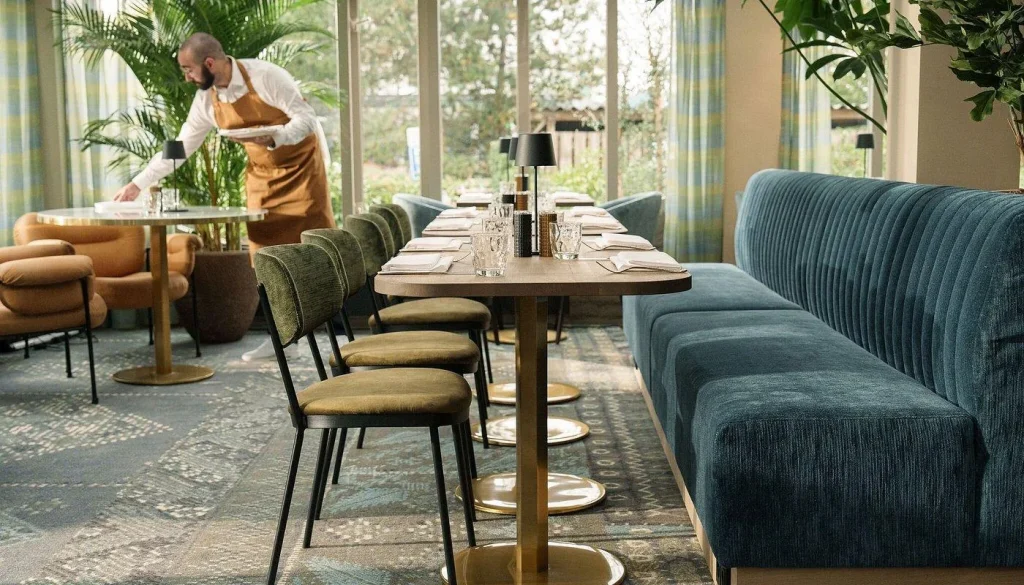
Common Mistake Scheduling installation for the same week the contractor is still finishing. Dust, blocked lifts and wet floors turn a two-day install into a two-week argument — and the furniture takes the blame.
When the Opening Date Moves: Four Compression Tactics
Opening dates move. The instinct is to ask the factory to “hurry”. That rarely works, because production is the least compressible block. The compressible blocks are scope, sequencing and freight mode.
| Tactic | Time it buys | Trade-off | Use when |
| Phase the shipment — front of house first, back areas later | Weeks, depending on the split | Two freights, two installs, two receiving events | Opening cannot move and back areas can wait |
| Use stock or special-order lines for high-visibility zones | Stock 5–20 days; special order 30–45 days (published lead times) | Less customisation; finishes limited to what is available | The date is fixed and the look can flex |
| Freeze the spec early and expedite critical items | Depends on the item and the slot | Higher cost; air freight on a small critical set | A few pieces are blocking the whole room |
| Reduce opening scope — main dining now, lounge later | Weeks | A second procurement and install cycle | The venue can open with a smaller footprint |
Two rules apply to all four. First, never compress the sample gate — skipping approval does not save time, it moves a 10–20 day re-sample from before production to after it. Second, decide the tactic before production starts; once the line is running, your options are mostly cost, not time.
Mẹo chuyên nghiệp If you must phase, split by zone and label everything at packing. The cheapest phase is the one where the cartons already say which room they belong to.
Delay Risk Matrix: What Slips First
Most schedule risk concentrates in six places, and each one announces itself before it bites. The impacts below are planning allowances derived from our published ranges and the project record above — not fixed industry standards. Your numbers will differ by port pair, order size and site conditions.
| Risk | Planning allowance | Early warning signal | Mitigation |
| Sample sent back for a second round | +10–20 days | “Looks good, just one change” | Consolidate comments into one round; approve with annotated photos |
| Specification change after production release | Re-quote and a new slot; allow +3–4 weeks (planning estimate) | “Can we just change the finish?” | Change freeze at release; price the change before agreeing to it |
| Vessel rollover or port congestion | +5–14 days (planning estimate) | Carrier rollover notice; blank sailing | Book earlier; hold slack after port arrival rather than inside it |
| Customs examination | +3–7 days; the project record shows 8 days for clearance and drayage combined | Missing or mismatched documents | Pre-clear HS codes and commercial invoice before sailing |
| Site not ready for installation | Install compressed into days, not weeks | Contractor behind on finishes | Separate the install date from handover; protect floors early |
| Missing parts or spares | Opening-week scramble | Packing list does not match the PO | Zone-labelled cartons; order spare modules with the main run |
The pattern is consistent: the risks that hurt most sit before the order is confirmed, and the most visible ones sit after. The cheapest risk control in the whole project is a signed sample and a frozen specification — not a tighter shipping contract.
Specify with MingMeng
MingMeng Furniture (Guangzhou Mingmeng Furniture Co., Ltd.) supplies factory direct restaurant furniture — chairs, booths, tables, table bases, bar and lounge seating — built for daily service, with project-based customisation of dimensions, upholstery and finish. We manufacture and ship factory-direct, which means one party owns the chain from sample approval through ex-works, ocean freight documentation and delivery handover.
- Nội thất nhà hàng — the full commercial collection, organised by category so a whole-room schedule can be built from one source.
- Gian hàng nhà hàng — banquette and booth runs dimensioned to the room, with modular options that survive reconfiguration.
- Bàn nhà hàng — tops and bases specified together, so table height and seat height are decided as one system.
- Custom Projects — project-based customisation and a reference set of completed hospitality fit-outs.
The figures in this guide come from three published articles rather than a sales sheet: the factory-direct vs wholesale comparison for the 80–110 day envelope and stock/special-order lead times, the supplier audit checklist for the sampling/production split and the 250-stool project record, and the high-volume venues guide for the East Coast transit band and the custom-colour adder.
Send us your opening date, floor plan and seat count by zone, and we will return a restaurant furniture project timeline with the sample-ready date, order confirmation date, ex-works date, port arrival and site ETA marked — so you can see the real decision points before you commit. The ranges above are the starting point; the written schedule for your order is the one that counts.
Request a restaurant furniture project schedule
Guangzhou Mingmeng Furniture Co., Ltd. Email: eiko@mingmeng07.com Phone: +86 13632456645 WhatsApp: +86 15812400982
Câu hỏi thường gặp
When should I order restaurant furniture for a new restaurant?
For custom factory-direct restaurant furniture, a conservative planning approach is to confirm the order approximately 21 weeks before opening. The illustrative calculation allows 110 days for the supplier-side cycle, 21 days for destination customs and drayage, and 14 days for receiving and installation. This totals 145 days, with two additional days available when the order is confirmed at T-21.
Stock and special-order products may require shorter lead times, but the quotation must identify its delivery endpoint before separate shipping and installation allowances are added. Confirm the sample schedule, production completion, port arrival, and final delivery dates in writing for each project.
Does the 80–110 day range include sampling?
Yes — and this is the part of custom restaurant furniture lead time that gets misquoted most often. The published definition is order to delivery, covering sampling, production, packing and sea freight. It does not include your pre-order work, destination customs, drayage or installation. That is why the 35–50 day production figure must never be used as a delivery date — production is roughly half the chain.
What exactly does the 97-day project figure measure?
Sample approval to warehouse delivery for one 250-stool order: 46 days production, 8 days to load at Shenzhen, 35 days at sea, 8 days from Long Beach to the client’s warehouse. It does not include sample development or pre-order work, and it is not an order-to-delivery total. Our previously published supplier audit article describes the same project as “98 days from deposit to doorstep.” However, its dated milestones document 97 calendar days from sample approval to warehouse delivery. Without the original deposit date, the difference cannot be fully reconciled. This guide uses the recorded milestone dates rather than assigning an unverified deposit date.
Is 25–35 days the standard for shipping furniture from China?
No. It is a planning band for U.S. East Coast services. The 250-stool project used Shenzhen → Long Beach on the West Coast and its sailing took 35 days — one shipment’s record, not a coast-wide benchmark. Transit depends on port pair, routing, transshipment and sailing schedule. Ask your forwarder for your own route, and keep customs and drayage as a separate line.
How long does sample approval take, and can I speed it up?
Sample development and delivery run 10–20 days across our published pages (10–15 in one, 15–20 in the other), and the cycle assumes a first-round approval. You cannot shorten the build, but you can avoid a second round: consolidate comments into one pass, review colour in the venue, and sign with annotated photos. A rejected sample adds 10–20 days plus return shipping to the back end.
What if my opening date moves earlier?
Use one of the four compression tactics: phase the shipment, switch high-visibility zones to stock or special-order lines, expedite a small critical set, or reduce opening scope. All trade cost or flexibility for time. None safely skips sample approval — that just moves a 10–20 day re-sample to opening week.
Can I ship the furniture in phases?
Yes. Phasing works best when the packing list is organised by zone, so front-of-house cartons ship and install first while back areas follow. Expect two freights, two receiving events and two installation windows — but it is often the cheapest way to protect a fixed opening date.
Last updated: November 2026. Lead-time figures are MingMeng’s published planning ranges, not a quotation or a guarantee; the binding schedule is the order confirmation. The 250-stool sequence is one project record and is not a transit or production standard. Customs, drayage and installation allowances are planning estimates. Fire, egress and accessibility requirements vary by jurisdiction — verify with your local fire marshal and code official before finalising.