
 English
 中文
 日本語
 한국어
 العربية
 Русский
 Português
 Türkçe
 हिन्दी
 Tiếng Việt
 ไทย
 Indonesia
 Melayu
 ខ្មែរ
 ລາວ
 မြန်မာ
 Afrikaans
 Hausa
 Igbo
 Sesotho
 isiXhosa
 Yorùbá
 isiZulu
Most upholstery specifications are written at the fabric level. Most compliance failures happen at the composite level. Here is what each standard tests, what evidence it produces, and where a compliant specification quietly stops being compliant.
A hotel group signs off a banquette in a beautiful wool-blend. The fabric has a Martindale abrasion certificate, a colour-fastness report and a shade label. Two weeks before opening, the local fire authority asks for ignition documentation. The file contains an abrasion test. It does not contain an ignition test — not on the fabric, not on the foam, not on the assembled seat.
The banquettes are re-upholstered in place, on site, at roughly three times the material cost, and the opening slips by nine days.
Nothing about this story is unusual, and nothing about it is a manufacturing defect. It is a specification gap: the buyer specified a fabric when the regulation governs a composite.
The question is not “is it fireproof” — it is “proven against which ignition source”
Ignition source, not material, is the unit of compliance
No upholstery is fireproof. Every standard in this field is a test of how a specific assembly behaves when exposed to a specific ignition source for a specific time, and whether it self-extinguishes within a defined period. Change the ignition source and the same beautiful banquette moves from pass to fail without a single material changing.
This is why “fire-retardant fabric” is not an answer to a compliance question. A fabric that resists a smouldering cigarette may fail a gas-flame test outright; a fabric that passes a small flame test can still fail a crib test because the foam underneath keeps burning after the cover has charred through.
The three layers that decide the result
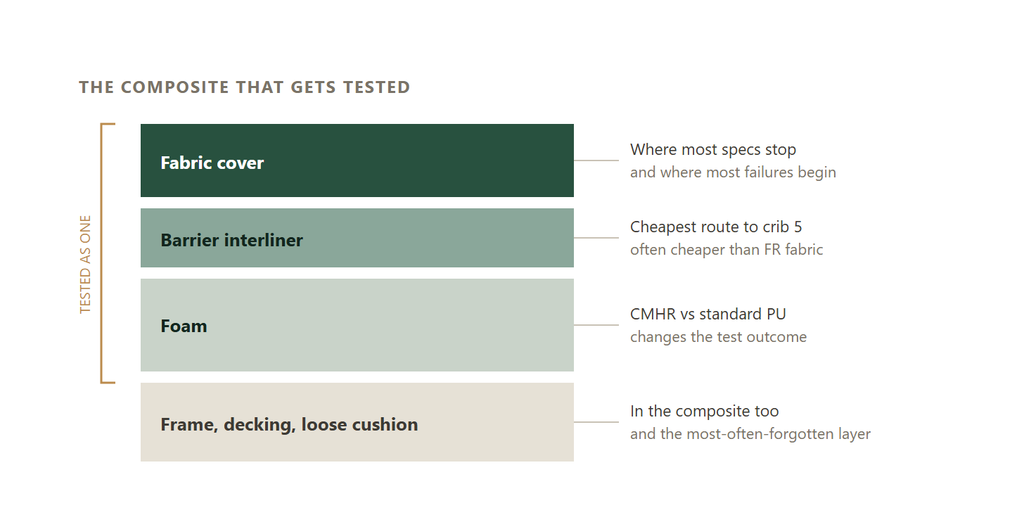
Four components end up inside a typical test composite: the cover fabric, the barrier interliner (if there is one), the foam, and the frame or decking in contact with the foam. A loose seat cushion is a separate composite. A back cushion is a separate composite. This matters later, when someone adds a throw cushion to a specification that was tested as a fixed bench.
The standards you will actually be asked for
| Market / context | Tiêu chuẩn | Ignition source | Tests what |
|---|---|---|---|
| US — California, adopted widely | CAL TB 117-2013 | Smouldering cigarette | Cover fabric, barrier, filling material and decking, tested as components |
| US — public occupancy, California | CAL TB 133 | Open flame, full-scale chair | The assembled item, tested as a whole piece of furniture |
| US — commercial contract | NFPA 260 / UFAC Class 1 | Smouldering cigarette | Composite, class-rated; the language most US specifiers write |
| UK | BS 5852, applied through BS 7176 categories | Cigarette, match, crib 3 / 5 / 7 | The complete composite — fabric, interliner, foam together |
| EU | EN 1021-1 and EN 1021-2 | Cigarette / match-flame equivalent | Cover and interliner combination, in the specified build |
| Marine, cruise and ferry | IMO FTP Code Part 8 (with Part 2) | Defined test ignition per IMO resolution | Upholstered furniture for ships, plus smoke and toxicity |
United States: CAL TB 117-2013
Technical Bulletin 117 is a California regulation that in practice sets the de facto national baseline, because most US buyers write it into specifications regardless of where the restaurant is. It is a smoulder test: the assembly is exposed to a smouldering cigarette and must not progress to open flaming within the test period.
What the 2013 revision changed
The 2013 version removed the open-flame requirement that had been in the older standard and shifted the test onto component parts — cover fabric, barrier material, filling material, decking — each assessed separately. It also introduced a labelling requirement that discloses whether added flame retardants are present.
For a restaurant buyer the practical consequence is this: a TB 117-2013 report may cover the fabric, the foam, or both, and it may not cover the combination. Read the scope statement, not just the word “pass”.
Where TB 117 stops being enough
TB 117 is a smoulder test. It says nothing about how the furniture behaves in a sustained open flame. In California, seating for certain public occupancies — including some restaurant and assembly uses — is specified against TB 133, which is a full-scale open-flame test on the finished chair. Elsewhere in the US, insurers, hotel brands and campus clients frequently write NFPA 260 or a project-specific open-flame requirement on top of TB 117. If your client is a chain with a brand standard, the brand standard is the real specification, and it is usually stricter than the code.
United Kingdom: BS 5852 and BS 7176
BS 5852 defines the test methods and a set of numbered ignition sources, from a smouldering cigarette (source 0) and a butane flame (source 1) up through wooden cribs of increasing mass. The cribs are the ones that matter in hospitality: crib 5 is the level almost universally demanded for UK contract seating, and crib 7 appears in the highest-hazard categories.
Crib 5 in plain language
A crib 5 test drops a burning wooden crib of a defined size onto the seat and the back of the upholstered composite, and observes whether the assembly self-extinguishes within the permitted time and whether burning material falls away. It is a substantially harsher test than a cigarette or a match, and it is the one that separates genuine contract upholstery from domestic-grade material with a fancy cover.
Why BS 7176 is the document specifiers cite
BS 7176 is the specification for resistance to ignition of upholstered furniture for non-domestic seating. It does not invent a new test — it maps hazard categories (low, medium, high, very high) onto BS 5852 ignition sources. A restaurant dining room is normally specified at medium or high hazard, which lands on crib 5. A hotel bedroom is lower hazard; a bar or a nightclub is higher.
When a UK client says “we need BS 7176”, they are not being difficult. They are telling you which hazard category the room sits in, and therefore which crib source the composite has to survive.
European Union: EN 1021-1 and EN 1021-2
EN 1021-1 tests resistance to a smouldering cigarette; EN 1021-2 tests resistance to a match-flame equivalent. Both are applied to the cover-and-interliner combination in the build that will actually be produced, which is why a report for “the fabric” without the interliner is not the same evidence.
Note that EN 1021 governs the furniture. Where fixed seating forms part of the building envelope, reaction-to-fire classification under EN 13501-1 can also be raised by an authority or an insurer, and that is a materials classification, not a furniture one. Ask which framework is being applied before you buy samples.
Marine, cruise and ferry: IMO FTP Code
If the project is a cruise ship, a ferry, a yacht or a floating venue, the applicable regime is the IMO Fire Test Procedures Code. Upholstered furniture falls under Part 8, and components are additionally assessed for smoke and toxicity under Part 2. Certification runs through a recognised laboratory and, for EU-flagged vessels, a MED/Wheelmark route.
This is the one segment where “we will sort the certificate later” reliably ends the project. Marine approval is a design input, not a paperwork step at the end: it constrains fabric choice, foam specification and even the way seams and buttons are built.
Where compliance actually lives: the three-layer stack
Barrier interliner — the cheapest insurance in the build
A barrier interliner is a fire-resistant fabric layer placed between the cover and the foam. It is the single most cost-effective way to reach crib 5, because it lets the designer keep a natural-fibre or a delicate decorative cover that would never pass the test on its own.
It is also the layer most often deleted to hit a price. If a quotation comes in materially below a competitor for an identical-looking banquette in a crib 5 specification, the interliner is usually where the difference went.
Foam: CMHR versus standard polyurethane
CMHR — combustion-modified high-resilience — foam is the contract standard. Standard polyurethane has better comfort-to-cost ratios and is what domestic furniture uses. In a crib test, the difference shows up quickly: a standard foam can continue to burn beneath a charred cover, and no cover fabric will save it.
Foam density and the presence of a CMHR grade are two different properties, and suppliers sometimes conflate them. A dense standard foam is still a standard foam.
Fabric: inherent FR, back-coated, or neither
Inherently flame-retardant fabrics — certain modacrylics, aramids and treated wools — hold their performance through washing and wear. Back-coated fabrics achieve their rating through a chemical treatment applied to the reverse; these are usually cheaper, and their durability depends on the treatment being labelled as durable and resistant to the cleaning regime the restaurant actually uses.
A non-durable treatment that washes out after the first deep clean is a compliance failure waiting for an inspection two years later. Ask for the durability classification, not just the test result.
Reading a test report without being fooled
Test report versus certificate of conformity
A test report is produced by a laboratory and describes what was tested, how, and the result. A certificate of conformity is a supplier’s declaration that delivered goods match something. The first is evidence; the second is a promise. Buyers regularly accept the second when the authority will ask for the first.
The “same as tested” problem
Almost every compliance dispute in furniture projects comes down to one question: is the thing in this room the thing that was tested? The report names a fabric reference, a foam grade, an interliner and a construction. If any of those four changed after the report was issued — even for a good reason, even at the client’s request — the report no longer describes the product.
The four fields to check
- Scope. Which components were tested: fabric only, foam only, or the composite?
- Identification. Manufacturer, reference number and batch of each component named, matching your approved sample.
- Ignition source and standard version. Cigarette, match, crib 5, or full-scale open flame — and which edition of the standard.
- Issuing laboratory and date. An accredited lab, and a date recent enough that the product has not been re-engineered since.
What compliance actually costs
Buyers often assume fire compliance is a large premium. It is usually a modest one, concentrated in one or two components — and it is far cheaper than re-upholstering on site. The uplifts below are indicative, expressed against the cost of the equivalent non-compliant upholstery build:
| Change | Uplift | Where it shows up |
|---|---|---|
| Add a barrier interliner | +4 – 8% | Material plus one extra sewing operation per panel |
| Switch standard PU to CMHR foam | +10 – 20% | Foam cost only; no change to labour |
| Specify inherently FR fabric | +15 – 40% | Cover cost, offset by not needing a back-coating step |
| Back-coated FR fabric | +8 – 15% | Cheapest option, weakest durability story |
| Full-scale open-flame test on the finished item | one-off lab fee | Per design, not per unit — but it must be repeated if the design changes |
The pattern worth noticing: on a typical banquette, a barrier interliner plus CMHR foam gets most projects to crib 5 for a fraction of the cost of an inherently FR cover — while preserving the fabric the designer actually wanted. Specifying an FR cover is often the most expensive route to the same result.

Six ways a compliant specification becomes non-compliant on site
Fabric substitution after approval
The most common failure, and usually the most innocent: the specified fabric is out of stock, a “close match” is proposed, and the close match has never been tested with that interliner. If the cover changes, the composite changes, and the report no longer applies.
Adding a loose cushion that was never tested
A fixed bench tested as a composite does not cover a loose seat pad added later. Loose cushions are their own composite, and in a crib test they are also the part most likely to be picked up and dropped on the floor, which is where real fires start.
Changing foam density mid-production
A supplier running short of the specified foam grade and substituting a heavier standard foam will not raise a flag, because it feels like an upgrade. It is not — CMHR is a chemistry, not a density.
Re-upholstering in place during a refurbishment
A refurbishment that re-covers existing frames with a cheaper fabric, and reuses the original foam, produces seating with no valid test evidence at all. This is extremely common in hotel and restaurant refresh cycles and is exactly the scenario a fire officer will ask about.
Mixing tested and untested components across a batch
Forty banquettes built with the approved interliner and ten built without it, because the interliner ran out on a Friday, is not a small deviation. It is an untraceable batch, and the whole shipment becomes difficult to defend.
Documentation that cannot be traced to the delivered batch
A folder of certificates that cannot be linked to specific cartons, item codes or production dates is not much better than no folder. Build the traceability into the order: item code, fabric reference, foam grade and interliner on the packing list, so the paperwork follows the goods.
A one-page spec you can send to any supplier
This is the minimum that removes ambiguity. Send it with the drawings, before the quotation, and ask for the documents in the right-hand column with the sample.
| Item to specify | What to write | Evidence to request |
|---|---|---|
| Governing standard | e.g. BS 7176 medium hazard / crib 5; or CAL TB 117-2013; or IMO FTP Part 8 | Confirmation the composite, not the fabric, has been tested to it |
| Cover fabric | Supplier, reference, colour, durability class | Ignition report naming that reference |
| Barrier interliner | Present or absent; reference if present | Report for the fabric-plus-interliner combination |
| Bọt | CMHR grade, density in kg/m³, thickness per zone | Foam specification sheet and ignition report |
| Đệm | Fixed or loose; if loose, treated as a separate composite | Separate report per cushion build |
| Sự thi công | Seam type, buttoning, any foam-wrapped detailing | Statement that construction matches the tested sample |
| Cleaning regime | The chemicals and frequency actually used on site | Durability classification of any FR treatment |
| Traceability | Item code printed on carton and packing list | Batch-level link from certificate to delivered goods |
Câu hỏi thường gặp
Does my restaurant need fire-rated upholstery?
In most regulated markets, yes — but “fire-rated” is not a single thing. The requirement comes from the building’s occupancy classification, the local fire code, the insurer and, for chains and hotel groups, the brand standard. Ask the authority having jurisdiction which standard applies to the seating, and ask your client whether a brand standard sits on top of it. The answer is often stricter than the code.
Is CAL TB 117 the same as fireproof?
No. TB 117-2013 is a smouldering-cigarette test. It measures resistance to a small, sustained ignition source. It does not demonstrate performance in an open flame, and no upholstery passes an open-flame test by virtue of a TB 117 report. If the space requires open-flame performance, you need TB 133 or an equivalent full-scale test.
Can a flame retardant be applied after the fabric is made?
Yes, as a back-coating or a topical treatment, and it is common in cost-driven contract furniture. The questions to ask are whether the treatment is classified as durable, what it does to hand and colour, and how it behaves after the cleaning chemicals the restaurant will actually use. A non-durable treatment can pass the test on day one and fail the same test after a year of deep cleaning.
Do leather banquettes need ignition testing?
Leather is generally more resistant to a smouldering cigarette than a textile cover, but it is not exempt. The composite still has to be tested where a standard applies, and the foam and interliner beneath the leather are the same foam and interliner. A leather cover over a standard PU foam can still fail a crib test.
What if my market has no specific requirement?
Then specify one anyway, and put it in the purchase order. A restaurant is a high-occupancy space with a commercial kitchen; insurers, landlords and future buyers will all eventually ask. Choosing BS 7176 medium hazard or CAL TB 117-2013 as a floor costs a few percent of the upholstery budget and removes an entire category of risk from the project — including the risk that a property changes hands and the seating becomes someone else’s problem to prove.
Tell us the market and the occupancy — we will spec to it
Send the destination country, the venue type and any client brand standard. We will confirm which ignition standard applies, propose a compliant build, and supply the test documentation with the approved sample.
Important notice. This article is a procurement guide, not a legal, fire-safety or certification opinion. Standards, editions, hazard categories and local adoption vary by country, state and occupancy, and are revised over time. Compliance is determined by the authority having jurisdiction, the insurer and, where applicable, the client’s brand standard. Test reports apply only to the components and constructions they describe. Confirm the applicable requirement with a qualified fire engineer, testing laboratory or the relevant authority before specifying, producing or installing upholstered furniture.