
 English
 中文
 日本語
 한국어
 العربية
 Русский
 Português
 Türkçe
 हिन्दी
 Tiếng Việt
 ไทย
 Indonesia
 Melayu
 ខ្មែរ
 ລາວ
 မြန်မာ
 Afrikaans
 Hausa
 Igbo
 Sesotho
 isiXhosa
 Yorùbá
 isiZulu
Stackable banquet chairs can make a hotel ballroom easier to manage—but only when the chairs are selected for the way the venue actually operates.
Consider a hotel that needs 300 chairs for wedding receptions, conferences, and corporate dinners. The purchasing team might compare upholstery colors, frame finishes, and unit prices. Yet once the chairs arrive, the operational questions become more important: How many can be safely stacked? How much storage space will they occupy? Can the staff move them efficiently? Will the upholstery withstand repeated cleaning and handling?
These factors influence the long-term suitability of a chair as much as its appearance.This guide explains how hotel operators, venue managers, FF&E buyers, and catering companies can evaluate stackable banquet chairs, including frame materials, stacking limits, storage calculations, seat comfort, cleaning, fire-performance documentation, and bulk purchasing requirements.
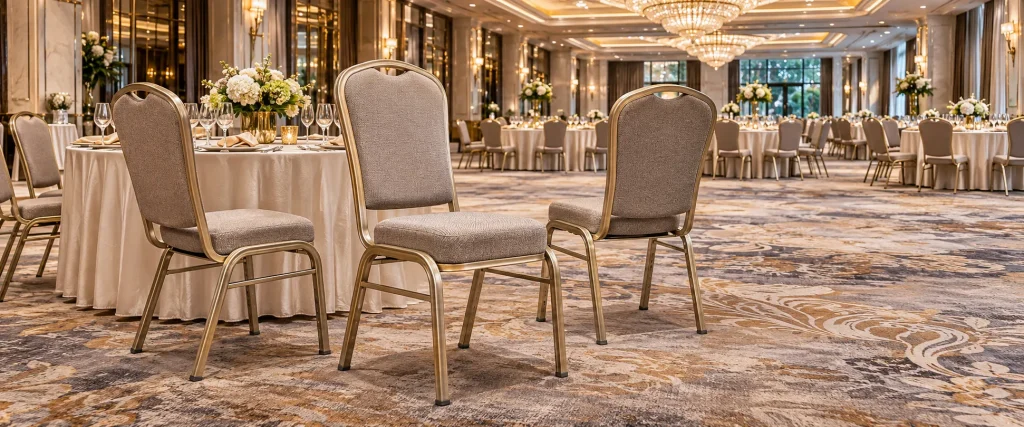
What Does Stackable Mean for Commercial Banquet Chairs?
A stackable banquet chair is designed so multiple chairs can be nested vertically for transportation or storage.
Unlike fixed dining chairs, stackable models are often used in facilities where seating arrangements change frequently.
Typical applications include hotel ballrooms, conference centers, banquet halls, event venues, multipurpose meeting rooms, and mobile catering operations.
However, stackability alone does not guarantee operational efficiency.
Three factors should be evaluated together.
Storage efficiency. The chair’s actual stacked dimensions determine how much storage space is required.
Handling efficiency. Chair weight, integrated handholds, stacking mechanisms, and compatible transport trolleys affect movement between events.
Durability. Frequent stacking, transportation, cleaning, and setup can cause wear to the frame, upholstery, and floor-contact components.
A chair that works well in a permanent dining room may not be the best choice for a hotel that reconfigures its ballroom every day.
1. Compare Banquet Chair Frame Materials
Frame material affects chair weight, appearance, corrosion resistance, handling requirements, and construction methods.
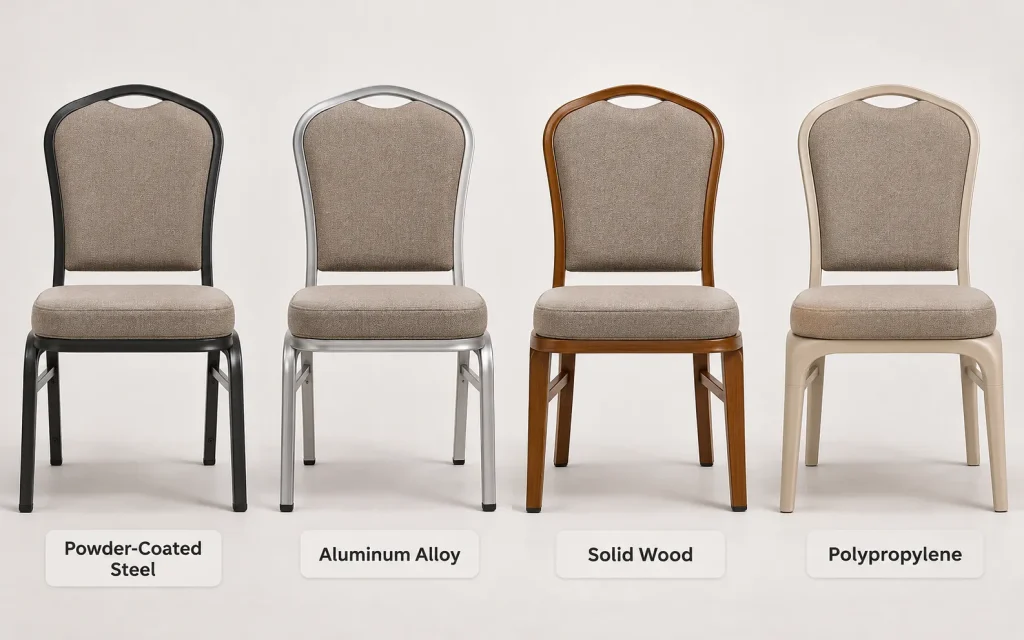
The four common options are steel, aluminum, wood, and polypropylene.
| Frame Material | Advantages | Factors to Verify |
|---|---|---|
| Powder-coated steel | Strong construction options, multiple finishes, widely used for commercial banquet seating | Tube specifications, weld quality, frame weight, coating durability |
| Aluminum | Generally lighter than comparable steel structures, useful for frequent handling | Frame geometry, joint construction, tested load capacity |
| Solid wood | Natural appearance suited to selected hospitality interiors | Joint strength, moisture response, stacking compatibility |
| Polypropylene | Easy-clean surfaces, potentially lightweight, suitable for certain multipurpose environments | UV resistance, structural testing, permitted stacking height |
Steel Frame Banquet Chairs
Steel is commonly used for upholstered banquet chairs because it supports a variety of frame shapes and finishes.
Some commercial models use 16-gauge steel, while others use 18-gauge steel.
Neither figure should be treated as a universal quality standard.
For example, Midwest Folding offers a commercial banquet/conference chair with an 18-gauge steel frame, while other commercial products use thicker steel.
The overall performance depends on more than wall thickness.
Before purchasing, request:
- Steel tube dimensions and wall thickness
- Frame construction details
- Weld and reinforcement information
- Manufacturer-rated seating capacity
- Relevant structural test documentation
- Finish specifications
Aluminum Frame Banquet Chairs
Aluminum frames can reduce handling weight, which may benefit hotels with frequent room changes or catering companies transporting chairs between venues.
However, lighter does not automatically mean stronger or more durable.
Compare the complete chair design, including connections, leg geometry, stacking contact points, and available test results.
Wood and Polypropylene Chairs
Wood can support a warmer, more residential hospitality aesthetic, but the chair must be specifically designed and tested for stacking if it will be used in a frequently reconfigured venue.
Polypropylene chairs can offer simple cleaning and a variety of colors. For outdoor-adjacent applications, confirm the product’s suitability for sunlight, temperature exposure, and the intended operating conditions.
Buying principle: Compare complete tested chair designs rather than selecting a product solely from its frame material.
2. Evaluate Upholstery, Seat Foam, and Comfort
A banquet chair may be used for several hours during a wedding dinner, conference, or corporate event.
Seat comfort matters, particularly when the same chair is expected to support multiple event formats.
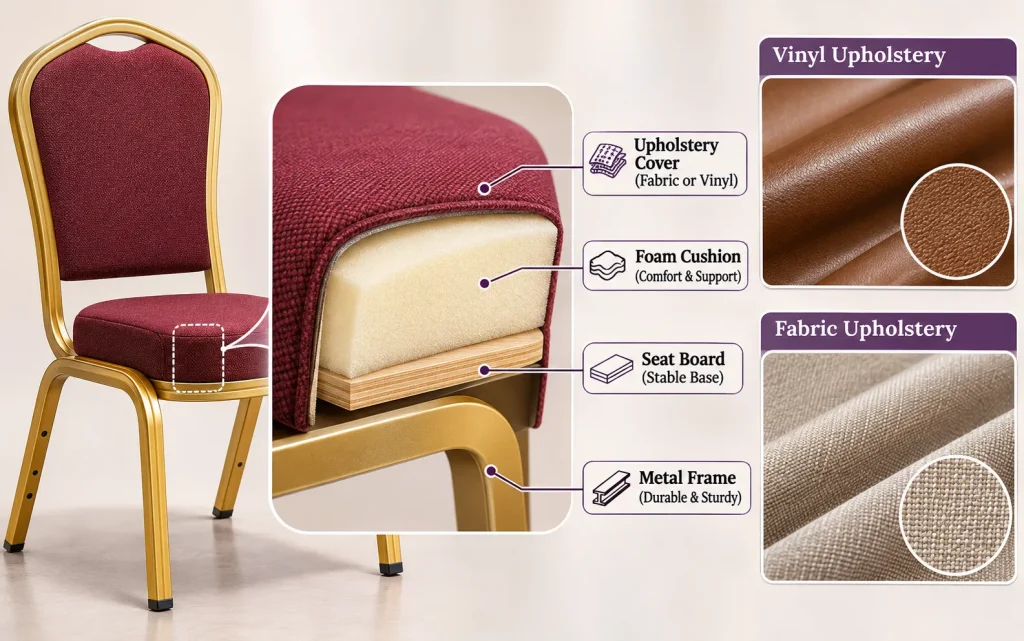
Foam Construction
Foam density is one factor affecting upholstered seating performance, but it should not be used as a standalone durability guarantee.
Foam quality also depends on resilience, compression behavior, formulation, and the construction of the complete cushion.
Instead of requiring one universal foam-density figure, ask suppliers for:
- Foam density and composition
- Cushion thickness
- Compression or durability test information, where available
- Upholstery construction
- Replacement seat options
A thicker cushion is not automatically more durable or more comfortable.
Vinyl Versus Fabric Upholstery
Vinyl upholstery is often selected for commercial venues because many suitable products can be wiped clean efficiently.
It can be useful for high-turnover banquet facilities and dining events where spills are common.
However, cleaning compatibility varies with the material formulation.
Fabric upholstery provides more choices in texture and visual appearance. It may be preferred for premium hotel interiors or venues where the seating design forms part of the overall hospitality experience.
Fabric maintenance depends on the specific textile, stain resistance, and manufacturer’s cleaning instructions.
For both materials, request the upholstery specification and any relevant durability or cleaning test reports.
Chair Shape and Ergonomics
Evaluate seat width, seat depth, backrest geometry, padding, and overall chair dimensions.
A chair that is too wide may reduce the number of seats available at each banquet table.
A compact chair may improve seating density but should still provide suitable comfort for the expected event duration.
Where possible, request a sample chair and evaluate it alongside the actual banquet table.
3. Check Stacking Limits and Handling Requirements
Not all stackable chairs have the same stacking capacity.The permitted quantity depends on frame design, nesting geometry, stability, chair weight, and manufacturer testing.
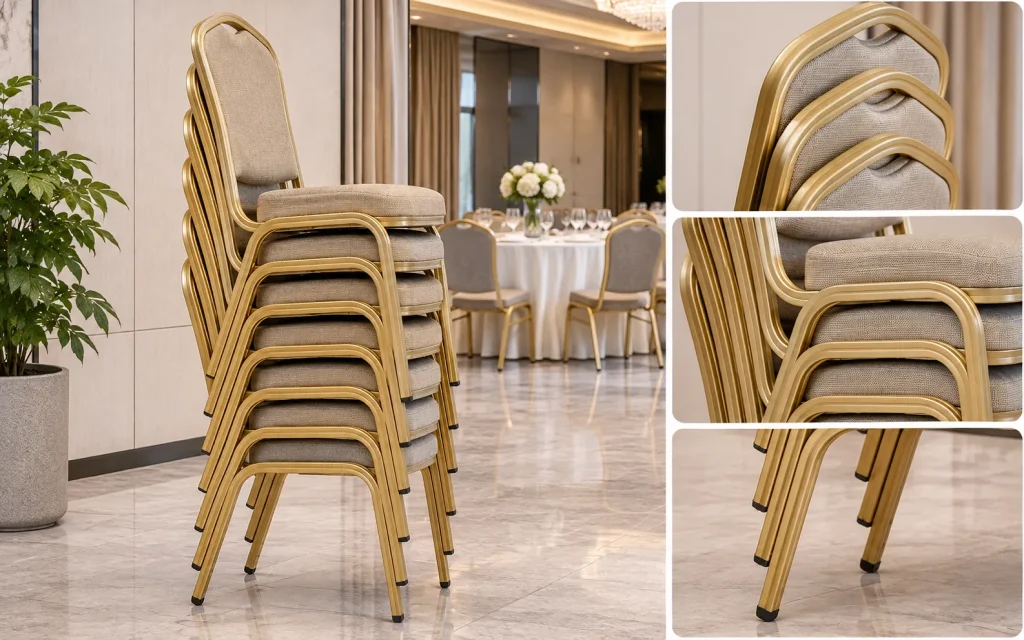
For example, Merryfair’s Fila chair is specified to stack up to ten high, while Uline also offers a banquet chair with a ten-chair stacking limit.These are product-specific examples, not an industry-wide maximum.
Request Two Essential Measurements
Ask the manufacturer to confirm:
Maximum approved stack count: The number of chairs that can be stacked under the manufacturer’s intended conditions.
Total stacked height: The actual height of a complete stack, including any necessary transport equipment.
Also request the maximum width and depth of the stack.
Two models that stack the same number of chairs may have different overall dimensions.
Protecting Chairs During Stacking
Check whether the chair includes:
- Dedicated stacking contact points
- Protective bumpers
- Suitable floor glides
- Integrated handholds
- Frame designs that limit upholstery contact
The objective is to reduce damage from repeated handling.
Do not assume that one model’s stacking limit applies when using a different trolley or storage method.
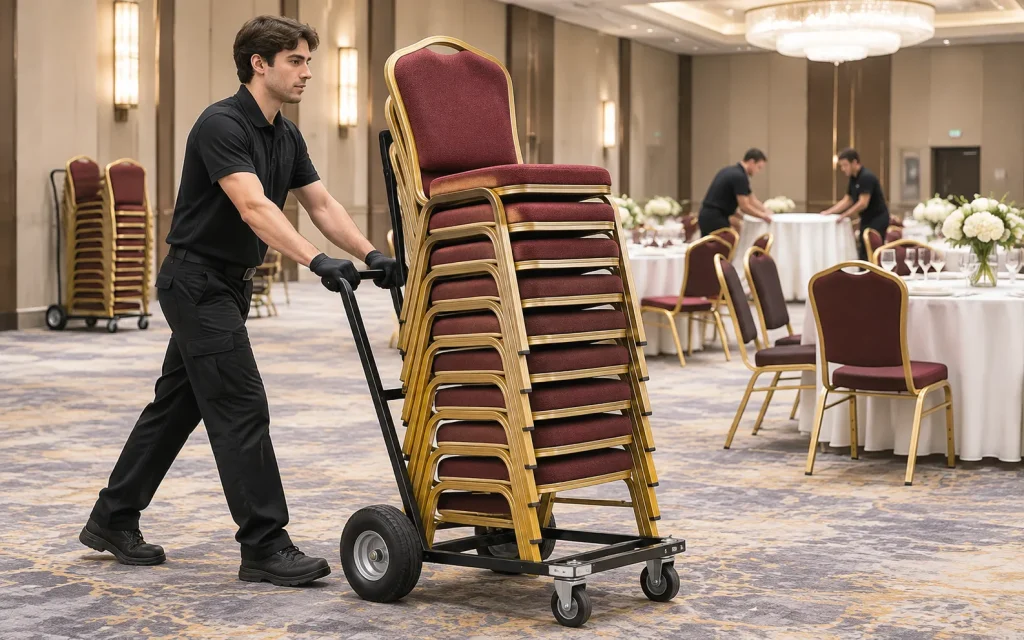
Select a Compatible Chair Trolley
A chair trolley should be selected according to the actual chair model.
For example, Shelby Williams offers a stack-chair carrier designed for transporting ten chairs, while Midwest Folding specifies that trolley capacity may vary with chair design.
Before ordering, verify the trolley’s dimensions, loaded height, rated capacity, and compatibility with the intended chair.
Doorway clearance, elevator dimensions, ramps, and storage-room access should also be checked.
4. Calculate Storage Space for Stackable Banquet Chairs
Storage capacity is a critical purchasing consideration for hotels and event venues.
The total number of chairs alone is not enough to determine the storage requirement.
You also need the approved stack count, stack footprint, transport equipment dimensions, and access space.
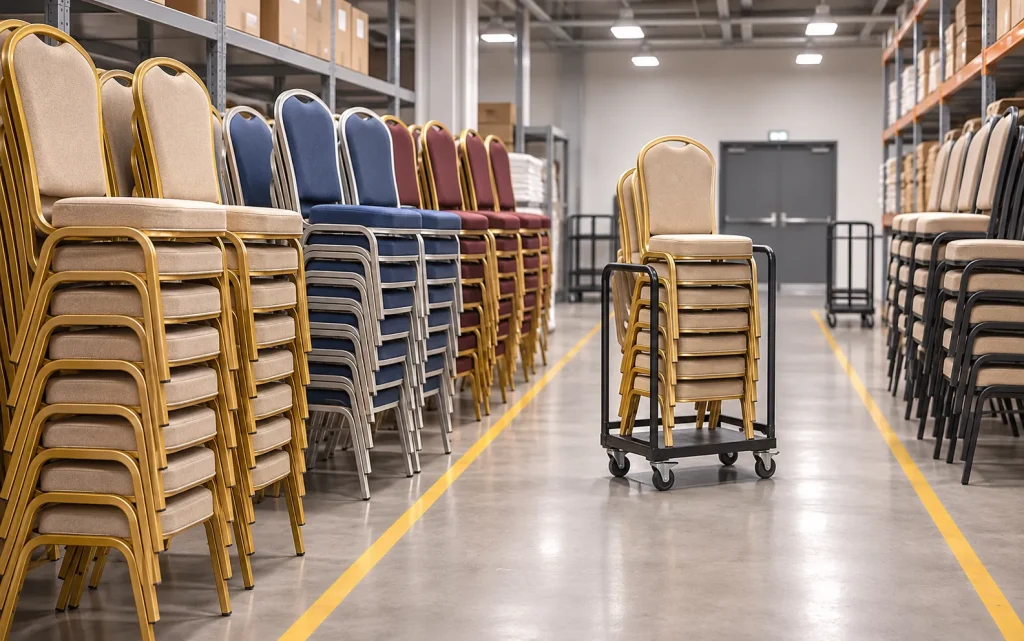
Example: Storing 300 Banquet Chairs
Assume a hypothetical chair model has the following manufacturer-confirmed specifications:
- Approved stacking capacity: 10 chairs
- Footprint per stack: 0.35 m²
- Total inventory: 300 chairs
The number of stacks is:
300 ÷ 10 = 30 stacks
The minimum combined footprint of those stacks is:
30 × 0.35 = 10.5 m²
This represents only the stacked-chair footprints.
It does not include working aisles, trolley maneuvering space, separation between stacks, access to doors, or other storage requirements.
The actual storeroom will need additional space.
Why Actual Chair Dimensions Matter
A manufacturer may offer several banquet chair models with different nesting structures.
Even when those models have similar individual dimensions, their stacked footprints and heights can differ.
Shelby Williams publishes a banquet-chair storage comparison illustrating how different stacking densities affect storage space.
This demonstrates why storage requirements should be calculated from the actual selected product rather than one universal area-per-stack figure.
Reference: Shelby Williams — Banquet Chair Storage.
Practical Storage Recommendations
Plan storage around the complete movement process.
Confirm where stacks will be positioned, how staff will reach them, and whether suitable trolleys can move through the available doors and corridors.
Do not place one freestanding stack of chairs on top of another unless the manufacturer provides a specifically designed and approved storage system.
The safest solution is generally to follow the manufacturer’s stacking and handling instructions.
5. Match Banquet Chair Height to Table Height
A stackable chair should be selected as part of a complete table-and-chair system.
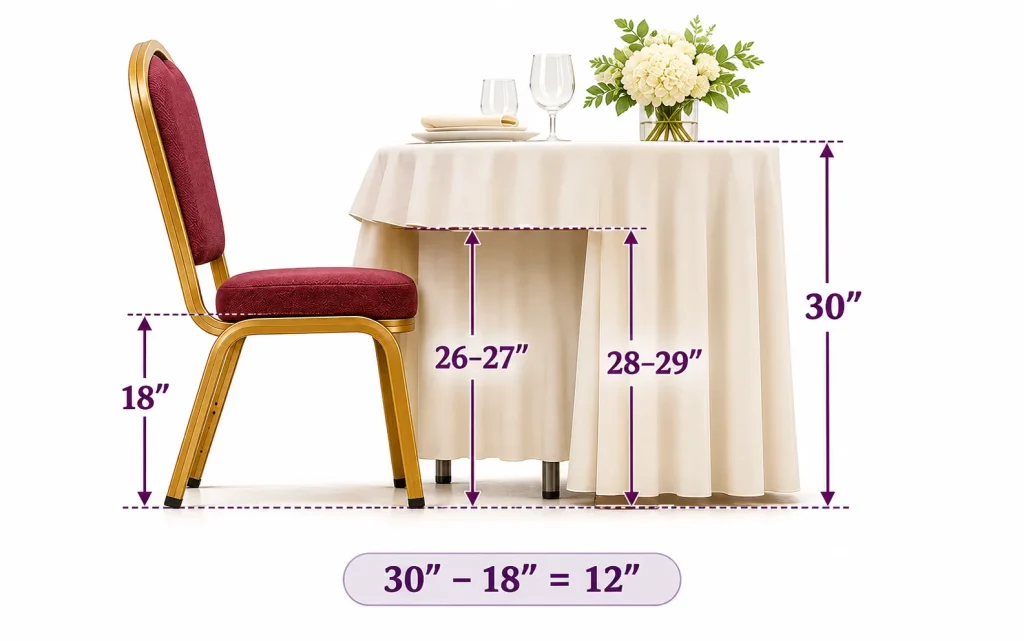
Many commercial banquet tables are approximately 29–30 inches high.
Banquet chair seat heights commonly fall around 18–19 inches, although individual products vary.
For example, a 29-inch-high table and an 18-inch-high chair seat create an 11-inch difference between the tabletop surface and seat.
This is a useful starting point for seating comfort, but it does not establish the available knee clearance beneath the table.
Check the Table Apron
Some banquet tables have frames or aprons beneath the tabletop.
These components reduce the space available for a seated guest’s thighs and knees.
Check:
- Tabletop height
- Lowest apron or underframe height
- Chair seat height
- Compressed seat-cushion height
- Chair width and depth
- Armrest height, where applicable
For detailed banquet table dimensions and types, see What Is a Banquet Table?.
To understand how furniture selection affects seating layouts, read our Banquet Style Seating Guide.
6. Verify Fire Performance and Applicable Standards
Fire-performance requirements should be evaluated according to the destination market, venue type, product construction, and applicable regulations.
A generic statement such as “fire-retardant upholstery” is not sufficient evidence of compliance.
United States: TB 117-2013
For upholstered furniture within the scope of U.S. federal regulation 16 CFR Part 1640, compliance is based on California Technical Bulletin 117-2013.
TB 117-2013 addresses resistance to smoldering ignition and evaluates relevant upholstery components and material combinations.
It should not be described as a general open-flame certification or proof that a chair is fireproof.
The applicability of this requirement, as well as any additional project requirements, should be checked for the specific product.
Reference: U.S. Consumer Product Safety Commission — Upholstered Furniture Guidance.
United Kingdom: BS 5852 and BS 7176
BS 5852 covers methods for assessing the ignitability of upholstered seating materials and composites.
BS 7176 addresses resistance to ignition for upholstered furniture used in non-domestic environments.
The appropriate specification depends on the intended application and required hazard classification.
The UK government’s fire-safety guidance for assembly premises identifies both standards as relevant references.
Reference: UK Government — Fire Safety Risk Assessment for Places of Assembly.
Documents to Request from the Supplier
Before procurement, ask for test documentation identifying the relevant standard, tested product or material configuration, test date, and issuing laboratory.
Verify that the supplied chair’s upholstery and foam construction correspond to the documentation.
For further discussion of commercial seating requirements, see our Fire-Rated Booths and Chairs Compliance Guide.
7. Plan Cleaning and Maintenance
Frequent room changes expose banquet chairs to repeated handling, spills, contact with cleaning products, and abrasion.
For upholstered chairs, request the manufacturer’s recommended cleaning procedures.
Different vinyl and fabric products may require different cleaning agents or methods.
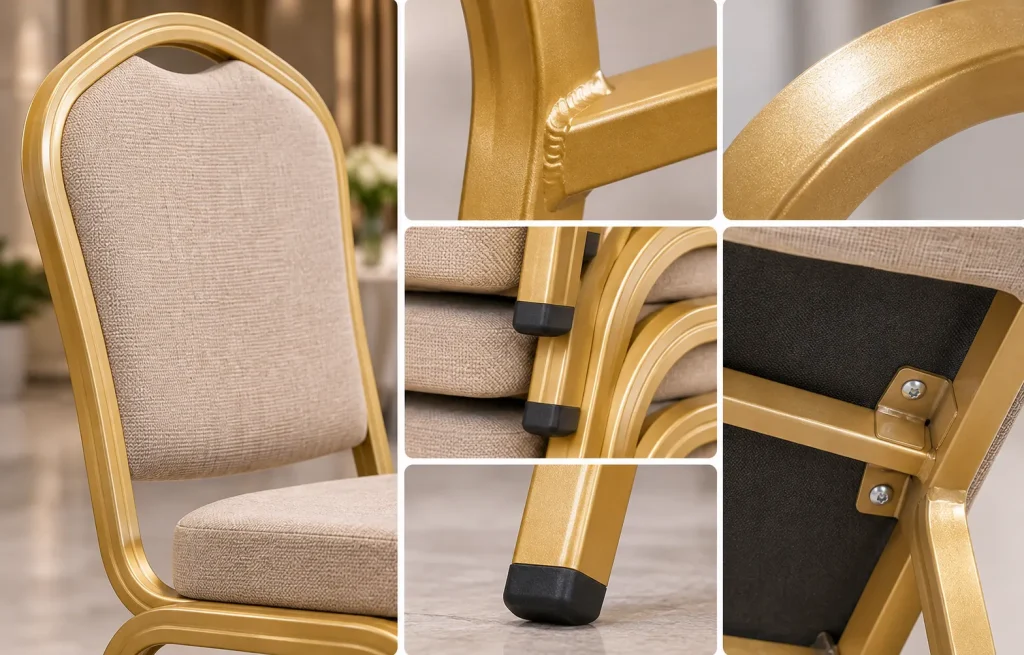
Routine Maintenance Checklist
Regularly inspect:
- Frame joints and welds
- Loose or damaged components
- Upholstery tears and stains
- Stacking bumpers
- Floor glides
- Transport-related frame damage
Replace worn protective components where compatible replacement parts are available.
A chair that can be maintained using replaceable glides and seat components may be more practical for long-term venue operation than a product requiring complete replacement after minor damage.
8. Bulk Banquet Chair Procurement Checklist
When purchasing hundreds of banquet chairs, specification consistency becomes as important as the appearance of a showroom sample.
Use the following checklist when requesting quotations from commercial furniture suppliers.
| Procurement Item | Information to Request |
|---|---|
| Frame construction | Material, tube dimensions, wall thickness, joint details |
| Seat and back | Dimensions, foam specifications, upholstery material |
| Structural performance | Rated capacity and available test reports |
| Stacking | Approved stack count, dimensions, handling restrictions |
| Transport equipment | Compatible trolley specifications |
| Fire performance | Applicable standards and product-specific test documents |
| Packaging | Carton dimensions, packing method, protection details |
| Logistics | Order quantity, estimated production schedule, shipping terms |
| After-sales support | Warranty coverage and availability of replacement parts |
Request a Production Sample
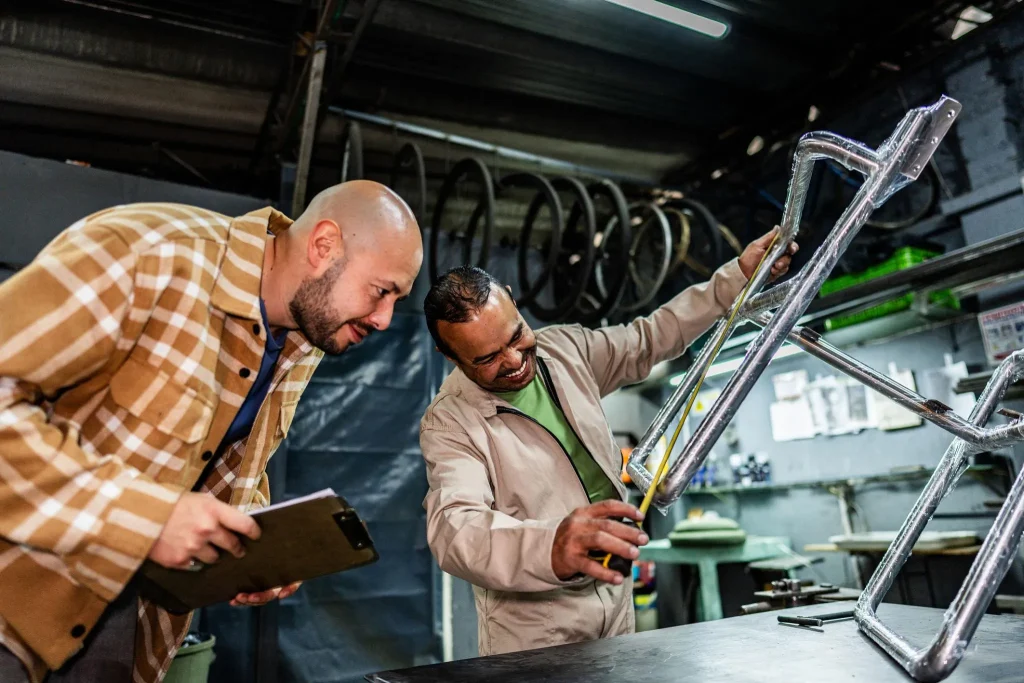
For significant orders, consider evaluating a sample before bulk production.
Check whether the chair matches the approved dimensions, materials, appearance, and finish.
If stacking and frequent transportation are important, test the sample with the intended trolley and handling procedure.
Compare Total Procurement Cost
Unit price is only one component of the purchasing decision.
Also consider freight, packaging, import duties, handling equipment, storage requirements, and expected maintenance.
Our guide to Factory-Direct vs. Wholesale Restaurant Furniture explains the broader sourcing considerations.
9. Why Banquet Chair Selection Should Begin with Venue Operations
The most suitable banquet chair is not necessarily the lightest, the most heavily padded, or the model with the highest advertised stacking count.
The right choice depends on how the venue operates.A hotel ballroom that changes configuration every day may prioritize easy handling, consistent stacking, and replacement parts.A premium event venue with less frequent reconfiguration may place greater emphasis on upholstery, appearance, and extended seating comfort.
A mobile catering operation may need to prioritize weight, transport equipment, packaging, and repeated loading.For each application, the purchasing team should compare the actual chair specifications against the event schedule, table dimensions, available storage, and maintenance requirements.
Frequently Asked Questions
How Many Stackable Banquet Chairs Can Be Stacked Safely?
There is no universal safe stacking count.Some commercial models are rated for ten-chair stacks, while others have different manufacturer limits.Always confirm the approved stack count and handling instructions for the exact chair model.
Are Steel or Aluminum Banquet Chairs Better?
Steel and aluminum can both be suitable for commercial banquet seating.Steel provides a range of strong frame construction options, while aluminum can reduce handling weight.The best choice depends on actual structural test results, chair weight, operating conditions, and the frequency of room changes.
What Is the Best Upholstery for Banquet Chairs?
Vinyl may be practical for frequent cleaning and high-turnover dining events.Fabric offers different texture and design options.Evaluate the selected upholstery’s durability, cleaning requirements, comfort, and applicable fire-performance documentation rather than relying on material type alone.
How Much Storage Space Do 300 Banquet Chairs Need?
The required space depends on the approved stacking capacity and stack footprint.For example, 300 chairs stacked ten high create 30 stacks. At a hypothetical footprint of 0.35 m² per stack, the chairs occupy 10.5 m² before adding access and handling space.
Actual storage requirements must be calculated from manufacturer dimensions.
What Fire Standards Should Banquet Chairs Meet?
Requirements depend on the destination market and the specific product.In the United States, 16 CFR Part 1640 and TB 117-2013 may apply to upholstered furniture within their scope.For UK non-domestic seating, BS 5852 and BS 7176 are relevant standards.Confirm the applicable requirements for your venue and obtain matching documentation before purchasing.
What Should Buyers Check Before Ordering Banquet Chairs in Bulk?
Verify frame construction, seating dimensions, upholstery, stacking limits, available test reports, packaging, trolley compatibility, production schedule, warranty terms, and replacement-part availability.
These details help buyers compare products beyond unit price.
Choose Banquet Chairs for Long-Term Commercial Use
Stackable banquet chairs are part of a venue’s operational furniture system.
Their value depends on more than appearance. Storage efficiency, handling requirements, comfort, maintenance, and documented product performance all affect the long-term purchasing decision.
MingMeng Furniture provides commercial furniture solutions for hotels, banquet halls, restaurants, and hospitality projects worldwide.
For venue furniture planning, explore our Restaurant and Café Chairs, Hotel Meeting-Room Furniture, and Project Solutions.
For a project-specific furniture discussion, share your intended chair quantity, venue application, upholstery preferences, and stacking or storage requirements with our team.
Technical References
- Midwest Folding — Commercial Steel Stack Chairs
- Uline — Stackable Banquet Chair Specifications
- Merryfair — Fila Stacking Chair
- Shelby Williams — Banquet Chair Storage Guide
- U.S. Consumer Product Safety Commission — Upholstered Furniture Guidance
- UK Government — Fire Safety for Places of Assembly
Last updated: November 4, 2026.
Technical note: Stacking limits, structural capacities, foam specifications, and storage footprints vary by product model. Published manufacturer specifications are examples, not universal industry requirements. Verify the applicable test reports, manufacturer instructions, and local regulations before procurement.