English
 中文
 日本語
 한국어
 العربية
 Русский
 Português
 Türkçe
 हिन्दी
 Tiếng Việt
 ไทย
 Indonesia
 Melayu
 ខ្មែរ
 ລາວ
 မြန်မာ
 Afrikaans
 Hausa
 Igbo
 Sesotho
 isiXhosa
 Yorùbá
 isiZulu
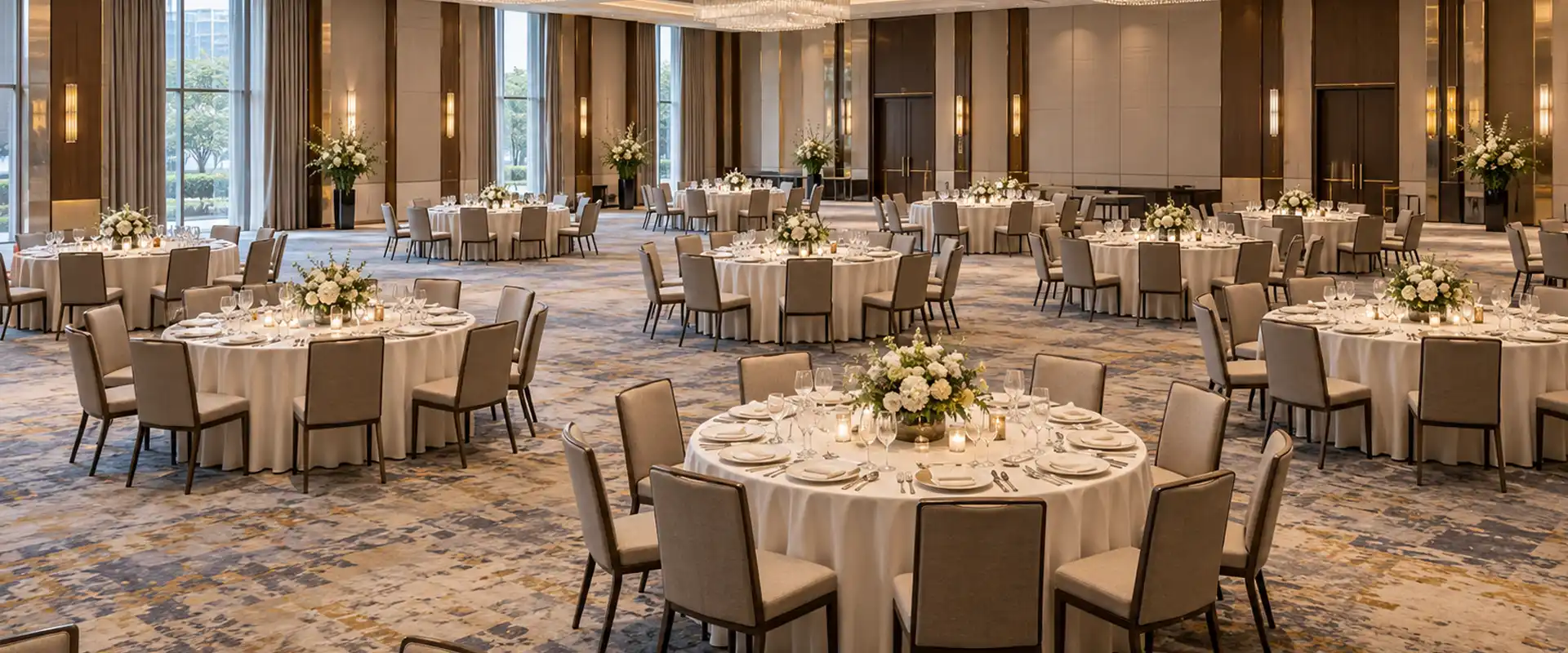
What is a banquet table? A banquet table is a commercial-grade table built for repeated event seating — set up, dressed, used, cleared, folded or moved, and stored, then repeated dozens or hundreds of times a year. Most are folding or trestle tables engineered for group seating at weddings, galas, conferences, hotel ballrooms, and catered events. The decision that matters most is not “which table looks best,” but “which shape and build matches the events you actually run, and how it survives the duty cycle.”
This guide defines what a banquet table is, distinguishes it from a regular dining table, walks through the common types and their uses, and gives a staged framework for specifying tables that hold up in commercial service.
For the broader commercial table range — fixed-height dining and café tables — see our restaurant tables.
The Short Answer
- A banquet table is event-seating furniture, built to be handled constantly. Most are folding, some are fixed-leg or trestle builds.
- Common types: round, rectangular, square, serpentine / half-round / quarter-round, and cocktail (highboy).
- Standard sizes: a 60 in round seats 8–10, a 72 in round seats 10–12, a 6 ft rectangular seats 6–8, an 8 ft rectangular seats 8–10.
- How to choose: match the shape mix to your events, size for seating and floor space, judge the top, frame, and edge separately, rate the fold hardware and load, then plan storage and transport.
What Is a Banquet Table?
A banquet table is a table designed for repeated event seating rather than permanent placement. The defining trait is the duty cycle: a banquet table is picked up, carried, unfolded or wheeled out, dressed with linen, loaded with place settings and centerpieces, used by guests, cleared, folded or stacked, and returned to storage — often within the same day, and many times per week in busy venues.
That cycle is what separates a banquet table from furniture built for a static dining room. A banquet table is usually one of two forms:
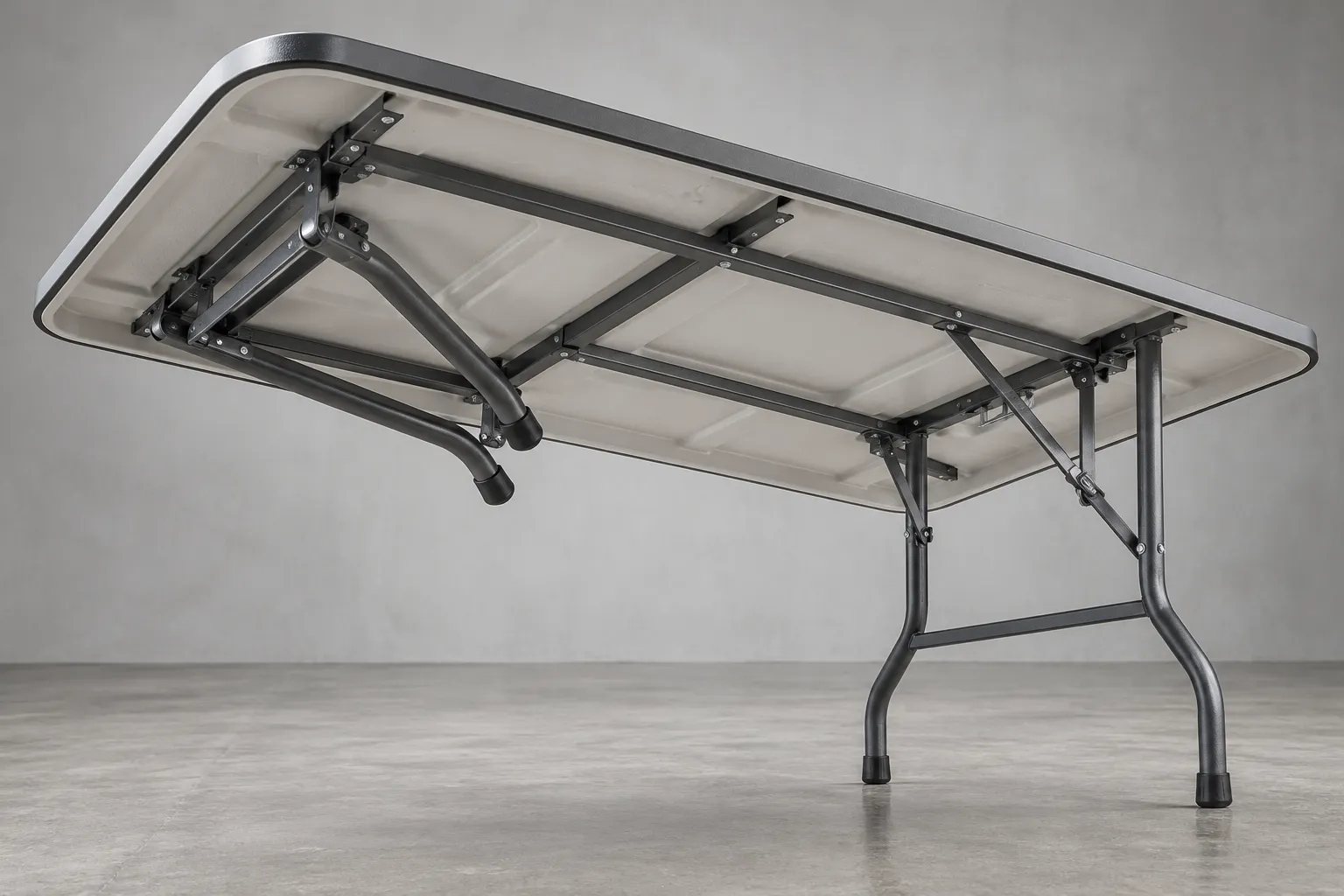
- Folding banquet table — legs fold flat against or under the top. The table stores vertically or stacks flat, and one or two staff can set it up quickly. This is the dominant form in hotels, banquet halls, and catering operations.
- Trestle / fixed-leg banquet table — a more permanent build, often with a separate base or A-frame legs. Used where the table stays dressed or where a heavier, more formal look is wanted, typically in hotel ballrooms and upscale venues.
Both are “banquet” because both are specified for event seating and commercial use — not because of a single shape.
Banquet Table vs Regular Table
The question “banquet table vs regular table” is worth answering directly, because the two are easy to confuse from a photo and very different in service.
| Factor | Regular (dining) table | Banquet table |
|---|---|---|
| Duty cycle | Static, set once and left | Set, moved, folded, stored, repeated daily or weekly |
| Build priority | Finish and style | Frame strength, fold hardware, weight |
| Load expectation | Light, static place settings | Heavy centerpieces, buffet loads, AV, repeated impact |
| Storage | Not designed to store | Folds or stacks; storage footprint is part of the spec |
| Linen | Optional | Usually dressed; top must sit flat under cloth |
| Typical buyer | Home, restaurant dining room | Hotels, banquet halls, caterers, venues |
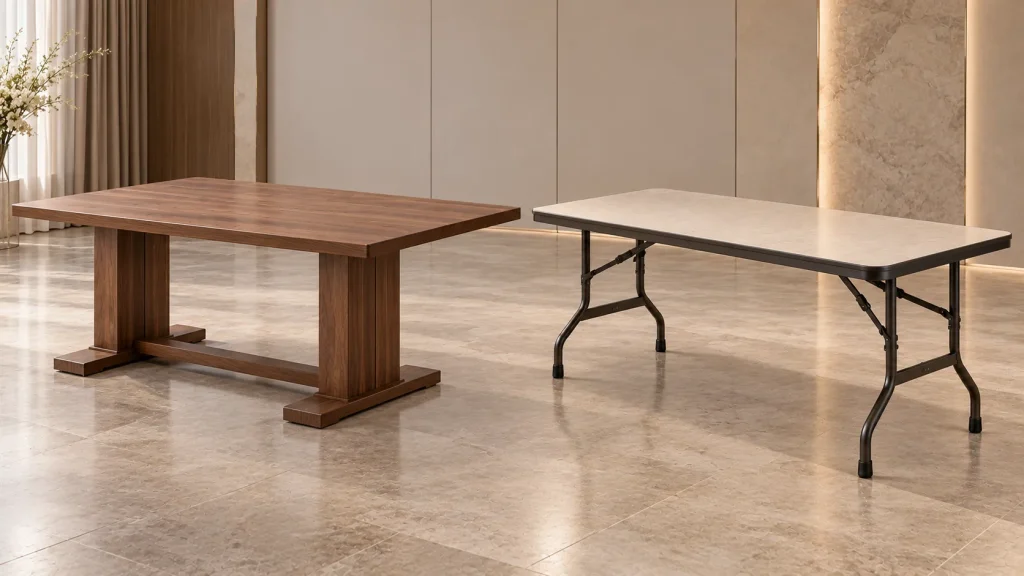
A regular dining table is built to sit in one room and look good doing it. A banquet table is built to be handled constantly and still seat guests correctly on the hundredth setup. That difference shows up in the frame gauge, the hinge and lock quality, the edge banding, and the top substrate — the parts that fail after cheap tables win a tender and then crack under a real event calendar.
Banquet Table Types
The banquet table types a venue is quoted usually come from a short, standard list. Knowing the list makes supplier quotations comparable, because you can force every vendor onto the same grid instead of comparing a round top against a rectangular frame.
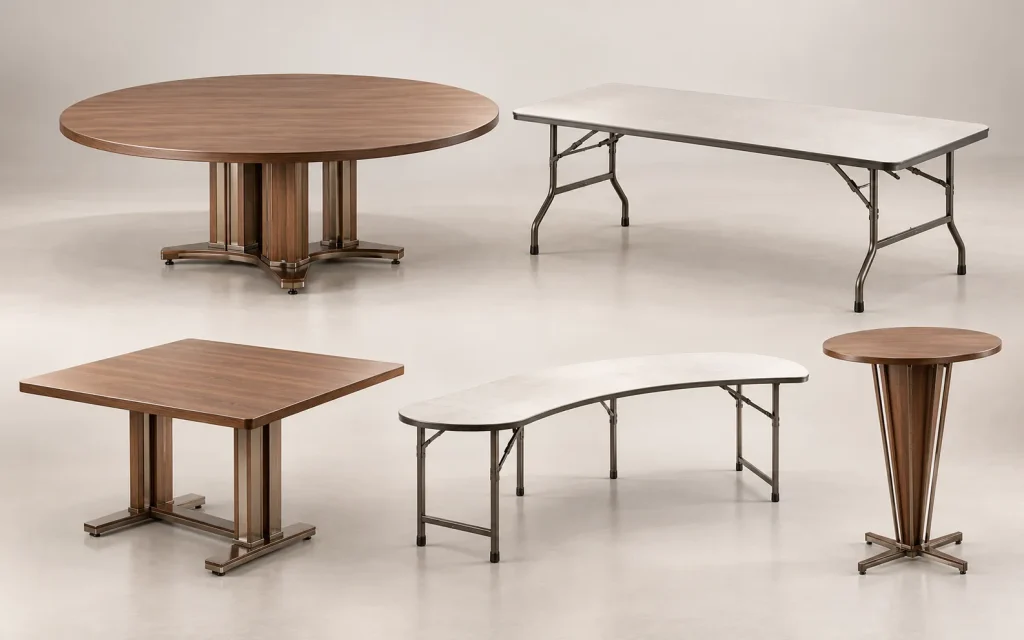
- Round banquet tables. The wedding, gala, and social-event standard. Guests face each other, which suits plated dinners and receptions. Diameters run from about 100 cm to 200 cm (roughly 40 to 79 inches). The 152 cm / 60 in round and the 183 cm / 72 in round are the two sizes that define most ballroom grids.
- Rectangular banquet tables. The flexible workhorse. They line up end to end for long banquet rows, push together for conference and classroom layouts, and handle buffets, registration, and back-of-house prep. The most common lengths are 183 cm / 6 ft and 244 cm / 8 ft.
- Square banquet tables. A modern alternative that arranges into clean grids or mixes with rounds. Less common than the other two, but useful where a venue wants a contemporary layout.
- Serpentine, half-round, and quarter-round. Shaping pieces. Half-rounds close the end of a rectangular run; quarter-rounds turn a corner; serpentine sections curve a buffet line so it reads as designed rather than improvised. Venues rarely need many, but the few they own get used constantly.
- Cocktail / highboy tables. Tall, narrow, usually with a separate base rather than folding legs. Built for standing receptions, not seating. Venues treat them as banquet furniture even though they never seat anyone.
- Folding vs fixed. Within any shape, the choice is folding (stores flat, fast turnover) or fixed-leg (heavier, more formal, stays dressed). Most high-turnover venues run folding; ballrooms that keep a permanent layout may run fixed.
What Is a Banquet Table Used For?
The use case decides the shape mix.
- Weddings and gala dinners. Round tables dominate — typically 152 cm / 60 in (8–10 seats) or 183 cm / 72 in (10–12 seats) — for conversation and a sense of occasion. Head tables and sweetheart tables are often rectangular or custom.
- Conferences, seminars, and training. Rectangular tables in classroom, U-shape, boardroom, or cabaret layouts. Flexibility and fast reconfiguration matter more than round-table intimacy.
- Hotel ballrooms and banquet halls. The mixed-use case: the same room runs a Saturday wedding in rounds, then a Monday conference in rectangles. The tables must look presentable under linen and survive being folded, wheeled, and stacked by staff in a hurry.
- Catering and buffets. Narrow rectangular or serpentine tables along walls or as serving stations. Display, dessert, and beverage stations are all banquet tables doing a non-seating job.
- Private dining and event spaces in restaurants. Smaller banquet setups for buyouts, rehearsal dinners, and corporate lunches.
- Outdoor and tented events. Weather-resistant tops and frames; portability matters because the setup moves between sites.
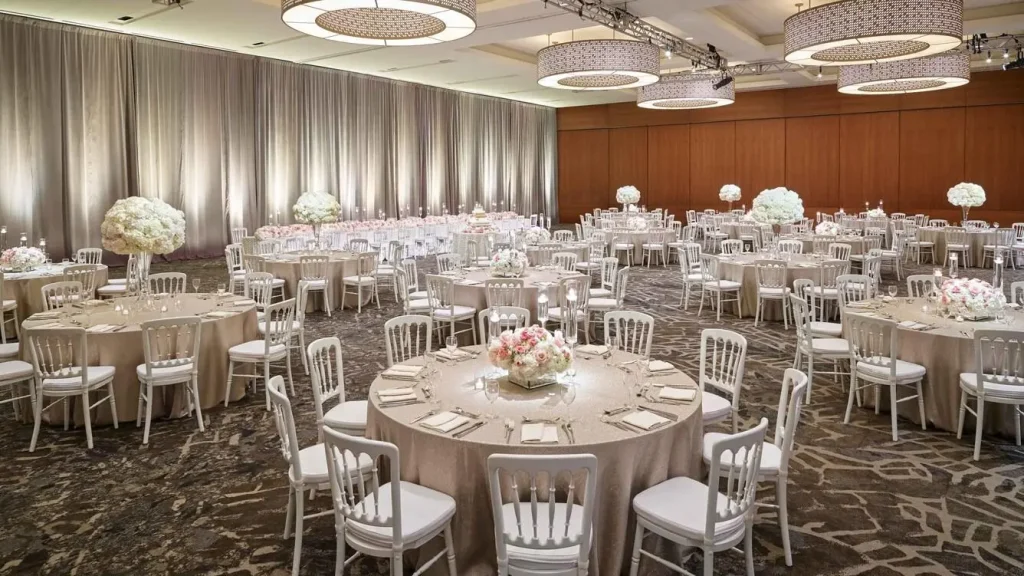
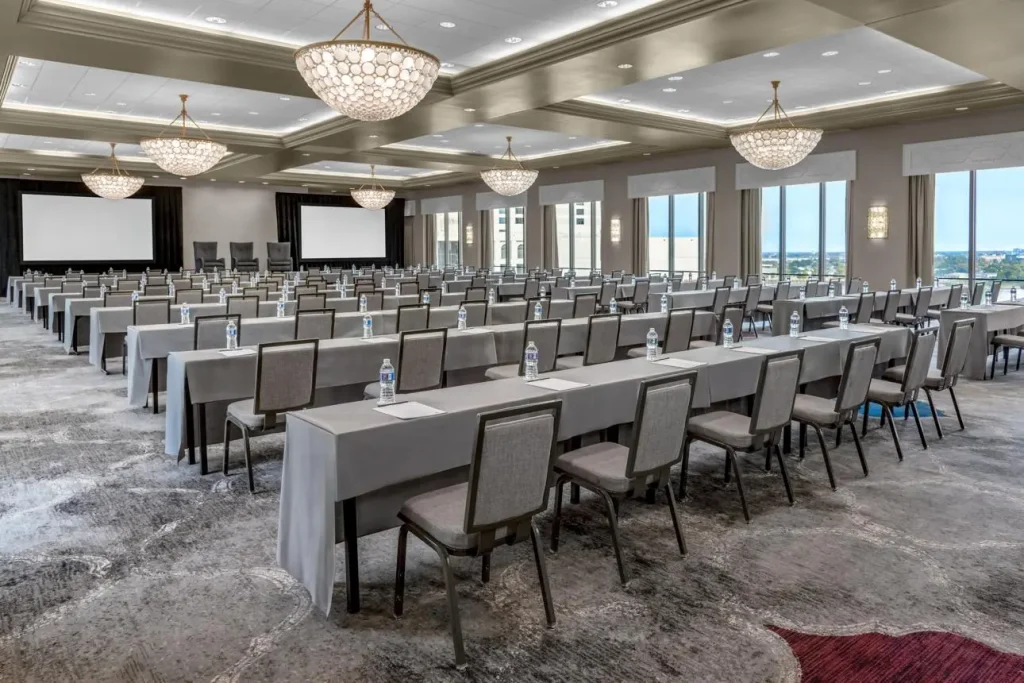
A venue that hosts mostly weddings leans heavier on rounds; a conference-heavy venue leans heavier on rectangles. Many venues skew their inventory toward whichever format they book most.
How to Choose a Banquet Table: A Staged Decision
Treat banquet table selection as a sequence, not a single purchase. Each stage constrains the next.
Stage 1 — Match shape to your event mix. Before looking at catalogs, decide the dominant event types. Wedding- and gala-heavy venues lead with rounds; conference- and training-heavy venues lead with rectangles; mixed venues buy both and weight the ratio to their booking profile. This single decision drives every size and quantity that follows.
Stage 2 — Size to seating and floor space, not just guest count. Capacity math is only half the picture. Plan roughly 10–12 sq ft / 0.9–1.1 m² per seated guest for banquet seating alone, and add dance floor, stage, buffet, and bar areas on top. A room that “fits 100 seats” on paper may seat far fewer once service aisles and those extra zones are accounted for. Plan the layout on a to-scale drawing before ordering.
Stage 3 — Specify the three components separately. A banquet table is not one product; it is a top, a frame, and an edge that fail at different speeds. Judge each:
- Top substrate. High-pressure laminate or molded polyethylene / composite tops resist scratches, spills, and impacts and suit high-turnover use. Solid timber or stone reads more premium but weighs more and demands gentler handling.
- Frame gauge. Heavy-gauge steel or aluminum frames with quality welds and fasteners avoid the wobble and costly repairs that appear after a few busy seasons.
- Edge banding. Banded or molded edges resist chipping where trolleys knock the table. An unprotected edge is the first thing to fail in real service.
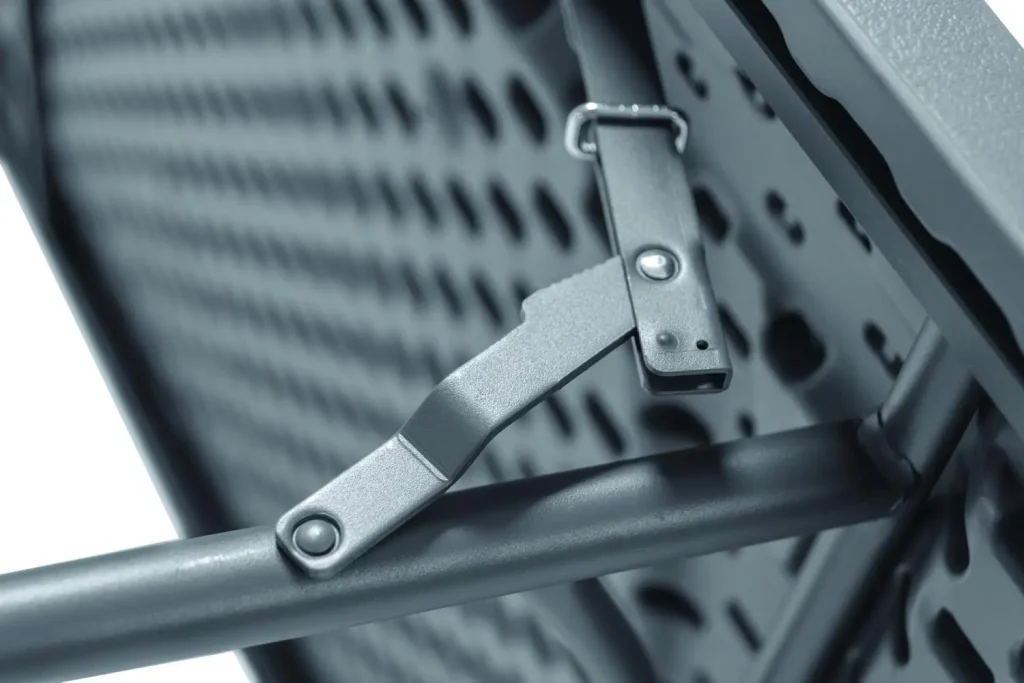
Stage 4 — Rate the folding hardware. The hinge and lock are the failure point on cheap tables. Spec commercial-grade hardware built for repeated fold cycles, and confirm the legs lock positively rather than relying on friction. A table that folds and locks in seconds, handled by one staff member, saves real labor across a busy event calendar.
Stage 5 — Confirm the load rating. Manufacturer spec sheets for commercial folding banquet tables commonly list about 440–485 lb / 200–220 kg static load for 48 in round and half-round tops; larger tops and different test methods vary. Confirm whether a rating is static or evenly distributed, and match it to your heaviest realistic use — heavy centerpieces, buffet loads, or AV equipment — not the lightest.
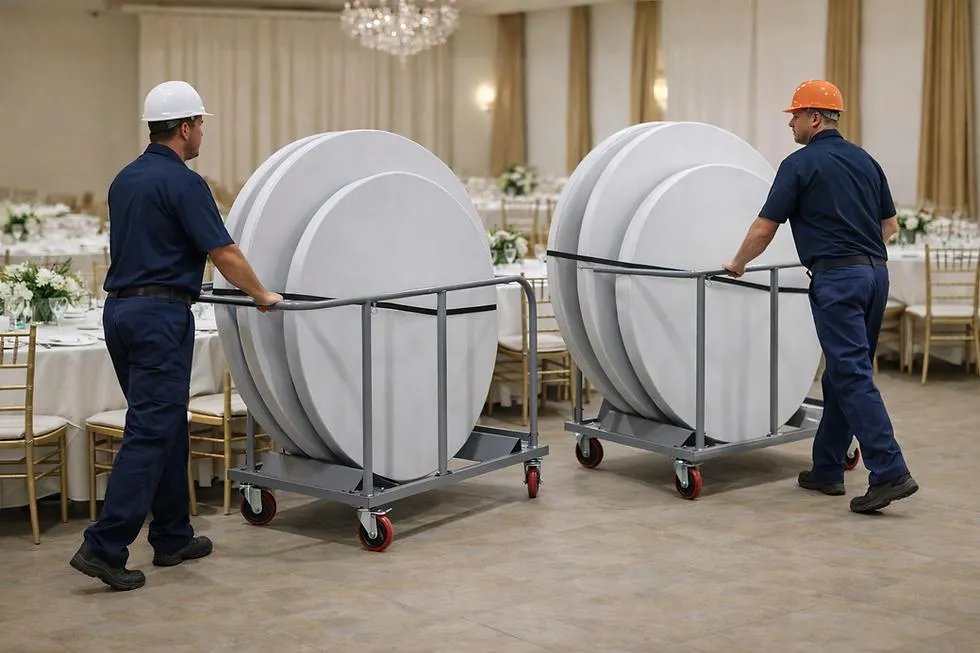
Stage 6 — Plan storage and transport. Tables live or die by how they move and store. Rounds store on edge in caddies or dollies; rectangulars stack flat on flat trucks. Buying the matching transport equipment up front protects both the tables and your staff. Calculate storage footprint before you buy, and match order quantity to storage capacity as carefully as to seating capacity.
Stage 7 — Check venue conditions. Floor finish (carpet, decking, concrete) changes effective clearance and glide wear. Linen programs affect whether an undraped top must look finished. Humid or outdoor environments demand moisture-resistant substrates and rust-resistant frames.
Standard Banquet Table Sizes and Seating
These are the industry-standard sizes most venues are quoted. They are planning references, not a single manufacturer’s catalog — confirm exact dimensions with your supplier.
| Type | Common size | Seats | Best use |
|---|---|---|---|
| Round | 122 cm / 48 in diameter | 6 | Intimate dinners, small receptions |
| Round | 152 cm / 60 in diameter | 8–10 | Weddings, galas (most common) |
| Round | 183 cm / 72 in diameter | 10–12 | Large banquet halls |
| Rectangular | 183 × 76 cm / 6 ft × 30 in | 6–8 | Conferences, buffets, classrooms |
| Rectangular | 244 × 76 cm / 8 ft × 30 in | 8–10 | Seminars, long banquet rows |
| Cocktail / highboy | 76–91 cm / 30–36 in diameter | Standing or 2–3 | Receptions, lobbies |
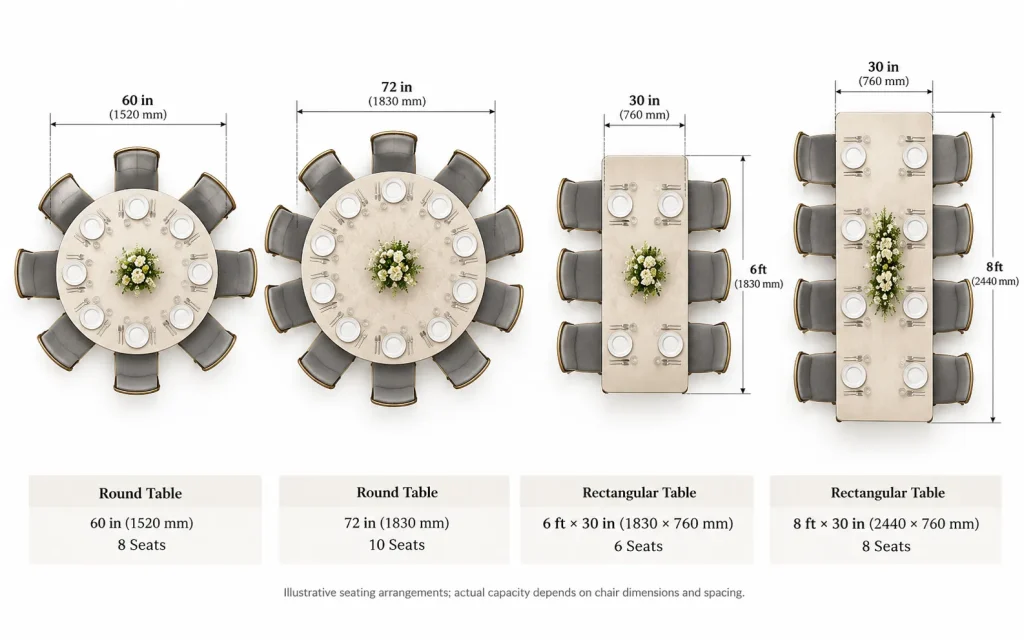
Standard banquet table height is 71–76 cm / 28–30 in, matching standard chair height. Cocktail tables are the exception at roughly 102–110 cm / 40–43 in.
Seat counts depend on chair width and spacing, and vendors quote different numbers for the same table — for example 4–6 at a 48 in round, or 6–8 versus 8–10 at a 60 in round. Treat the higher figure as a maximum for narrow chairs and tight spacing, not as a comfortable layout.
Banquet Table Spacing and Egress
Banquet layouts are governed by fire and building codes, not just comfort. Some authorities set minimum distances between tables. For example, California’s State Fire Marshal rules (Title 19, §3.06) require rectangular conference or banquet-type tables to be at least 54 in / 1,372 mm apart and at least 36 in / 914 mm from walls, and building codes measure required aisle width from a line 19 in / 483 mm beyond the table edge. Confirm the requirement with your local fire marshal before the layout is final.
Accessibility also applies where banquet seating counts as dining seating. ADA rules call for accessible seating that is dispersed across the room, with 28–34 in surface height and 27 in knee clearance. Check that your leg or base design leaves knee room at the accessible positions, and confirm the requirement with your local code official.
For wider layout planning, see our Restaurant Seating Layout Guide.
Common Banquet Table Mistakes
- Buying on price per unit. Cheap tables win tenders and then fail at the edge, the hinge, or the foot cap within a season. Spec the components, not the headline price.
- Ignoring the storage footprint. Tables that don’t nest or stack efficiently eat back-of-house space and slow turnaround. Storage planning should precede the order.
- Mismatching shape to event mix. A conference-heavy venue over-buying rounds, or a wedding venue short on rounds, both leave money on the table.
- Forgetting the carts. Transport equipment is not optional for high turnover; it protects tables and staff during rapid resets.
- Treating “banquet” as one product. A round, a rectangle, a serpentine, and a cocktail table solve different problems. Buy the mix, not a single SKU.
FAQ
What is a banquet table?
A banquet table is a commercial-grade table built for repeated event seating — set up, dressed, used, cleared, folded or moved, and stored, often daily. Most are folding or trestle tables used at weddings, galas, conferences, hotel ballrooms, and catered events.
What is the difference between a banquet table and a regular table?
A regular dining table is built to sit in one room and look good. A banquet table is built to be handled constantly — folded, wheeled, stacked, and reset — and still seat guests correctly on the hundredth setup. The difference shows in frame gauge, fold hardware, edge banding, and top substrate, not in appearance.
What are the main types of banquet tables?
Round (weddings, galas), rectangular (conferences, buffets, classrooms), square (modern grids), serpentine / half-round / quarter-round (buffet lines and corners), and cocktail / highboy (standing receptions). Each solves a different layout problem.
What is a banquet table used for?
Weddings and galas, conferences and seminars, hotel ballrooms and banquet halls, catering and buffets, private dining, and outdoor or tented events. The use case decides the shape mix.
How many people fit at a standard banquet table?
A 152 cm / 60 in round seats 8–10; a 183 cm / 72 in round seats 10–12; a 183 cm / 6 ft rectangular seats 6–8; a 244 cm / 8 ft rectangular seats 8–10. Seating assumes standard chair spacing and no end crowding, and vendors quote different counts for the same table.
How much floor space does a banquet table need?
Plan roughly 10–12 sq ft / 0.9–1.1 m² per seated guest for banquet seating alone, then add dance floor, stage, buffet, and bar areas. Confirm the number of tables that fit with service aisles on a to-scale plan.
How far apart should banquet tables be?
It depends on local fire and building codes. California’s State Fire Marshal rules, for example, require rectangular banquet-type tables to be at least 54 in / 1,372 mm apart and 36 in / 914 mm from walls. Confirm the requirement with your local fire marshal.
What load can a commercial banquet table hold?
Manufacturer spec sheets for commercial folding banquet tables commonly list about 440–485 lb / 200–220 kg static load for 48 in round and half-round tops. Check whether the rating is static or evenly distributed, and match it to your heaviest realistic use.
Are banquet tables the same as folding tables?
All banquet tables are built for event seating, and most are folding, but not every folding table is a banquet table. Folding tables also serve cafeterias, classrooms, and utility use. A banquet table is the event-seating grade of the folding-table family.
Specify the Mix, Not the SKU
A banquet table program is a matched set of shapes, sizes, and builds chosen for the events a venue actually runs — not a single product picked from a price list. The venues that get it right spec the top, frame, and edge separately, rate the fold hardware, confirm the load, and plan storage before the first table arrives.
MingMeng Furniture is a Guangzhou-based manufacturer of commercial restaurant and hotel furniture, including folding banquet tables. Send us your floor plan and event profile, and our project team will quote the shape mix, sizes, top substrates, and finishes as one package alongside commercial restaurant chairs and the rest of your commercial restaurant furniture. Contact our team below with your quantities and event types.
Last updated: 2026-10-28. Dimensions and seating counts are planning ranges; fire, egress, and accessibility requirements vary by jurisdiction — verify with your local fire marshal and code official before finalizing layouts.