

 English
 中文
 日本語
 한국어
 العربية
 Русский
 Português
 Türkçe
 हिन्दी
 Tiếng Việt
 ไทย
 Indonesia
 Melayu
 ខ្មែរ
 ລາວ
 မြန်မာ
 Afrikaans
 Hausa
 Igbo
 Sesotho
 isiXhosa
 Yorùbá
 isiZulu
CBM, container fill rate and Incoterms decide more of your furniture budget than the unit price does. Here is how the money actually moves — with a worked model for a 120-seat restaurant.

Three factories quote the same 90-seat restaurant. USD 41, USD 44 and USD 39 a chair. The USD 39 quote wins the comparison sheet, and the project manager feels good about it for about eleven weeks — until the forwarder’s invoice arrives, the crates turn out to be 30% bulkier than the drawing implied, and the banquette has to be re-booked as LCL on its own because it no longer fits the container that was already reserved.
The chair lands at USD 55. Nobody lied. The factory quoted a product. The project bought a shipment.
This is the single most expensive misunderstanding in ເຟີນິເຈີຮ້ານອາຫານ procurement, and it is entirely avoidable — not by negotiating harder, but by pricing four numbers that never appear on the quotation.
Why the same chair costs USD 39 at the factory gate and USD 55 on your floor
The quote prices goods. The invoice prices goods plus everything that touches them.
A factory quotation is a manufacturing document. It describes material, construction, finish, quantity and lead time. It is not, and was never intended to be, a logistics model. When a buyer compares three quotations on the price per chair, they are comparing three manufacturing offers and assuming the remaining 40% of the cost is identical across all three.
It almost never is. Two factories can build the same chair to the same specification and pack it 40% differently — one nested and compressed, one in individual cartons with foam blocks. Same chair, same price, wildly different freight.
Four layers that appear after you sign
- Volume. What the goods occupy in a container, not what they weigh. For furniture this is the dominant freight driver.
- Container economics. A 40HQ costs the same whether you fill 62% of it or 94% of it. The empty space is not free — it is simply invisible.
- Risk transfer. Whoever owns the goods at each leg of the journey pays for what goes wrong. Incoterms decide this, and they are chosen far more casually than they should be.
- Local execution. Port charges, clearance, final mile, hoisting, unpacking, assembly, waste removal. In Europe and North America this is routinely 8–15% of the total, and it is quoted by someone else entirely.
A furniture quotation tells you what the product costs to make. It tells you nothing about what the product costs to move. Those are two different budgets, and only one of them is on the page you are comparing.
CBM is the number that decides your cost — and it is almost never on the quotation
CBM — cubic metre — is the packed volume of a unit, including carton, foam, corner protection and pallet share. It is the currency of ocean freight, and for furniture it matters far more than weight. A cast-iron table base and a stack of paper napkins can weigh the same; only one of them will cost you a container.
What one cubic metre actually buys
The ranges below are indicative packed volumes for commercial-grade furniture, based on typical export packing. Use them to sanity-check a quotation, then ask your supplier for the actual packed dimensions of your approved sample — not the drawing dimensions.
| ລາຍການ | Packed CBM / unit | What it means in practice |
|---|---|---|
| Stackable side chair, assembled, 4 per pallet | 0.07 – 0.09 | 330–400 chairs per 40HQ. The cheapest seat to ship, by a wide margin. |
| Upholstered dining chair, assembled, boxed | 0.16 – 0.22 | 300–420 per 40HQ. Bulk comes from the backrest, not the seat. |
| Upholstered armchair / lounge chair | 0.24 – 0.32 | 210–280 per 40HQ. Arms are expensive in volume terms. |
| Dining table, knock-down, 800×800 | 0.10 – 0.14 | Top and base ship flat; assembly on site is minutes per table. |
| Dining table, knock-down, 1200×800 | 0.16 – 0.22 | Oversized tops become the constraint before volume does. |
| Bar stool, assembled, boxed | 0.13 – 0.18 | Height, not width, is what you pay for. |
| Cast-iron table base, knock-down | 0.04 – 0.07 | Low volume, high mass — these hit weight limits before they hit volume limits. |
| Banquette / booth, per linear metre, assembled module | 0.65 – 0.95 | Roughly ten times the volume of a chair. The single biggest swing factor in any fit-out. |
Banquettes: the most expensive thing you can put in a container
A 6-metre banquette run for a 20-seat dining room is around 5 CBM packed — the freight equivalent of thirty chairs, for a fraction of the seat count. This is why fixed seating feels cheap at quotation and expensive at delivery, and why the difference between a modular banquette and a welded one-off matters so much.
The lever here is not the price per linear metre. It is whether the run is broken into shippable sections with a repeatable joint, so that the container can be filled to a sensible density instead of carrying four giant upholstered boxes and a lot of air.
Where stackable chairs win, and where they quietly lose
Stackable chairs are the cheapest thing in commercial furniture to ship, and buyers reasonably conclude they are the cheapest thing to buy. But stackability is a design constraint. It usually means a thinner seat cushion, a less generous backrest, a simpler frame joint. In a 90-minute-turnover café that is fine. In a two-hour à la carte room it is a complaint waiting to happen, and a re-purchase in eighteen months costs more than the freight you saved.
Ship the right chair. Then optimise its packing — not the other way round.
The LCL trap: chargeable weight versus volume
Less-than-container-load shipments are priced on the greater of actual weight and volume weight (typically 1 CBM = 1,000 kg). Furniture is almost always volume-driven, so a small order is billed on space. That is not the trap.
The trap is that LCL adds destination handling, consolidation, de-consolidation and a per-shipment minimum that a full container does not carry. A 6 CBM pilot order can easily cost twice per CBM what the same goods would cost inside a shared 40HQ. If your project is going to need a second order in four months, shipping the first one LCL is often the more expensive decision.
Container fill rate: packing method beats purchase price
Floor-loading versus palletising

Pallets are convenient. They also consume vertical space you paid for, and each pallet footprint is roughly 1.2 × 1.0 m of floor that could have held cartons. On a 40HQ, switching from full palletising to floor-loaded cartons commonly recovers 8–12% of usable volume, which on a USD 2,400 freight bill is a few hundred dollars — not transformative, but free.
The trade-off is honest: floor-loading means more cartons to move by hand at destination, and more handling risk on upholstered pieces. Palletise anything with a hard edge or an exposed frame corner; floor-load the rest.
Knock-down hardware: what it saves, what it costs on site
Tables knock down almost for free — a top and a base become two flat items, and assembly is a bolt and a wrench. The saving is large, and the risk is low, provided the hardware is specified properly: threaded inserts rather than wood screws, a locking mechanism that survives repeated assembly, and a base plate with enough surface area that the joint does not work loose in a year.
Banquettes knock down far less willingly. A modular system with a repeatable end joint saves volume; a fully welded banquette does not, and cutting it apart to ship is how projects end up with a visible seam in the middle of a dining room. If a supplier offers to “make the banquette knock-down to save freight”, ask exactly what the joint looks like and where it will land on the finished run.
A real 40HQ mix for a 120-seat restaurant
Here is a plausible specification for a 120-seat casual dining room, packed and measured:
- 96 upholstered dining chairs × 0.19 CBM = 18.2 CBM
- 30 knock-down tables × 0.28 CBM = 8.4 CBM
- 18 linear metres modular banquette × 0.75 CBM = 13.5 CBM
- Cartons, corner protection, pallet share = 1.9 CBM
Total: 42 CBM. A 20GP holds about 28 CBM usable. A 40HQ holds about 68 CBM usable. So this shipment fills 62% of a 40HQ — and that number is the whole logistics decision.
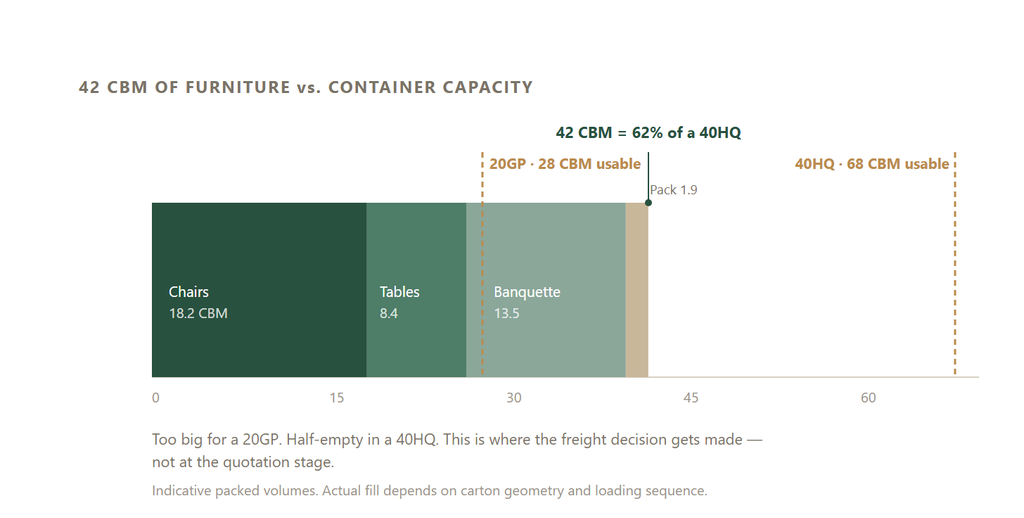
62% fill is the most expensive number in furniture logistics, because you are paying for a full container and buying 38% air. There are exactly three solutions, and only one of them is good:
- Ship LCL and pay per CBM — acceptable if the order is genuinely one-off.
- Ship a 40HQ at 62% — fast, simple, and quietly 38% waste.
- Consolidate. Add the ອາຈົມບາ, the terrace furniture, the staff lockers, the packaging for phase two, or the second outlet — anything that closes the gap to 85–90% fill.
Incoterms, without the sales pitch
Incoterms do one thing: they define where the seller’s responsibility ends. Everything else buyers believe about them — that CIF is cheaper, that DDP is easier, that FOB is safer — is a consequence of that single line.
FOB — control, and the work that comes with it
Free On Board: the seller delivers to the named port and clears export. After the rail is lifted over the ship’s side, the goods are yours — risk, freight, insurance, destination charges, everything. FOB is the default for experienced importers because it lets you use your own forwarder and see the real freight cost instead of a bundled number. It also means you own the arrival.
If you have never imported before, FOB is not wrong — it is simply more work than you are expecting. Someone has to book, insure, clear and truck.
CIF — the freight number that is not a freight number
Cost, Insurance, Freight: the seller arranges and pays ocean freight and minimum insurance to the destination port. Two things get lost in that sentence. The insurance is Institute Cargo Clauses (C) — the narrowest cover, which does not pay for handling damage in most circumstances. And the freight is bundled into the goods price, so you can no longer tell what you paid for it.
CIF is not a scam. It is a convenience with an opaque component. If a supplier quotes CIF and their freight line is 30% below your own forwarder’s rate, ask what routing and what transit time that implies — the answer is usually a transhipment and three extra weeks.
DDP — convenience with an invisible margin
Delivered Duty Paid: the seller handles everything to your door, including duty and import clearance. For a first-time buyer this is genuinely attractive, and for a small project it can be the right answer.
But DDP means the seller is the importer of record, which means the customs value, the HS classification and the duty paid are all their decisions, presented to you as one number. On a project where the duty rate is meaningfully above zero, the margin between the real duty and the duty embedded in the DDP price is invisible. Ask for the classification and the duty amount in writing. A supplier who cannot produce them is pricing risk, not logistics.
EXW — almost always the wrong choice for a fit-out
Ex Works puts everything on you from the factory door, including Chinese export clearance. Unless you have a freight operation in Guangdong, this is a way to discover a problem at the port instead of at the factory.
A worked landed-cost model for a 120-seat restaurant
The project and the assumption set
Same 120-seat room: 96 chairs, 30 tables, 18 linear metres of banquette, 42 CBM. Route: South China to Rotterdam. All figures below are illustrative and must be replaced with the actual quotation, forwarder rate and duty classification for your shipment — the structure is the point, not the numbers.
| Layer | USD | % of total | ບັນທຶກ |
|---|---|---|---|
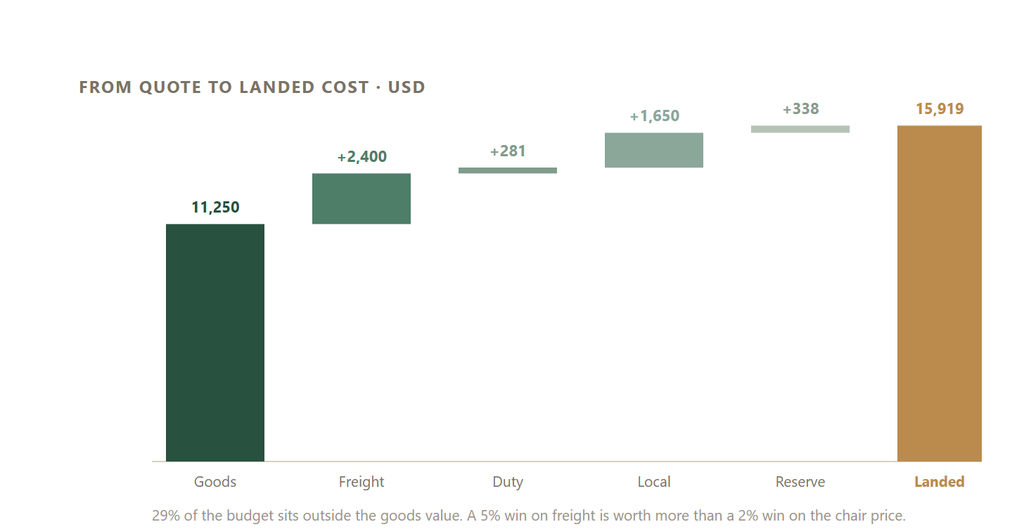
| Goods, ex-works | 11,250 | 70.7% | The only number most buyers compare. |
| Ocean freight, 40HQ | 2,400 | 15.1% | Paid whether the container is 62% or 94% full. |
| Import duty | 281 | 1.8% | 2.5% illustrative. Chair, table and seating lines can carry different rates. |
| Port, clearance, final mile | 750 | 4.7% | Terminal handling, documentation, customs broker, delivery. |
| On-site assembly & waste removal | 900 | 5.7% | Knock-down tables, banquette joints, carton disposal. |
| Damage & shortage reserve | 338 | 2.1% | 3% of goods value. Not pessimism — history. |
| Landed, before VAT | 15,919 | 100% | ≈ USD 133 per seat |
Goods value
Straightforward, but note what it excludes: samples, freight of samples, design and drawing time, and the cost of the second production run you will need when the first one reveals a specification error. Budget the sample round separately.
Freight, allocated by CBM rather than by unit
Allocate freight by volume share, not by unit count. Chairs occupy 43% of this container, so they carry 43% of the freight — about USD 10.90 per chair. The banquette carries 32%, which is why a “cheap” fixed seat is often the most freight-intensive line on the invoice. Allocate by unit and you will mis-price your own menu.
Duty, VAT and the classification question
Duty depends on the HS code, and restaurant furniture does not sit in one code. Wooden dining chairs, metal-framed seating, upholstered seats and table parts can fall under different subheadings within Chapter 94, with different rates and, in some markets, additional measures. Get the classification from your customs broker before you place the order — not after the goods arrive.
VAT is not a cost for a VAT-registered business. It is a cash-flow item: you pay it at import and recover it later. Small importers routinely treat VAT as a cost, price the project wrong, and then panic about margin. Separate the two in your model.
Port, clearance, final mile, installation
This bucket is where DDP prices hide their margin and where FOB buyers get their surprises. Ask your forwarder for a door-delivered quote with terminal handling and customs brokerage itemised, and ask the installer separately whether they charge for a second visit because half the banquette arrived on the wrong truck.
The damage and shortage reserve
Three percent of goods value is a reasonable working reserve on a first shipment from a new supplier, and it is what a professional importer budgets rather than argues about. Upholstered goods in a floor-loaded container will occasionally arrive with a compressed corner. The reserve is not there to cover the average case — it is there so that one bad crate does not become a project-level problem.
What the model tells you to change
Run this once and the priorities invert. Freight and local charges are 21% of the total; a 15% improvement in fill rate is worth more than a 3% discount on the chair. Suddenly the conversations that matter are about pack dimensions, modular banquettes and container consolidation — not about shaving USD 2 off a unit price.
It also reframes the specification question. Specifying a chair with a 0.19 CBM packed volume instead of 0.24 is worth roughly USD 11 a chair on this route, before anyone negotiates anything.
Seven decisions that move cost per seat by more than ten percent
- Lock the SKUs before you book the container.Every specification change after booking is a re-packing, and re-packing is either a second shipment or a schedule slip. Freeze the schedule, then book.
- Ask for packed dimensions, not product dimensions.A chair that is 620 mm deep on a drawing can be 780 mm deep in a carton with corner protection. The carton is what you pay for.
- Specify knock-down only where the joint survives it.Tables: yes, almost always. Banquettes: only with a designed modular joint. Chairs: rarely worth it.
- Floor-load what can take it.Recover the 8–12% of volume that pallets are holding hostage, and palletise only the pieces with exposed frames or hard edges.
- Consolidate every supplier into one container.Lighting, signage, tableware, soft furnishings — anything that shares a delivery week belongs in the same box. This is the single largest lever on a mid-size fit-out.
- Book space after sample approval, not before.The most expensive container is the one you booked to protect a date that moved because the fabric was wrong.
- Budget the reserve and then actually use it.A 3% damage and shortage line is not pessimism; it is the difference between a resolved problem and a stalled opening.
What a quotation should show before you agree to compare it
Five lines to ask for
- Packed dimensions and CBM per unit, per SKU.
- Units per 20GP and per 40HQ at that packing specification.
- Total packed volume for your order, plus packaging overhead.
- The Incoterm being quoted, and the named port or place.
- ເວລານໍາ broken into sample, production and packing — not one number.
A supplier who can answer all five is not necessarily cheaper. They are, however, quoting you something you can actually compare, which is worth more than a discount you cannot verify.
Red flags
- A CBM figure that is suspiciously round, or identical across different products.
- “We will confirm packing after you place the deposit.” Packing is part of the price, not a detail.
- An unusually low CIF freight line with no routing or transit time stated.
- A DDP price with no HS code and no duty amount disclosed.
- Quotations that quote chairs, tables and banquettes from three different factories with no consolidation plan.
Frequently asked questions
How much does it cost to ship restaurant furniture from China?
For furniture, cost is driven by packed volume rather than weight. As an order-of-magnitude guide, a 40HQ of commercial furniture from South China to a European or North American port typically lands freight at 12–18% of goods value, and a 20GP or LCL shipment at a notably higher percentage because the fixed charges are spread over less cargo. The exact number depends on route, season, container availability and — most of all — how well the goods are packed.
Is it cheaper to ship assembled or knock-down?
Almost always knock-down, for tables in particular: a top and a base packed flat can occupy less than half the volume of an assembled table. The exception is fixed seating, where a poorly designed knock-down joint costs more on site than the freight it saves. Chairs are rarely worth knocking down — the frame joint is the structure.
Can I mix chairs, tables and booths in one container?
Yes, and you generally should. Mixed loading is the standard way to close a container to a sensible fill rate. The practical requirement is a zone schedule: which cartons go where, in what order, so that unloading at destination follows the installation sequence and the banquette is not buried behind eighty chairs.
Who pays import duty under FOB?
You do. Under FOB the seller’s obligation ends when the goods are on board at the origin port, so duty, VAT, destination charges and clearance are yours. This is exactly why FOB is preferred by importers who want a transparent landed cost — and exactly why it is a poor first choice for a buyer with no import operation.
How much contingency should I budget for damage?
Around 3% of goods value on a first shipment from a new supplier, and 1.5–2% once you have a track record with them and a settled packing specification. The reserve covers replacement production and re-shipping, which is slow — so for critical pieces, order one or two extra units instead of budgeting for a repair.
Send us your floor plan before you book freight
We will come back with packed volumes per SKU, a container loading plan and a fill-rate comparison for your project — the three numbers that decide what your furniture actually costs.
Note on figures. Packed volumes, freight rates, duty percentages and the worked example are indicative and are included to demonstrate a costing method, not to quote a price or a delivery term. Container capacities, freight rates and duty classifications vary by route, season, product construction and destination market. Confirm packed dimensions with the factory, freight with your forwarder, and duty with a licensed customs broker before committing a project budget.


