
 English
 中文
 日本語
 한국어
 العربية
 Русский
 Português
 Türkçe
 हिन्दी
 Tiếng Việt
 ไทย
 Indonesia
 Melayu
 ខ្មែរ
 ລາວ
 မြန်မာ
 Afrikaans
 Hausa
 Igbo
 Sesotho
 isiXhosa
 Yorùbá
 isiZulu
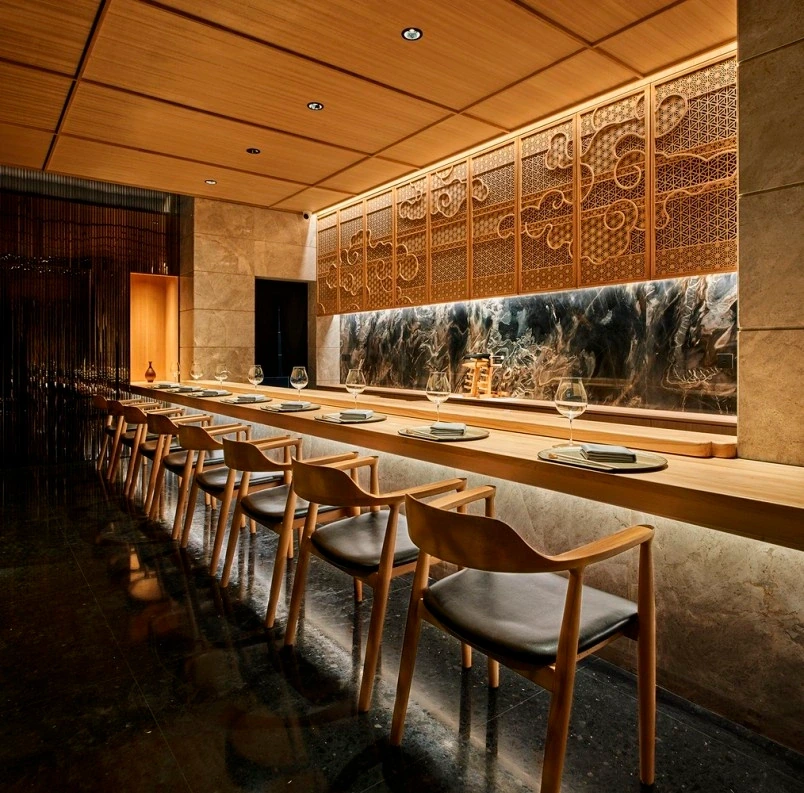
In high-end Omakase spaces, the sense of thickness of bar countertops and the wrapping feeling of bar stools together form diners’ first definition of brand value. This is not only a game of decoration style, but also a precise calculation of ergonomics and consumer psychology. A professional Omakase furniture solution can keep diners comfortable during the 2-hour dining experience, thereby significantly increasing the Average Check Size and repurchase rate—and all of this lies in easily overlooked details such as the thickness of solid wood bar countertops and the size ratio of bar stools.
1. Material Psychology: Why 5cm-8cm Is the Threshold of “Luxury Feeling”?
In high-end catering scenarios, the thickness of bar countertops is never a randomly chosen number, but an “invisible ruler” that directly affects diners’ psychological price. Speaking of which, many high-end stores have stepped into the same trap: using thin spliced boards for the bar seems to save costs, but it greatly undermines the store’s high-end positioning.
Visual Anchor: Mainstream high-end Omakase stores all choose 5cm-8cm solid wood slabs, such as Hinoki and black walnut. This thickness inherently has a strong sense of stability visually, as if silently conveying the signal of “scarce ingredients and chef’s ingenuity”, making diners subconsciously recognize the store’s high-end positioning and willing to pay for this texture.
Commercial Durability: For Japanese restaurants with high-frequency operations, the durability of solid wood bar countertops is crucial. Thickened solid wood slabs can effectively absorb vibrations during chefs’ cutting, preparation and plating, and are not prone to deformation or cracking after long-term high-frequency use, saving the trouble of frequent maintenance and replacement in the later stage, indirectly reducing store operation costs, and leaving more room for RevPASH improvement.
Anti-Penetration Technology: In this regard, Mingmeng does particularly meticulous work. We adopt food-grade nano-glazing technology, which completely isolates the penetration of strong pigment stains such as sushi vinegar and soy sauce while retaining the warm touch of solid wood—as we all know, high-end diners care most about dining details, and a little stain may reduce the overall experience.
2. Three-Stage Partition: The Dual Code of Visual Guidance and Immersive Experience
A professional Omakase bar countertop is never a flat board, but achieves dual improvement of function and experience through scientific drop design, keeping diners’ attention focused on the cuisine throughout. The specific partition design is as follows:
| Zone Classification | Core Function | Ergonomic Design Advantages | Commercial Value |
| Diner Dining Zone | Placing tableware and enjoying food | Highly fits the eye-level perspective, no need to bow or bend down, and no fatigue after long sitting | Enhances dining ritual sense and extends diners’ stay time |
| Chef Operation Zone | Ingredient processing and cuisine preparation | Slightly lower than the dining zone, with sufficient operating space reserved, not blocking diners’ sight | Clearly shows the chef’s exquisite knife skills, enhances interaction, and strengthens the high-end experience |
| Ingredient Display Zone | Display of fresh daily ingredients | Slightly raised drop design, combined with warm local lighting, highlighting ingredient texture | Stimulates visual appetite, induces diners to add high-value items, and boosts Average Check Size |
3. Golden Ratio: Bar Stool Height and the “2-Hour Long Sitting” Formula
Omakase dining time usually lasts 90-120 minutes. A slight size deviation of bar stools may cause diners to leave early or reduce their experience—and this is no trivial matter. After all, keeping diners’ time is the key to increasing Average Check Size.
The Golden Drop: The vertical distance from the seat surface to the bar countertop must be strictly controlled between 28cm and 30cm. This seemingly insignificant distance allows diners to sink their shoulders naturally when eating, without lifting their arms to pick up food or bending over to approach the countertop, greatly relieving shoulder and neck fatigue during long-term dining, and allowing diners to comfortably enjoy the complete cuisine experience—after all, keeping diners staying for the whole process is the foundation of increasing Average Check Size.
Low-Back Support: Most Omakase bar stools adopt a 20cm-25cm low backrest, which is not a random design. It can accurately fit the lumbar curve and provide appropriate support to avoid back soreness after long sitting. It also does not block the service line of the back kitchen, so waiters will not be hindered when serving from behind; more cleverly, the low backrest can guide diners to lean forward slightly, naturally focusing on every cooking action of the chef, strengthening the immersive interaction, and making diners more willing to pay for this exclusive experience.
Silence and Details: Omakase spaces focus most on tranquility and elegance. A little harsh noise may damage the overall atmosphere, thereby affecting diners’ willingness to consume. The bottom of Mingmeng bar stools is equipped with high-density silent felt pads as standard. Whether diners get up to adjust their sitting posture or waiters move the stools, it can completely eliminate dragging noise and silently guard the tranquility of the space. This seemingly small detail is actually an invisible help to improve diners’ experience and stabilize Average Check Size.
4. Commercial Details: Invisible Added Value, Hiding the Code to RevPASH Improvement
What really widens the gap between high-end Omakase stores is never the obvious design, but the thoughtful consideration hidden in the details—these details seem irrelevant to Average Check Size, but can indirectly drive RevPASH growth by improving diners’ satisfaction, and Mingmeng knows this well.
Invisible Storage: 15cm below the bar countertop, Mingmeng can customize embedded storage layers to specifically solve the pain point of storing diners’ expensive bags and mobile phones. No need to worry about bags getting dusty on the ground, nor let mobile phones take up desktop space, allowing diners’ attention to fully return to the cuisine itself. This inadvertent care can greatly improve diners’ favorability towards the store, and even promote them to add high-value cuisine items.
Structural Strength: In commercial scenarios, high-frequency use of bar stools is the norm, and stability is crucial. Mingmeng adopts a solid wood frame reinforced with mortise and tenon structure instead of ordinary screw fixation. It can not only ensure that bar stools remain stable and free of noise under long-term high-frequency use, but also extend the service life of furniture, reduce the cost of later replacement and maintenance of the store, indirectly improve the store’s profit space, and make RevPASH steadily increase.
자주 묻는 질문(FAQ)
Q: How to prevent solid wood bar countertops from being stained by soy sauce?
A: The key lies in “sealing”. Mingmeng uses a three-layer food-grade anti-penetration process to form a dense protective layer on the surface of solid wood. Even if the sauce stays for 15 minutes, it can be restored to cleanliness with a slightly damp soft cloth, without frequent sanding and renovation. It not only saves the store’s maintenance cost, but also retains the warm texture of solid wood for a long time, avoiding reducing Average Check Size due to countertop stains affecting diners’ experience.
Q: What is the most universal seat height for bar stools?
A: For a standard bar countertop with a height of 105cm-110cm, it is recommended that the seat height of the bar stool be set to 75cm. Combined with the preset footrest height of Mingmeng, it can easily adapt to most diners with a height of 160cm-190cm, no need to worry about the comfort of diners of different body types, maximize the dining experience, and help improve RevPASH.
Q: Why is solid wood slab more suitable for Omakase than spliced boards?
A: Commercial operation values “seamlessness” and “stability”. Solid wood slabs have no splicing gaps, are not easy to hide dirt, and are more convenient for daily cleaning, which is in line with the hygiene standards of high-end Omakase stores; at the same time, solid wood slabs have more stable physical properties under large-span applications, are not prone to deformation and cracking, and can maintain high-end texture for a long time. They are a must for stores to improve brand image and stabilize Average Check Size.
Q: How to solve the safety problem of high-legged bar stools?
A: In the design, we specially expand the support points of the bar stool legs outward by 3-5 degrees to enhance stability by lowering the center of gravity, ensuring that the stool remains as stable as a mountain when diners turn around, get up or even shake slightly. This design that balances safety and comfort allows diners to enjoy the dining process more at ease, indirectly extending the stay time and promoting the increase of Average Check Size.
Conclusion: Ingenuity in Dimensions, Profit in Details
The Average Check Size and RevPASH of Omakase stores are never supported by ingredients alone. The thickness of bar countertops, the size ratio of bar stools, and the thoughtful design in details are all indispensable core factors. The 5cm-8cm solid wood slab conveys high-end texture; the 28-30cm golden vertical drop guards long-sitting comfort; details such as invisible storage and silent design carry diners’ favor. Mingmeng is deeply engaged in Omakase catering furniture customization, integrating ergonomics, consumer psychology and commercial needs in depth. From material selection to size measurement, from process polishing to detail optimization, every set of bar countertops and bar stools becomes the core help for stores to improve Average Check Size and drive RevPASH growth, making the ritual sense of high-end cuisine land and profits happen naturally.