
 English
 中文
 日本語
 한국어
 العربية
 Русский
 Português
 Türkçe
 हिन्दी
 Tiếng Việt
 ไทย
 Indonesia
 Melayu
 ខ្មែរ
 ລາວ
 မြန်မာ
 Afrikaans
 Hausa
 Igbo
 Sesotho
 isiXhosa
 Yorùbá
 isiZulu
Hotel furniture cost is not fixed. It varies based on materials, design, customization, quantity, and other project requirements. Understanding those variables before you begin budgeting prevents the most common procurement mistake in hotel FF&E cost management: specifying a furniture package, receiving the quotation, and discovering the hotel room furniture cost is 40% above budget with no room to reduce scope without changing quality.
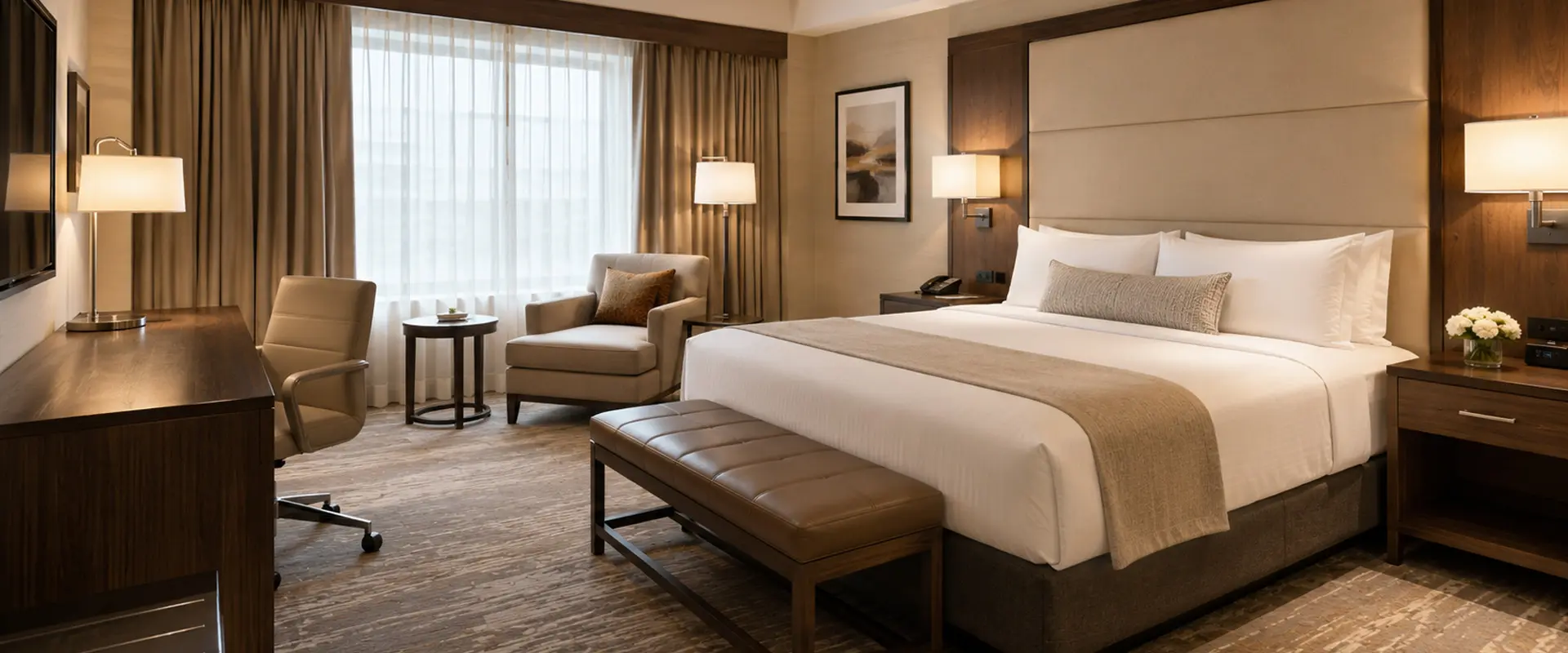
Six factors determine hotel furniture cost more than any others:
1. Property tier and brand standard. The single largest determinant. A furniture package that meets a limited-service brand standard costs roughly one-third of the same package meeting a luxury brand standard. Tier determines not just the quality level but the specification discipline — luxury brand standards typically require custom-dimensioned pieces, proprietary finishes, and pre-approval processes that add cost at every step.
2. Room count and order volume. Hotel furniture is priced on volume curves. A 100-room order commands a meaningfully lower per-unit price than a 30-room order because setup costs, tooling amortization, and logistics are spread across more units. This is also why phased hotel openings — where furniture is ordered in batches as rooms become available — almost always cost more per unit than a single order for the full room count.
3. Specification complexity. Custom dimensions, non-standard finishes, proprietary fabrics, integrated technology (USB charging, wireless charging, power management), and furniture that requires bespoke joinery all add cost. The specification complexity multiplier can range from 1.2× to 3× the base cost of a standard equivalent.
4. Lead time. Standard lead times for commercial-grade hotel furniture range from 8 to 14 weeks from order confirmation to ready-to-ship. Compressed timelines — 6 weeks or less — typically carry a 15–25% rush premium. Extended timelines (16+ weeks) may reduce cost slightly but increase holding costs and carry risk if the project schedule slips.
5. Geographic destination. Freight cost is a line item that surprises many operators. Shipping a full FF&E package from a manufacturer in Southeast Asia to a US West Coast port costs significantly less than shipping to a landlocked inland city. For European projects sourcing from Asian manufacturers, port-to-port costs plus inland freight, duties, and bonding can add 8–15% to the landed cost.
6. Duty and import treatment. US projects sourcing from China face Section 301 tariffs currently at 25% on most furniture categories. Vietnam, Indonesia, and Mexico sourcing can reduce or eliminate this exposure depending on the product category. EU projects face standard import duty rates of 2–5% on most furniture categories under the Harmonized Tariff Schedule. These are not avoidable costs — they are specification inputs that must be accounted for before budgeting.
Before discussing specific hotel furniture cost per room figures, here is the industry-wide cost framework that helps you understand what drives hotel furnishings cost at each tier: that contextualizes everything that follows. This is the baseline from which tier, volume, and specification adjustments apply:
These ranges are indicative — actual costs vary based on volume, specification complexity, and sourcing geography. The percentages in the middle column reflect the furniture portion of a full FF&E budget that also includes soft goods, FF&E installation, artwork, and operating equipment. A detailed project quotation is the only way to determine a precise number for your property.
Guest Room Furniture Budget by Tier
The guest room is where hotel furniture cost is most concentrated. In most hotel projects, guest room furniture represents 55–65% of the total furniture budget. Getting this number right — and understanding what drives it — is the single most important budget decision in hotel FF&E procurement.
What is included in guest room furniture cost
Before discussing per-room costs, it helps to define what “guest room furniture” actually includes. In standard hotel FF&E terminology, the guest room furniture package typically encompasses:
- Bed frame and headboard
- Nightstands and bedside tables
- Desk, desk chair, and any floating shelf or credenza
- Lounge seating (where applicable): armchair, sofa, or loveseat
- Luggage bench or ottoman
- Case goods: dresser, media console, or wardrobe
- Closet system: rod, shelf, drawer unit
- Window treatment hardware and drapery
- Bathroom vanities and millwork (often FF&E rather than construction, depending on project delivery)
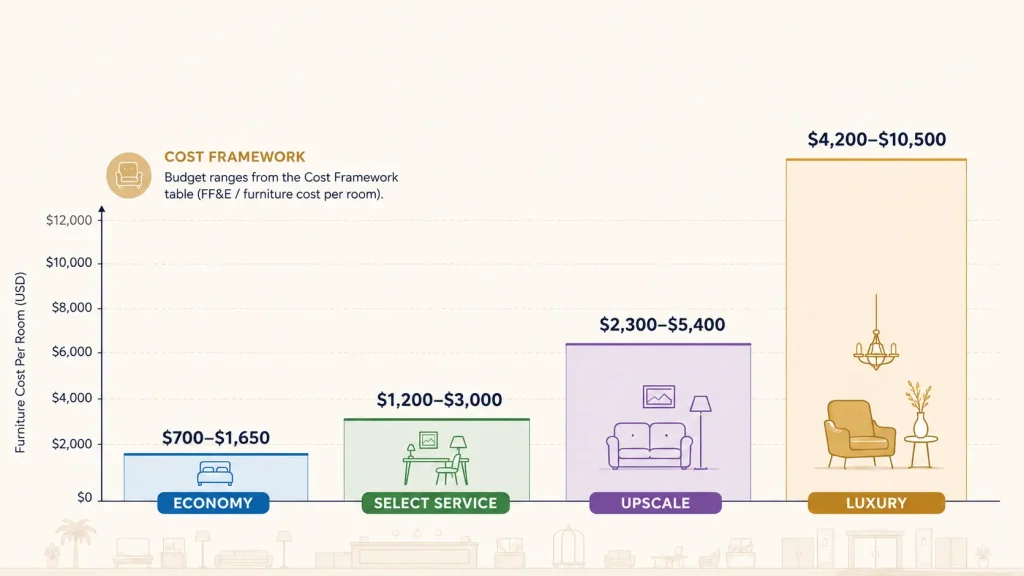
Guest room furniture cost per room ranges from $700–$1,650 at economy tier to $4,200–$10,500 at luxury tier, depending on specification level and tier standard.
How guest room furniture cost breaks down
Within the guest room furniture budget, the cost distribution follows a predictable pattern regardless of tier. Understanding this distribution helps operators make informed trade-offs when budget pressure forces prioritization.
The bed and headboard represent the largest single line item — typically 22–30% of the guest room furniture budget. This reflects both the functional importance of the sleep system and the cost of commercial-grade beds, which must survive 10–15 years of daily use by hundreds of different guests. A nightstand that costs $150 versus $250 per unit may not seem significant until multiplied across 200 rooms. A bed frame that fails at year three rather than year fifteen is a maintenance and replacement cost that dwarfs the initial savings.
The desk and seating area — desk, chair, and any lounge seating — represents the second-largest allocation, typically 18–25% of the guest room budget. In economy configurations where lounge seating is absent, the desk and chair allocation increases proportionally.
Case goods (dresser, media console, closet system) represent 12–18% of the budget. In upscale and luxury configurations where drawer units, premium hardware, and integrated technology are specified, this percentage increases.
The distribution shifts by tier in one important way: at economy tier, a higher percentage of the budget goes to the bed because the bed is the room’s primary function and the only category where compromising quality produces immediate guest complaints. At luxury tier, the distribution flattens across categories because every piece is a brand expression and every compromise is visible.
Economy and Limited Service: $700–$1,650 per room
At economy tier, the guest room furniture budget must deliver durability, brand compliance, and a functional guest experience at the lowest feasible cost. This is not a quality compromise — it is a specification discipline.
At this tier, the furniture package typically includes: a metal platform bed frame, vinyl-wrapped or laminate headboard, laminate case goods with basic hardware, a standard desk with a task chair, and no lounge seating in standard configurations. Window treatments are typically contractor-supplied rather than FF&E.
The most common budget error at this tier is underspecifying the bed frame. Economy operators who select particleboard bed frames to save $30–$50 per unit discover within 18–24 months that the frames are failing — splitting at joints, sagging under load, producing noise complaints. The replacement cost of a full bed frame replacement across 200 rooms quickly exceeds the original savings.
Select Service and Upper Midscale: $1,200–$3,000 per room
At select service tier, the budget expands to accommodate a second nightstand, a full-size desk with a commercial-grade task chair, and lounge seating in a meaningful percentage of rooms. Fabric-upholstered headboards replace vinyl, and case goods move from laminate to wood veneer finishes.
The key budget decision at this tier is the lounge seating specification. A property that chooses to include a lounge chair in 40% of rooms (e.g., king rooms only) versus 100% of rooms will have a meaningfully different per-room cost. The decision should be driven by the target guest profile — business travelers value lounge seating more than leisure travelers in most select-service markets.
Upscale and Lifestyle: $2,300–$5,400 per room
At upscale tier, the furniture specification expands in every category simultaneously. Headboards move to custom or designer dimensions. Case goods gain integrated technology (USB, wireless charging). Lounge seating becomes a sofa or loveseat in most configurations. Closet systems add drawer units and premium hardware.
The dominant cost driver at this tier is specification complexity rather than volume. A single custom-dimensioned headboard at upscale tier may cost $400–$600 per unit versus $150–$200 for the same headboard in a standard dimension. Across 150 rooms, that differential is $30,000–$60,000 — a meaningful line item that must be budgeted explicitly rather than discovered at quotation.
Luxury: $4,200–$10,500 per room
Luxury guest room furniture is where cost becomes a function of design ambition as much as specification standard. A luxury room may include custom-designed headboards, bespoke case goods with proprietary finishes, integrated lighting in case goods and headboards, premium leathers and textiles, and furniture that requires artisan-level joinery.
At this tier, the furniture budget is typically developed in close collaboration with the interior designer and the brand’s FF&E approval team. The per-room cost reflects not just the furniture but the approval and customization process — a luxury furniture quotation at $8,000 per room may include $1,500–$2,000 per room in design development, sampling, and approval costs that would not appear in a standard furniture quotation.
Lobby and Public Area Furniture Budget
The lobby is the highest-visibility furniture location in any hotel. It is also the most complex to budget, because the lobby furniture package is not standardized the way guest room furniture is. Every lobby has a different layout, a different design intent, and a different mix of seating groupings.
As a rough framework, lobby and public area furniture typically represents 20–30% of the total furniture budget in a hotel project. For a 150-room select-service property with a furniture budget of $2,000 per room ($300,000 total), the lobby allocation would typically range from $60,000 to $90,000.
What drives lobby furniture cost
The cost drivers specific to lobby furniture are different from guest room furniture in several important ways:
Scale. Lobby furniture must match the scale of the lobby volume. A high-ceiling lobby (12–16 feet / 3.7–4.9 meters) requires oversized furniture — higher backs, larger modules, statement pieces — that costs more per unit than equivalent pieces for a standard-height space. A 60-inch sofa in a 14-foot lobby reads as undersized; a 72-inch sofa in the same lobby reads as intentional. The scale difference is not just visual — it affects frame engineering, material requirements, and often manufacturing process.
Configuration complexity. Lobby seating is rarely a single piece. It is typically a grouping: a sofa, two accent chairs, a coffee table, side tables, a console, and floor lamps. The grouping must be designed as a system, not as individual pieces — which means the supplier must understand the design intent and the spatial relationships between pieces. This design involvement adds cost that does not appear in a simple per-unit price.
Fabric and material performance. Lobby furniture is exposed to continuous use by a much broader and less predictable population than guest room furniture. Spills, heavy soiling, and physical stress are regular conditions, not exceptions. Commercial-grade fabric (minimum 30,000 Wyzenbeek rating) and reinforced frame construction are non-negotiable at this tier — and they cost more than equivalent residential-grade materials.
Budget allocation across public area spaces
For a hotel with a total public area furniture budget, the typical distribution across spaces looks like this:
Lobby lounge and seating groupings represent 45–55% of the public area furniture budget. This is the highest-visibility allocation and the one that most directly affects guest first impressions and online review photographs.
Corridor and elevator lobby furniture represents 10–15% of the budget. This includes corridor seating (where specified), artwork, and millwork. In many limited-service properties, this allocation is minimal or zero.
Restaurant, bar, and F&B seating represents a separate allocation (discussed in the next section) and is not typically included in the public area budget.
Meeting and event furniture represents 15–25% of the public area budget in properties with significant meeting space. In limited-service properties without meeting space, this allocation is zero.
Pool, fitness, and outdoor areas represent 10–20% of the budget in properties with these amenities. Outdoor furniture is a specialized category — marine-grade materials, UV-resistant fabrics, and corrosion-resistant hardware add cost that is not present in indoor furniture specifications.
Restaurant and Bar Furniture Costs
Restaurant and bar furniture cost depends primarily on three variables: the type of seating, the volume of the order, and the severity of the foodservice environment. These three factors interact to produce a cost range that can vary by a factor of 3× between the most economical and the most expensive configurations.
Seating type cost comparison
The fundamental choice in restaurant furniture is between booth seating, table-and-chair seating, and bar seating. Each has a different cost structure and a different operational profile.
Booth seating is the most expensive initial investment but often the lowest cost over a 10-year period in high-volume foodservice environments. A commercial booth with a wood or upholstered frame, commercial-grade vinyl, and reinforced joinery costs $800–$1,500 per linear foot depending on configuration. A 6-foot booth section (seating four guests) costs $4,800–$9,000. But that booth will survive 8–12 years of daily use in a high-volume restaurant without the replacement frequency of table-and-chair seating, which typically requires refreshing every 3–5 years in equivalent environments.
Table-and-chair seating is less expensive per unit but generates higher replacement frequency. A commercial dining chair with a wood frame and commercial-grade upholstery costs $150–$300 per chair. A matching dining table costs $400–$800 per table depending on size and material. For a 60-seat restaurant with 20 four-top tables and 60 chairs, the seating investment is $24,000–$48,000. Over 10 years with one chair replacement cycle, the total seating cost reaches $32,000–$60,000.
Bar seating falls between these two in terms of both cost and durability. A commercial bar stool with a metal or wood frame and commercial upholstery costs $175–$350 per stool. Bar-height tables cost $300–$600 per table. For a 20-seat bar area, the investment is $7,000–$13,000.
Volume and foodservice environment factors
Within seating type, the foodservice environment is the cost multiplier. A quick-service restaurant with vinyl upholstery and metal frames operates at a different cost level than a fine dining restaurant with leather upholstery and custom wood frames. The multiplier between the most economical and most demanding foodservice environments is approximately 1.5–2× for equivalent seating types.
For hotel restaurants specifically, the environment typically falls in the mid-range — more demanding than quick-service, less demanding than fine dining. A hotel all-day dining restaurant typically budgets $200–$400 per seat for seating furniture, which translates to $20,000–$40,000 for a 100-seat restaurant.
Custom vs Standard Production
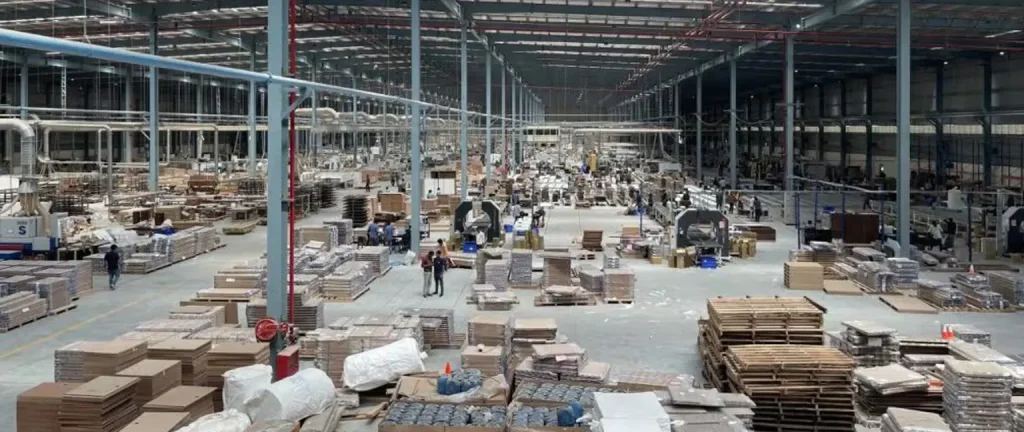
The choice between custom and standard production is one of the most consequential decisions in hotel furniture procurement. It affects cost, lead time, specification control, and brand differentiation. Understanding the trade-offs before specifying is essential to avoiding budget surprises at quotation.
What “custom” actually means in hotel furniture
“Custom” in hotel furniture ranges from minor modifications to fully bespoke production, and the cost implications are very different across that range.
Modified standard: The most common form of custom in hotel furniture. A standard product is selected from a manufacturer’s catalog, then modified in one or more dimensions, finishes, or specifications. A standard headboard height of 54 inches is modified to 60 inches. A standard wood finish is matched to the project’s color sample. Lead time adds 2–4 weeks. Cost premium is typically 10–25% over the standard equivalent.
Custom-specified: A product designed to the project’s specific requirements from a clean brief. The manufacturer produces drawings for approval, builds samples, and manufactures to the approved sample. Lead time adds 4–8 weeks over standard. Cost premium is typically 30–60% over the standard equivalent.
Bespoke/artisan: Fully custom-designed pieces produced by specialist workshops. Typically reserved for luxury tier or signature design projects. Lead time adds 12–24 weeks. Cost premium is 100–300% over standard equivalents.
Standard production: when it makes sense and when it does not
Standard production is appropriate when the brand standard is met by an existing product, when the order volume is sufficient to justify the manufacturer’s setup investment, and when the project timeline does not accommodate custom lead times.
Standard production is not appropriate when the brand standard requires a specific dimension or finish that is not available in standard product lines, when the design intent requires a visual distinctiveness that standard products cannot provide, or when the brand approval process requires a custom sample as part of the specification process.
The cost comparison framework
| Production Type | Lead Time vs Standard | Cost Premium | Mafi kyawun Ga |
|---|---|---|---|
| Standard catalog | Baseline | Baseline | Economy and select-service tier, high-volume orders |
| Modified standard | +2–4 weeks | +10–25% | Most upscale tier projects, finish matching |
| Custom-specified | +4–8 weeks | +30–60% | Upscale and luxury tier, dimensional customization |
| Bespoke/artisan | +12–24 weeks | +100–300% | Luxury and resort, signature design elements |
The cost premium for custom production is not arbitrary — it reflects real engineering, sampling, and manufacturing complexity. But it is also frequently over-applied by manufacturers who quote custom pricing for modifications that could be handled through standard production with minor adjustment. Getting a manufacturer to justify the premium is always worth doing before accepting a custom quotation.
Shipping, Packaging, and Logistics Costs
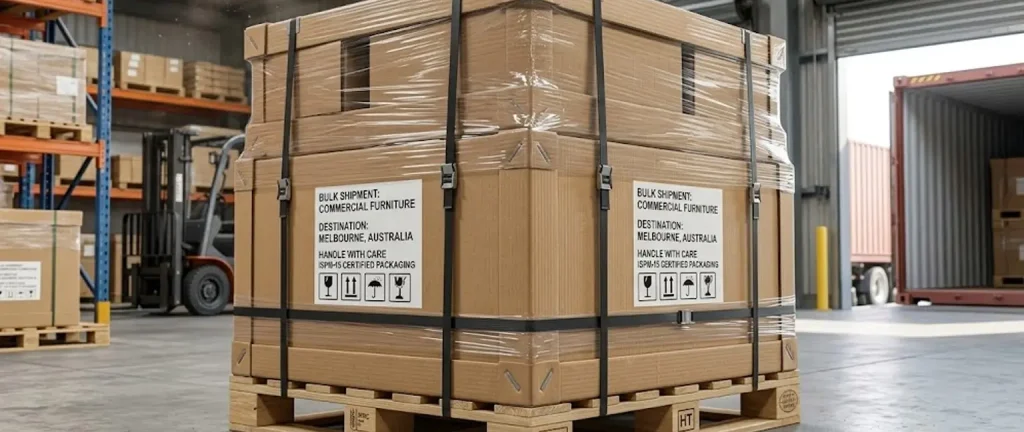
Shipping, packaging, and logistics are consistently underestimated in hotel furniture budgets. They rarely appear in the initial budget estimate and frequently appear as a shock at quotation review. Understanding what they include — and how they vary — prevents a budget overrun at the worst possible moment.
What freight costs include
Hotel furniture freight cost is not simply the port-to-port shipping rate. It includes the following components, each of which must be accounted for in the landed cost calculation:
Origin handling and trucking: Moving furniture from the manufacturer’s facility to the export port or loading point. Typically $150–$400 per shipment, regardless of size.
Port handling and documentation: Export customs documentation, port terminal handling charges, and loading onto the vessel. Typically $200–$500 per container.
Ocean or air freight: The actual transportation cost from origin port to destination port. Ocean freight from China to US West Coast runs approximately $1,500–$3,000 per 20-foot container and $2,500–$5,000 per 40-foot container. From China to US East Coast via Panama Canal, add $500–$1,000. Air freight is 6–10× ocean rates and is rarely used for full container furniture shipments.
Destination port charges: Import customs clearance, port terminal handling, and unloading at the destination port. Typically $300–$700 per container.
Inland freight: Trucking from the destination port to the project site. This is the most variable component and the one most dependent on project location. Freight from Los Angeles port to a Phoenix hotel runs $2,000–$4,000 per 40-foot container. Freight from Los Angeles to a Denver hotel runs $4,000–$7,000 per 40-foot container. Freight to inland cities from any East Coast port adds significant cost.
Duties and tariffs: Import duties are a function of the product’s HTS code classification and the origin country. US tariffs on Chinese furniture products currently include Section 301 tariffs of 25% on most categories — this is a significant line item that must be included in the landed cost calculation before budgeting.
Bonding and insurance: ISF bonding (for US imports), cargo insurance, and project-specific insurance requirements. Typically $500–$2,000 per shipment.
Typical freight cost ranges
For a full guest room FF&E package shipping from China to a US coastal city:
| Cost Component | Range |
|---|---|
| Origin handling | $150–$400 |
| Ocean freight (40ft container) | $2,500–$5,000 |
| Destination port handling | $300–$700 |
| Inland freight (coastal city) | $1,500–$3,000 |
| Duties (25% on furniture, China origin) | Varies by value |
| Bonding and insurance | $500–$2,000 |
| Total freight and logistics | $5,000–$12,000+ per 40ft container |
For a 150-room project with two 40-foot containers, total freight and logistics cost ranges from $10,000 to $24,000 — equivalent to $65–$160 per room. This number must be in the budget before procurement begins, not discovered at quotation review.
Reducing freight cost
The most effective strategies for reducing freight and logistics costs are: consolidating shipments to minimize the number of containers, specifying inland-origin ports when available (e.g., shipping to a East Coast port for a East Coast project rather than transiting via West Coast), qualifying Vietnam or Indonesia manufacturing for equivalent quality with lower tariff exposure, and building logistics cost into the manufacturer selection criteria rather than treating it as a post-quotation surprise.
How to Request an Accurate Hotel Furniture Quotation
A furniture quotation is only as accurate as the specification it is based on. Vague inquiries produce vague quotations. Specific, detailed inquiries produce quotations that can be compared apples-to-apples and that reflect the actual cost of the project.
What to include in a furniture RFQ
A complete furniture request for quotation — the document that determines your hotel FF&E cost with precision — should include the following information at minimum:
Project information: Property name, location, room count, and anticipated delivery date. Include whether the order is for a single phase or multiple phases — phased orders change the volume economics.
Tier and brand standard: The brand or tier standard that the furniture must meet. If there is a brand FF&E manual, reference it explicitly. If the standard is described in your own specification, describe it completely.
Room type breakdown: How many rooms of each type? King rooms, double/double rooms, suites? Each room type has a different furniture package and a different cost.
Furniture specification by category: List the furniture items required for each room type. Include quantities, dimensions (where known), material requirements, finish requirements, and any brand-standard requirements. The more specific this list is, the more accurate the quotation.
Public area requirements: List the public area furniture requirements by space. Include lounge groupings, F&B seating, corridor items, and outdoor items separately.
Customization requirements: Note any dimensional customization, non-standard finishes, integrated technology, or other specification complexity that requires custom production. Custom requirements are the most common source of quotation surprises.
Sourcing geographic preference: Note any preference for domestic versus import sourcing, specific country of origin, or supplier location requirements.
The information that matters most
In practice, the three pieces of information that most directly affect quotation accuracy are: the complete room type and count breakdown, the tier or brand standard (which determines specification level), and the delivery timeline (which determines whether rush premiums apply).
The most common reason hotel furniture cost comes in significantly over budget is that the specification embedded in the RFQ is more complex than the budget was based on. A “select-service standard” budget that does not specify which select-service brand standard — and therefore which specification level — will receive quotations for hotel furniture cost that range 40% from low to high, all technically responsive to the RFQ but none of which represents the actual cost to furnish a hotel room for your project.
What to ask the supplier before accepting
Before accepting any hotel furniture quotation, ask the supplier the following questions:
Does this quotation include freight, duties, and landing costs, or is it FOB origin? A low factory price that excludes freight and duties will frequently exceed a higher factory price that includes them.
What is the lead time, and does this quotation include any rush premium? Compressed timelines are a common source of cost surprises.
Are samples included in this quotation? For custom or modified standard products, physical samples are typically required for approval. The sample cost and lead time should be quoted separately.
What is the payment terms structure? Hotel furniture suppliers typically require 30–50% deposit at order confirmation and the balance prior to shipment. Payment terms affect cash flow planning.
What is the warranty coverage and what does it include? Commercial furniture warranties range from 1 year to 10 years depending on the supplier and the product category. A lower-priced quotation that includes a shorter warranty may cost more over the furniture’s service life.
Summary and Next Steps
Hotel furniture cost is a function of tier standard, volume, specification complexity, lead time, sourcing geography, and logistics. Understanding those variables — and how they interact — is what allows developers and operators to build accurate budgets and make informed procurement decisions.
As a practical starting point for your hotel furniture budget: budget $700–$1,650 per room for economy tier guest room furniture, $1,200–$3,000 for select service, $2,300–$5,400 for upscale, and $4,200–$10,500 for luxury. These hotel furniture cost per room figures are the ranges most procurement professionals use as a planning baseline — and they are the foundation for any serious hotel furnishings cost analysis. Add 20–30% of the guest room furniture budget for lobby and public area furniture, and 15–25% for restaurant and bar seating. Add $65–$160 per room for freight and logistics from Asia to a US coastal destination. Add a 10–60% premium for any custom or modified-standard specification.
These are indicative ranges, not guarantees. A detailed project quotation from a qualified hotel furniture supplier — based on a complete specification — is the only way to determine the precise budget for your property.
Matakai na gaba: For an accurate project quotation based on your property’s tier, room count, and specification requirements, request a consultation with MingMeng Hospitality’s commercial furniture team. Share your room type breakdown, tier standard, and delivery timeline, and we will provide a detailed budget estimate within 5–7 business days.