Restaurant Furniture Delivery Checklist: A Receiving Guide for Project Teams
2026-11-16
Based on over a decade of experience at Mingmeng, the act of signing for a delivery does not equate to the formal completion of a project inspection for restaurant furniture. Before scheduling transport, a restaurant furniture delivery checklist be prepared: confirm the delivery time window, designate an on-site contact person, and reach an agreement regarding unloading procedures and temporary storage arrangements. The inspection record is only considered complete once the team has verified the received items against the original order, documented any visible discrepancies, and assigned outstanding issues to the appropriate personnel for follow-up.
The difference becomes clear at the site entrance. The furniture arrives while other trades may still be working, the unloading area may be shared, and the person who understands the floor plan may not be the person meeting the driver. If cartons are counted without checking their marks, or damage is photographed without recording the affected item, the project may have to reconstruct the delivery from incomplete notes later.
A planned receiving process connects the shipment to the project documents. It gives the site team a consistent way to identify what arrived, where it belongs, what condition was observed, and which issues still need a decision.
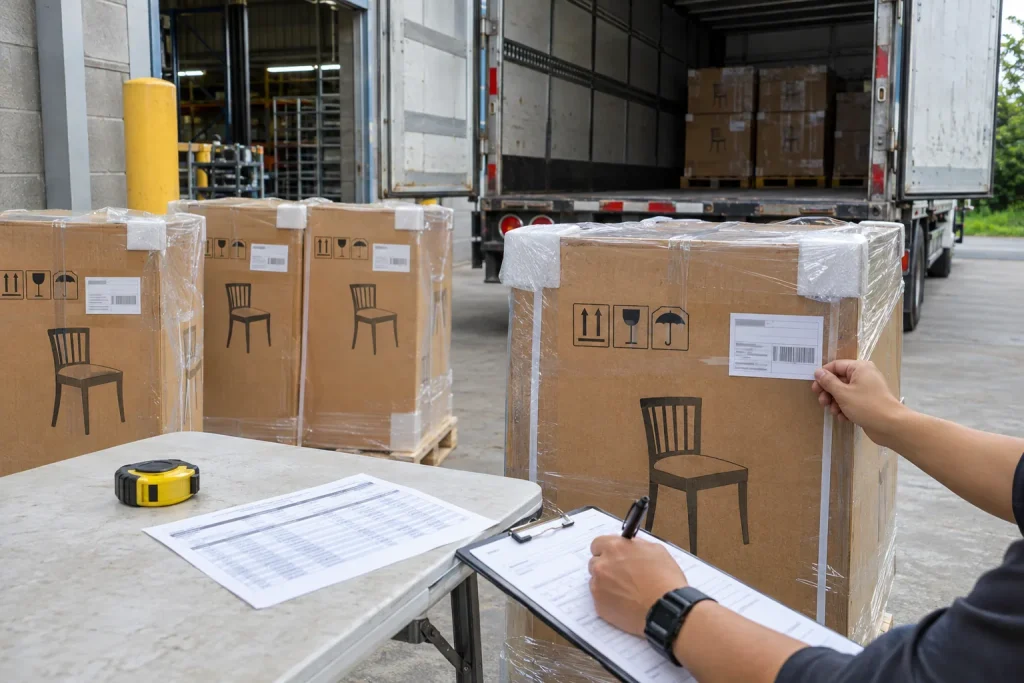
Restaurant furniture prepared for project site receiving, package verification and installation coordination.
Signing a Delivery Is Not the Same as Receiving It
A signature on a delivery receipt records a handover of freight. On its own, it does not confirm that every ordered item has arrived, that the packages are in acceptable visible condition, or that the furniture has been matched to the correct project zone.
For a multi-zone restaurant project, receiving involves more than checking package condition. The team must reconcile each carton with the ordered item, destination zone, approved configuration and installation sequence. A delivery record should preserve these connections so that the receiving team and installation crew can work from the same references.
The distinction matters when a shipment contains different furniture types, finishes or upholstery options. A carton may be physically present but still require investigation if its item code, quantity, finish reference or destination does not match the current order documents.
The receiving process therefore has five connected stages: arrange the delivery, identify the shipment, record its arrival condition, resolve exceptions and hand the documented goods over for installation.
A delivery receipt records the handover. The receiving record shows what was delivered, what was checked and what remains unresolved.
What a Project Receiving Day Involves
A project receiving day has to coordinate three conditions that are often treated separately.
First, there is volume and variety. A truck may carry chairs, tables, booth sections and other furniture assigned to different zones. The shipment may include cartons, pallets and larger crates, each carrying different item references.
Second, there is a shared construction site. The loading area, doorway, corridors and temporary storage space may also be used by contractors and other trades. The route from the unloading point to the intended room needs to be considered before the shipment arrives.
Third, there is a limited handover window. The driver and receiving team need to complete the delivery handover according to the carrier’s arrangements. Detailed unpacking or a full condition inspection may not be possible during that period, so the team needs to know what must be checked immediately and what must be recorded for follow-up under the applicable terms.
A practical restaurant furniture receiving checklist should reflect this sequence. Before the truck, the team confirms access, people and space. At arrival, it checks the shipment identity, package count and visible condition. After unloading, it manages inspection, storage and the handoff to installation.
Before the Truck: Booking, Contact and Site Access
Receiving problems often begin at the booking stage, when the delivery is arranged without confirming three essential points.
A confirmed delivery window and a named site contact. The carrier needs to know when someone will be available to receive the freight. The named contact should have the authority to coordinate the unloading location, contact the project manager when a discrepancy is found, and ensure that the delivery documents and packing list are available. If the contact cannot make decisions or locate the relevant documents, the handover can become unnecessarily difficult.
Unloading conditions confirmed before dispatch. Establish whether the delivery requires a liftgate, forklift, pallet jack or manual unloading, and confirm which equipment and labour will be available at the site. These arrangements may affect service availability and cost, so they should be agreed with the carrier or forwarder before dispatch rather than improvised at the entrance. Door widths, corridor turns, stair access and elevator dimensions should also be checked. A booth section that cannot pass through a stairwell is a site-routing issue that needs to be identified before delivery.
A receiving and storage area that is ready. Clear the unloading space, protect vulnerable floor finishes and identify where cartons can be staged without obstructing other trades. Keep the delivery date consistent with the wider project schedule. The Restaurant Furniture Project Timeline helps place delivery and installation within the overall project sequence.
Put the delivery window, site contact, unloading method and staging location in the project or order notes. Confirm that the responsible parties have the same information before the truck is dispatched.
If the driver has to discover the unloading arrangements at the site entrance, the delivery plan is incomplete.
At the Tailgate: Count, Match and Photograph
When the truck arrives, the receiving team should work through three checks in a consistent order. The aim is to establish what has arrived and create a record that can be reconciled with the order documents.
Count the packages against the packing list. Start with the total number of cartons, crates or pallets, then check the package groups and item references shown on the packing list. If the shipment is partial or split across multiple deliveries, record the quantity received in this delivery separately from the quantity still outstanding. Do not mark the full order as received simply because one delivery has arrived.
Match carton marks to the order and project zones. Check the item code, carton mark, quantity and zone against the current packing list and quantity schedule. Where the order uses approved fabric, finish or material references, retain the link to the relevant approval record. The Restaurant Furniture Sample Approval guide explains how sample decisions and revisions can be documented. Receiving does not approve the material again; it verifies that the delivered item carries the identifiers required by the approved order.
For example, a booth carton labelled BT-07B-FAB-r2 may identify a particular booth section, upholstery reference and revision. The receiving team should compare that mark with the packing list, approved sample record and designated installation zone. If the delivered carton carries a different revision, record the discrepancy against the item code and request written clarification before the affected furniture is released for installation. This is an illustrative coding example; actual project codes should follow the approved project documentation.
Photograph the shipment before moving or rearranging it. Take an overall photograph of the load as delivered, then photograph package labels and any visible damage. For a defect, include the affected carton mark or item reference in the same image where practical. A close-up of damage without a package identifier may be difficult to connect to a specific order line later.
Match carton marks and package quantities against the approved packing list before moving furniture to site storage.
If a shipment arrives in multiple drops, maintain a separate arrival record for each delivery and update the outstanding balance against the order. This makes it possible to distinguish goods received, goods still in transit and discrepancies that need investigation.Count, match and photograph before the packages are dispersed across the site.
Three Types of Receiving Exceptions and Their Reporting Routes
Receiving exceptions should be described according to what was observed. The correct reporting route depends on the facts, the shipment documents and the applicable contract or carrier terms.
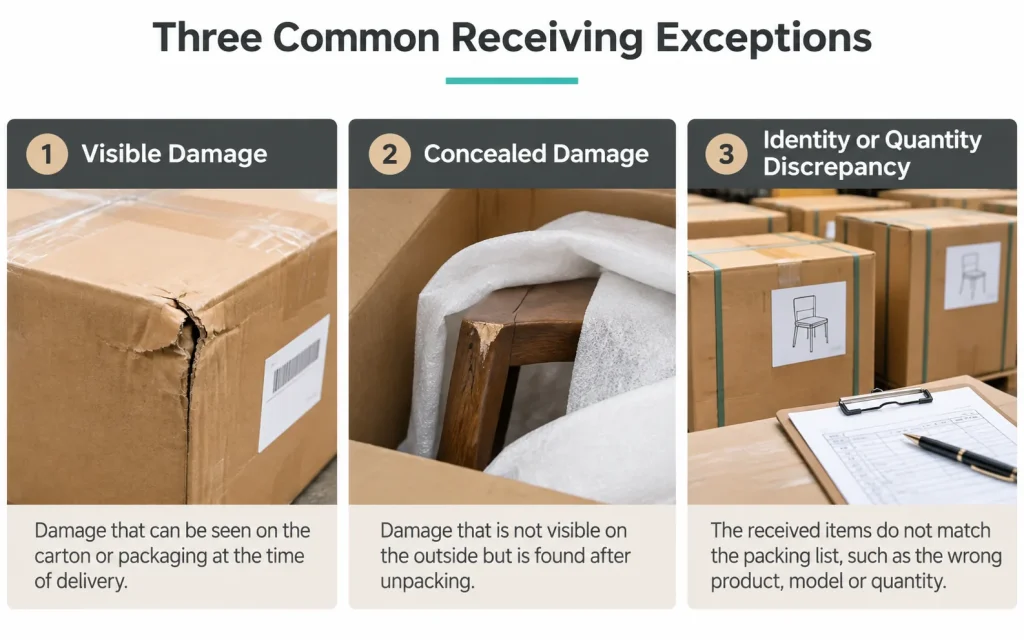
Visible damage is damage that can be observed on the packaging or goods at the time of delivery. Record the affected package, the visible condition and the corresponding item or carton mark on the carrier’s prescribed delivery document or electronic receipt, following the applicable procedure. Take photographs before the packaging is moved or discarded. The carrier’s terms and the contract determine the required reporting process and any claim requirements.
Concealed damage is damage discovered only after packaging has been opened. Record when and where it was discovered, identify the affected item and retain the packaging until the carrier or responsible party confirms whether it is needed for inspection. Notify the relevant party within the reporting period specified in the applicable carrier terms or contract. Do not assume that a general industry time limit applies to every shipment.
Identity or quantity discrepancies include a wrong item, an incorrect finish reference, missing packages or a quantity that does not reconcile with the order. These discrepancies should not automatically be classified as supplier errors or transit losses. Compare the purchase order, current quantity schedule, packing list and shipment references first. A missing carton may reflect a partial shipment, a packing omission or a shortage in transit; a different finish may indicate a product mismatch or an outdated document. Assign the issue to the supplier or carrier according to the documented facts and the applicable agreement.
The Restaurant Furniture RFQ Checklist explains how item descriptions, quantities and requirements can be defined before an order is placed. At receiving, those agreed references help the project team identify what does not match.
A transit claim asks what happened to the freight. An order discrepancy asks whether the delivered goods match what was agreed. Check the records before deciding which route applies.
Visible damage, concealed damage and order discrepancies require different documentation and reporting routes.
Signing With Specific Notes, Not Just a Name
The signature is only one part of the delivery record. Where an exception is visible, the receiving team should record the specific observation on the carrier’s prescribed delivery document or electronic receipt, following the procedure that applies to the shipment.
Use factual descriptions rather than general comments. For example, identify the carton number, the location and type of visible damage, and the related item code. A note such as “crate 4 of 9, lower corner crushed, item BT-07B” is more useful for later investigation than a general entry such as “damaged.”
If the carrier’s device does not allow a detailed notation, ask the driver or carrier representative which alternative record is accepted. Keep a copy of the submitted documentation and the related photographs. Do not assume that a separate email or handwritten note changes the status of the signed receipt unless the carrier confirms that procedure.
Do not rely on a generic phrase such as “subject to inspection” as a substitute for describing visible damage. If a full inspection cannot be completed during the driver’s handover window, record the visible condition accurately and confirm the carrier’s procedure for reporting damage discovered after opening. The applicable reporting windows, forms and claim requirements are determined by the carrier’s terms and the project contract.
A delivery receipt with a bare signature may leave important questions unanswered. Specific notes, package identifiers and supporting photographs make the receiving record more useful.
Record what was actually observed, identify the affected package and follow the carrier’s documented procedure.
After the Truck Leaves: Unpacking, Storage and Handoff
The truck leaving does not end the receiving process. The remaining work is to inspect, store and transfer the furniture without losing the references established at delivery.
Plan unpacking around installation, but respect inspection deadlines. The installation sequence may determine which cartons should be opened first. However, do not postpone condition checks beyond the reporting period specified by the carrier or contract. If some items must remain sealed until the site is ready, record the reason, storage conditions and planned inspection date. Confirm that the planned opening date is consistent with the applicable reporting requirements.
Store furniture in conditions that protect its condition. Keep cartons away from water, dust, paint work and other site activities that could cause damage. Avoid placing heavy packages on upholstered surfaces or stacking goods beyond the packaging instructions. Keep package marks visible so that the team can identify each item without opening every carton. Retain packaging where it may be needed for inspection or a claim, and confirm before disposal that it is no longer required.
Hand over the records with the furniture. The installation team should receive the packing list, carton references, receiving photographs and unresolved exception notes. A carton assigned to a particular booth run or dining zone should reach the intended location without being opened simply to identify it. Where furniture is supplied in sections to suit the building route, the receiving team should preserve the section identifiers so that the installers can assemble the correct configuration. The restaurant booths range provides examples of seating configurations that may need to be considered alongside site access and installation planning.
The handoff is complete when the installation team knows what has arrived, where it belongs and which items remain on hold or require follow-up.
Organize delivered furniture by project zone and preserve carton references for the installation team.
What the Receiving Record Owes the Order File
By the end of receiving, the project should retain a connected set of records: the delivery receipt and its notations, photographs identified by carton or item reference, the package count for each delivery, exception records with their current status, and the unpacking or installation handoff notes.
These records continue the documentation chain established before dispatch. The purchase order and quantity schedule define what was ordered. The approved sample record identifies the relevant material or finish decision. Pre-shipment inspection records document checks made before goods are released. The receiving record documents what actually arrived at the project site. These records serve different purposes and should not be treated as substitutes for one another.
Supplier-side logistics capability and pre-shipment controls are covered in the Restaurant Furniture Supplier Audit Checklist. On the buyer’s side, the authorized receiving contact and backup person should be identified separately in the project documents. This keeps supplier responsibilities distinct from the site’s receiving and acceptance responsibilities.
A receiving record is useful when someone who was not present can later identify which carton carried which item reference, what condition was documented at arrival, which quantities were received, and who is responsible for each unresolved issue. Retain it alongside the applicable purchase agreement, warranty terms and carrier claim records.
A receiving day that produces no usable record survives only in memory. A traceable record lets the project team act on what actually happened.
Frequently Asked Questions
Who should be the site contact on receiving day, and what do they need?
Choose someone who knows the delivery arrangements, has access to the packing list and project zone references, and can coordinate decisions with the project manager. The contact should know where the freight can be unloaded and staged, who can authorize access to the receiving area, and how to record an exception. If the main contact is unavailable, name a backup person before dispatch.
Should we photograph cartons that appear undamaged?
Yes. Photographs of the load and package labels document the visible condition and identification of the shipment at arrival. They provide a useful baseline if a discrepancy is discovered later. They do not prove the condition of furniture inside unopened packaging, so any later inspection findings should be recorded separately.
What should we do if the site is not ready when the truck arrives?
Do not improvise an unloading or storage arrangement without checking the applicable delivery terms and site constraints. Redelivery, waiting time, temporary storage and additional handling may involve costs or responsibilities defined by the carrier or contract. Record what happened, contact the responsible project and logistics parties, and agree on the next step in writing. This is why site readiness should be confirmed during the booking stage in Section 3.
How should a project team receive a restaurant furniture shipment delivered in multiple batches?
Record each delivery separately. For every arrival, note the date, shipment reference, packages received, item or carton marks and any visible exceptions. Update the outstanding quantity schedule without marking undelivered items as received. When the remaining shipment arrives, reconcile the final total against the purchase order and packing documents.
What should remain in the receiving record after installation is complete?
Retain the annotated delivery receipt, photographs with their file references, package and quantity reconciliation, exception records and their resolutions, and any handoff notes that affected storage or installation. Keep these documents with the relevant purchase agreement, warranty information and carrier claim records so that later questions can be checked against the correct project references.
Prepare the Receiving Plan With the Order Pack
A smooth receiving day is usually unremarkable: the truck arrives within the agreed window, the site contact knows where the goods should go, package marks match the project documents, and exceptions are either absent or recorded clearly. That outcome is prepared before dispatch, not improvised at the tailgate.
Include the receiving arrangements in the project order pack. Confirm the delivery window, site contact and backup contact, unloading method, access constraints, staging location and zone references with the parties responsible for the shipment. Make sure the receiving team has the current packing list and knows how to report visible or concealed damage under the applicable terms.
For project enquiries, contact MingMeng with your current furniture schedule and site requirements. The Contact page provides the appropriate channel for discussing a project.
Please leave your contact information, the products you need and the quantity. Mingmeng will contact you later and provide you with a detailed product quotation


 English
 Zulu
 Igbo
 Yoruba
 Xhosa
 Afrikaans
 Sesotho
 Thai
 Vietnamese
 Indonesian
 Malay
 Lao
 Myanmar
 Khmer
 Turkish
 Hausa
 Portuguese
 Hindi
 Arabic
 Russian
 Japanese
 Chinese