

 English
 Zulu
 Igbo
 Yoruba
 Xhosa
 Afrikaans
 Sesotho
 Thai
 Vietnamese
 Indonesian
 Malay
 Lao
 Myanmar
 Khmer
 Turkish
 Hausa
 Portuguese
 Hindi
 Arabic
 Russian
 Japanese
 Chinese
A generic pre-shipment checklist looks like the easiest document in a furniture project—until the shipment arrives and nobody can say which purchase order line a photograph belongs to. Restaurant furniture pre-shipment inspection is not simply a list of standard checks downloaded from the internet. It is a documented comparison between the goods prepared for shipment and the requirements agreed for a specific order.
Most of the necessary information already exists. The purchase order identifies what was purchased, the sample approval register identifies which materials and finishes were accepted, the drawings establish the specified construction, and the zone schedule identifies where each furniture item belongs. The challenge is bringing these records together so that every inspection result can be traced to an agreed requirement.
This guide explains how to develop a project-specific furniture inspection checklist, record nonconformities, document corrective actions, verify packing references and distinguish an inspection recommendation from authorization to ship. It is intended for restaurant owners, designers, contractors and procurement managers handling commercial dining chairs, tables, booths, bar stools and other hospitality furniture.

The objective is straightforward: every inspection result should identify what was checked, which approved requirement it was checked against, what was observed and what decision followed.
1. Why a Generic Checklist Cannot Check This Order
A downloadable furniture inspection checklist is written for furniture in general. It may ask whether a finish is consistent, whether joints are secure, whether upholstery is properly fitted and whether cartons provide adequate protection. These are useful categories, but they do not establish the particular requirements agreed for an individual restaurant furniture order.
For example, a general instruction to check the finish means different things across two lines of the same purchase order. One chair may use an upholstery fabric approved against a physical swatch, while another uses a metal frame with a specified coating reference. The inspector needs to know which approved sample, drawing revision or finish specification governs each item before deciding whether the observed result is acceptable.
The same problem occurs with dimensions, construction and packaging. A fixed banquette, a dining table base and an upholstered bar stool may all require inspection, but the relevant acceptance criteria differ because their designs, installation requirements and approved references differ. Applying one undifferentiated checklist risks overlooking these distinctions.
Restaurant furniture pre-shipment inspection must therefore answer a more specific question: does the inspected furniture conform to the requirements documented for this order? Generic checklists can help identify inspection categories, but they cannot establish the agreed criteria or approval references on their own.
A photograph without an item code or documented reference may illustrate a condition, but it is difficult to use as evidence of conformity or nonconformity. The inspection record should identify the item, location, applicable requirement and evidence file so that another person can review the finding without relying on the inspector’s memory.
2. Four Source Records, Not One Generic Checklist
Four groups of project records provide the basis for a restaurant furniture inspection: the purchase order and quantity schedule, the approved sample register, the current drawings and specifications, and the zone allocation and packing references. These may exist as separate documents or combined project exhibits. The inspection sheet brings their requirements together under traceable check-row references.
| Source record | Information it establishes | How it supports inspection |
|---|---|---|
| Purchase order and quantity schedule | Item codes, quantities, descriptions, variants and agreed order scope | Identifies which furniture items and quantities are covered |
| Approved sample register | Accepted physical samples, materials, finishes and revisions | Identifies the approved reference for comparison |
| Drawings and specifications | Dimensions, construction details, hardware and agreed tolerances | Defines the technical requirements to be checked |
| Zone and packing schedule | Destination zones, furniture allocation and package identification | Connects inspected items to cartons and installation locations |
The purchase order provides the commercial and product reference. Where the same chair is supplied in different upholstery colours or finishes, those variants should be distinguishable in the item schedule. Otherwise, the inspection sheet may incorrectly combine furniture items governed by separate material approvals.
The approval register provides the current accepted sample reference, including its identification number and revision. Drawings and specifications establish the agreed construction and dimensions, while the zone schedule connects the finished furniture to its intended installation location. Together, these records allow the inspector to identify both the item being examined and the requirement against which it should be assessed.
These documents originate at different stages of the procurement process. Our Restaurant Furniture Project Timeline addresses scheduling and approval milestones, while the Restaurant Furniture RFQ Checklist explains how to prepare consistent supplier quotation requirements.
The Restaurant Furniture Sample Approval Guide establishes how accepted materials and revisions are documented, and the Supplier Audit Checklist addresses supplier capability and evaluation.
This inspection guide serves a different purpose. It explains how the approved order information becomes a set of inspection criteria and how inspection outcomes are recorded against the same references.
3. Three Ways to Build the Check, and What Each Can Prove
There are three common approaches to preparing a furniture inspection checklist. Each can be useful, but they provide different levels of order-specific evidence.
Approach 1: Use a Published Furniture Checklist
A general checklist is quick to obtain and can remind inspectors of common inspection categories such as upholstery, hardware, finishes, assembly, surface condition and packaging. It is useful for reviewing whether obvious areas have been overlooked, particularly when the project team is unfamiliar with a particular furniture category.
Its limitation is that the criteria are not necessarily tied to the purchase agreement. A published checklist cannot identify which fabric article was approved for a specific chair or which drawing revision governs the connection between a table base and tabletop. The inspector must still establish the applicable requirement from the project’s own documents.
Approach 2: Use the Supplier’s Quality Control Procedure
A supplier’s internal quality control procedure can provide useful information about its production checks, inspection records, responsibilities and corrective-action process. It may also show how the factory monitors workmanship and verifies its internal production requirements.
However, the supplier’s internal criteria are not automatically identical to the buyer’s approved order specifications. The factory may use standard operating procedures that are suitable for its product range but do not cover every customization, finish reference or installation requirement specified by the buyer.
The supplier’s procedure can therefore support inspection planning, but the order-specific criteria still need to be confirmed.
Approach 3: Derive the Inspection Rows From the Order
The most traceable approach is to develop inspection rows from the agreed purchase order, sample approvals, drawings and specifications. Each row identifies a particular requirement and the document or physical reference that supports it.
When a finish variant is added, the relevant inspection criteria can be updated. When a drawing changes, affected check rows can be reviewed against the new approved revision. This creates a direct relationship between the actual order and the inspection record.
| Approach | Main advantage | Principal limitation |
|---|---|---|
| Published checklist | Broad coverage of common inspection areas | Cannot establish order-specific criteria |
| Supplier QC procedure | Shows the supplier’s internal inspection approach | May not match every buyer-approved requirement |
| Order-derived checklist | Connects results to the agreed specifications and revisions | Requires coordinated and current project documents |
For custom restaurant furniture, the strongest process combines these approaches. Use general checklists and supplier procedures to help identify relevant inspection areas, but derive the actual acceptance criteria from the approved order requirements.
Borrow the inspection categories where useful; establish the acceptance criteria from the documents agreed for the order.
4. Derive One Check Row From One PO Line
Start with one line of the furniture quantity schedule. Instead of asking what should generally be inspected on a chair, identify what the particular order line requires and which documents establish those requirements.
An item code may appear in the purchase order, approval register, drawings and zone schedule. These references describe different aspects of the same furniture item. A useful inspection row connects the relevant requirements and records whether the observed furniture matches them.
Consider the following illustrative examples. The item codes are fictional and are not MingMeng project records.
| PO Line | Approved Reference | Inspection Question |
|---|---|---|
| BT-07B-FAB-r2 — North booth run | Fabric sample ID and revision; zone schedule | Does the upholstery match the approved fabric and specified orientation? |
| CH-23-WD-r1 — Main dining chair | Wood finish sample; frame drawing | Do the visible finish and frame joints conform to the accepted references? |
| TB-11-MTL-r3 — Terrace table base | Coating sample; base-to-top fixing drawing | Do the coating and fixing details match the approved specification? |
Each question is linked to a specific product and a defined reference. The inspection team should also record the applicable check method, agreed coverage and result rather than relying only on an informal visual judgement.
Where a drawing or specification establishes a measurable tolerance, the inspection row should cite that requirement. Where no acceptance criterion has been agreed, the inspector should not invent a universal limit and present it as a contractual requirement. The issue should be identified and referred to the appropriate project authority for clarification.
Example: Order-Derived Pre-Shipment Inspection Check Sheet
The following template illustrates how one inspection requirement can be recorded. It can be copied into a spreadsheet, project document or supplier inspection form.
| Inspection Field | Information to Record |
|---|---|
| Inspection ID | [Project / Inspection Reference] |
| Purchase Order | [PO Number / Revision] |
| Inspection Date | [Date] |
| Item Code | [Furniture Item Code] |
| Item Revision | [Current Approved Revision] |
| Product / Zone | [Product Description / Destination Zone] |
| Approved Reference | [Sample ID / Drawing / Specification] |
| Check Criterion | [Agreed Requirement] |
| Inspection Coverage | [Agreed Scope and Method] |
| Result | [Pass / Fail / Not Checked / N/A] |
| Finding | [Observed Condition] |
| Evidence Reference | [Photograph / Measurement / Report ID] |
| Corrective Action / Disposition | [Rework / Concession / Hold / Other] |
| Responsible Person | [Name / Role] |
| Re-inspection | [Date / Result / Evidence] |
| Final Decision | [Accepted / Open / Held / Other] |
| Release Authority | [Name / Decision / Scope] |
Illustrative documentation structure. Inspection criteria, sampling arrangements and release authority must be established for the actual order.
A Not Checked result must remain distinguishable from a Pass. Likewise, an item awaiting clarification should not be treated as accepted simply because no defect has been recorded.
The purpose of this check sheet is not to create a universal furniture inspection standard. It is to provide a consistent place for recording project-specific requirements, observations, evidence and decisions.
5. Let the Product Family Decide What to Look At
A generic instruction such as check the finish becomes useful only after the relevant product, component and approved reference have been identified. Different restaurant furniture categories have different construction details and conditions of use, so their inspection rows should reflect the actual specifications agreed for those products.
An upholstered dining chair may require checks relating to the approved fabric article, upholstery orientation, seam details, frame construction and visible hardware. A restaurant table may require comparison against the specified tabletop finish, edge treatment and base connection details. Metal-framed furniture may have separate approved references for coatings, weld appearance and visible joints.
Fixed restaurant seating introduces additional considerations. Banquettes and booth assemblies may consist of several sections intended to connect along a wall or across a dining zone. Their inspection records should reflect the agreed upholstery, panel details, modular construction and any approved connection or installation requirements. Product-specific information about these seating types is covered in our Restaurant Booths category.

The intention is not to produce a universal checklist for every furniture product. It is to determine which approved attributes apply to each item code and where a nonconformity could appear. A flat upholstery swatch may match the approved fabric while the finished chair shows an incorrect pattern orientation or seam construction. Both the material identity and its agreed application may therefore need to be considered.
Inspection rows can vary by furniture family, zone and revision. What must remain consistent is the reference system connecting the observed condition to the applicable purchase order, drawing and approved sample.
6. Record a Finding So Someone Else Can Re-Check It
When an inspected item does not match its agreed requirement, the value of the inspection depends on how clearly the finding is documented. The report should allow someone who was not present to understand what was examined, which requirement applied and what was observed.
A useful finding begins with the item code and revision. It then identifies the physical location or relevant production reference, such as a carton number, batch identifier or zone allocation. The record should cite the applicable drawing, sample or specification and describe the observed difference in factual terms.
For example, an illustrative finding might read:
Item TB-11-MTL-r3, terrace furniture group. The inspected coating appearance differs from the approved metal finish sample under the agreed inspection lighting conditions. Photograph reference [PHOTO-ID] records the observed condition. Supplier response and disposition are pending, with the project buyer assigned to review the proposed resolution.
This statement identifies the affected item, approved reference, inspection condition, evidence and decision status. It does not automatically classify the furniture as accepted or rejected, nor does it invent a defect grade that the parties have not agreed to use.
Descriptions such as looks wrong or poor quality may express a concern, but they do not provide enough detail for another person to verify the issue. A more useful record states what differs, where it was observed and what supporting evidence is available.
The finding should remain open until an authorized person has reviewed the evidence and recorded an appropriate disposition. A proposed correction or supplier explanation should not be mistaken for confirmation that the problem has been resolved.
7. Write Findings Back Into the Order File
An inspection finding becomes useful to the wider project when its outcome is connected to the documents governing the order. A problem recorded only in an isolated inspection report may be difficult to trace during later production, packing, delivery or installation.
Every disposition should identify the affected item code, approved reference, decision authority and resulting action. The original finding, corrective action and any subsequent verification should remain available as part of the inspection history.
Rework and Re-inspection
Rework normally means correcting the affected unit so that it conforms to the existing approved requirements. The corrective action should be recorded, and the unit should be re-inspected against the original check criterion. Both the initial result and the subsequent inspection result should be retained.
A rework operation does not normally require the purchase order or approved drawing to be changed if the original specification remains unchanged. Those documents should be revised only when the parties formally agree to modify the requirement.
Written Concession
A concession occurs when the responsible buyer or other authorized party expressly accepts a specified deviation from an agreed requirement.
The record should describe the exact deviation, identify the affected items and revisions, state the conditions of acceptance and identify who approved the decision. Acceptance of one deviation should not automatically apply to unrelated items or future production.
Hold or Rejection
Where goods remain subject to unresolved findings or are rejected under the agreed procedure, the affected items should be identified and controlled. Their status should be reflected in the relevant packing and shipment records so that they are not unintentionally included in an authorized shipment.
If some items are permitted to proceed while others remain on hold, the shipment scope and associated documents should make that distinction clear.
| Disposition | Required Record | Follow-up |
|---|---|---|
| Rework | Original finding and corrective-action record | Re-inspect against the existing approved requirement |
| Written concession | Item-specific deviation and authorized acceptance | Retain the acceptance with the order file |
| Hold / Reject | Affected item codes, quantities and reasons | Update shipment status and resolve according to the agreed procedure |
| Re-inspection | New result linked to the original check row | Retain both results and supporting evidence |
A formal change to the approved specification is different from correcting furniture to meet the original specification. Any such change should be handled through the relevant order, drawing and sample approval controls.
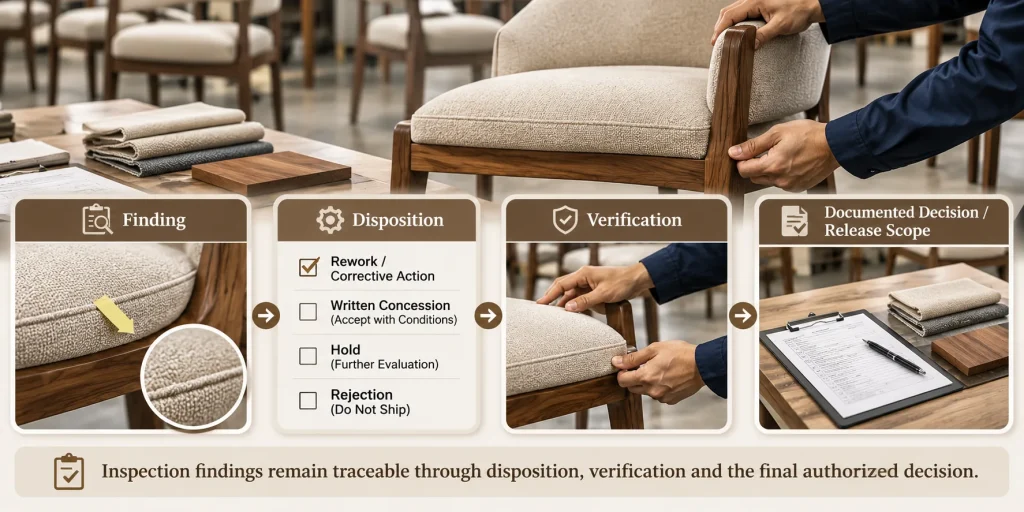
Restaurant furniture pre-shipment inspection is only as useful as the record that survives after a finding has been resolved. Retaining the original observation and subsequent decision makes the final inspection outcome easier to verify.
8. Packing and Carton Marks Come From the Zone Schedule
Packaging inspection is often treated as a separate activity focused on protection, carton condition and labels. For a multi-zone restaurant furniture project, carton identification should also connect the packaged furniture to the order and installation schedule.
The zone schedule identifies which item codes belong to the main dining area, bar, private dining room, terrace or other project locations. Packing records then connect those items to the cartons, crates or packages used for shipping.
The relevant question is not simply whether a carton has a label. It is whether the package can be reliably matched to the correct furniture item, quantity and intended destination.
This distinction becomes important when a furniture assembly is divided among several packages. A banquette may be shipped as multiple sections, while a dining table may have its tabletop and base packed separately. The packing list should make these relationships understandable so that the receiving and installation teams can identify the correct components.
Carton markings must provide a reliable link to the packing list and the corresponding order items. Where a full sample revision or drawing reference is not printed on the carton, the carton number and packing records should still allow the shipment to be traced to the correct item code, approved specification and destination zone.
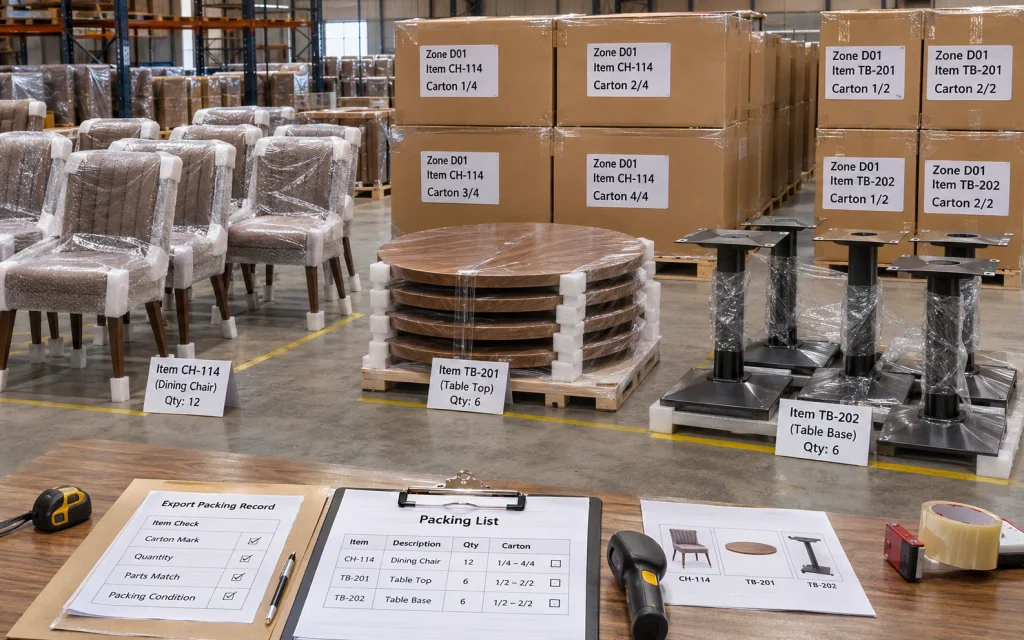
For example, a carton identifier could reference a packing list entry that identifies the furniture item, finish variant and approved drawing revision. The entire specification does not need to be reproduced on every package when the supporting records provide a reliable connection.
This process also supports the inspection record. If a package is opened during inspection, the inspector should be able to identify which item and approved reference apply. The receiving team should later be able to use the same package information to connect the delivered furniture to its installation location.
Any inconsistency among the purchase order, packing list and zone schedule should be clarified before shipment rather than left for the installation team to resolve on site.
9. What “Release” Actually Authorises — and What It Does Not
Release is one of the most important decisions in a pre-shipment inspection process because the word can carry different meanings depending on the inspection agreement and the authority of the person issuing the decision.
A pre-shipment inspection release records the outcome of the agreed inspection scope and any associated disposition decisions. It identifies the item codes and revisions examined, the checks completed, and the findings that have been resolved or expressly accepted.
Whether the goods may proceed to loading depends on the authority assigned in the purchase agreement and the separate shipping arrangements. An inspector’s recommendation, the buyer’s acceptance of deviations and the operational authorization to load should not be treated as automatically interchangeable.
Define the Scope of Release
A release record should make clear which items and revisions are covered and which inspection criteria were applied. It should also identify outstanding findings, authorized concessions and any conditions attached to the decision.
For example, a report may recommend release of the inspected dining chairs while retaining a hold on a particular banquette section awaiting rework. That distinction should remain visible in the release note and related shipment documentation.
An inspection release does not establish that every unit in the shipment is free from defects, particularly when inspection coverage is limited. It also does not extend to uninspected items, later product changes or conditions outside the agreed inspection scope.
Separate Pre-Shipment Release From Receiving Inspection
Pre-shipment inspection and receiving inspection are different events.
The first records the condition and conformity of inspected goods before shipment. The second records the goods received at the destination, including package identification, completeness and any visible condition changes occurring between shipment and delivery.
Both records should use compatible item codes and package references. If damage or shortages are discovered after arrival, the receiving team can compare its observations with the pre-shipment evidence without treating the documents as interchangeable.
Release records what was inspected and what decisions were made before shipment. Receiving records what actually arrived. Maintaining both records provides a clearer basis for resolving discrepancies.
10. Agree the Inspection Terms Before Production Starts
An order-specific inspection checklist cannot function effectively if the applicable criteria are discussed only when the goods are already packed for shipment. By that stage, the production schedule, freight arrangements and installation planning may be difficult to change without additional consequences.
The inspection scope should therefore be agreed while the purchase order and supporting documents are being finalized. The buyer and supplier should establish who will conduct the inspection, who may attend or review the results, and what information the inspector will receive. They should also identify the products and quantities covered, the intended inspection method and the basis on which inspection coverage will be determined.
Acceptance criteria require the same level of attention. Where the project relies on approved physical samples, the inspection instructions should identify those samples and their revisions. Where measurements, tests or construction checks are required, the applicable methods and agreed requirements should be documented. Where a specification is incomplete, the unresolved issue should be referred to the responsible party rather than filled with an assumed industry value.
The project should also establish who may authorize concessions, require rework, place goods on hold and issue any final release decision. An inspection company or supplier representative may be responsible for reporting observations without necessarily having authority to change the purchase agreement or authorize shipment.
This guide deliberately does not prescribe a universal sampling level, defect allowance, dimensional tolerance, test standard or inspection service. Those requirements depend on the product, project, contractual arrangements and applicable market requirements. A numerical acceptance threshold copied from another project is not automatically suitable for the current order.
The objective is to confirm the inspection process early enough for all parties to understand what will be checked, how results will be documented and what happens when a requirement is not met.
11. Frequently Asked Questions
What is restaurant furniture pre-shipment inspection?
Restaurant furniture pre-shipment inspection is the examination of furniture against agreed requirements before shipment. It may include checks of materials, finishes, construction, product identification, packaging and other attributes specified in the purchase order or supporting documents. The inspection record should identify the scope, criteria, findings and applicable decisions rather than relying only on a general statement that the furniture passed inspection.
What if the supplier uses its own inspection report format?
Different report formats can be acceptable as long as the results can be traced to the agreed order requirements. Ask the supplier to map its report references to the relevant item codes, revisions, approved samples and inspection criteria. A supplier report can serve as supporting evidence, but an internal numbering system without a link to the purchase order may make later verification difficult.
Can an inspection finding change the approved furniture sample?
An inspection finding does not automatically change the approved sample. If a proposed resolution requires changing an accepted material, finish or construction detail, the project should follow the applicable revision and approval procedure. The new reference should be documented and the affected order and inspection records updated where necessary. Rework that restores conformity to the existing specification normally does not require changing the original approved sample.
What should be kept after the furniture arrives?
Retain the inspection sheet, applicable reference documents, findings, photographs, corrective-action records, re-inspection results and release documentation. The receiving record should also be linked to the relevant item codes and carton references. Keeping the complete history makes it easier to establish which approved revision was used, what was observed before shipment and how any discrepancies were resolved.
Who fills in the inspection check rows—the buyer or the supplier?
The buyer should establish or approve the relevant order requirements, while the supplier and designated inspection parties should confirm how those requirements will be examined and documented. The person conducting the inspection records the actual observations and evidence according to the agreed scope. Responsibilities can differ by contract, so they should be stated in writing rather than assumed. Neither side should silently introduce acceptance criteria that the other has not agreed to.
Does a passed inspection guarantee that every item is defect-free?
No. An inspection result applies to the products, characteristics and coverage included in the agreed inspection scope. It does not automatically establish conformity for items or attributes that were not examined, nor does it guarantee that damage cannot occur during transportation. The inspection report should clearly distinguish examined items, accepted deviations, unresolved findings and any limitations of the inspection.
Should packing and carton labels be included in the inspection?
Packing and carton identification should be included when they form part of the agreed shipment requirements. The inspector may need to verify that packages can be traced to the packing list, item codes and destination zones, particularly for mixed furniture orders. The necessary checks depend on the approved packing requirements and the documentation agreed by the buyer and supplier.
12. Send the Check Sheet With Your Order Pack
The most practical time to establish a pre-shipment inspection check sheet is before the production run begins, while the relevant requirements and document references can still be clarified. Build the proposed inspection criteria from the purchase order, approved sample register, drawings and zone schedule, then include the check sheet with the order documentation.
For customized restaurant furniture, a consistent set of item codes and approved references can help the buyer, supplier and inspection team identify which requirements apply to each product. This is especially important for projects containing multiple upholstery selections, finish variants, fixed seating sections or furniture components that will be packed separately.
MingMeng Furniture works with commercial restaurant, hotel, bar and café furniture projects, including project-based customization of dining chairs, tables, booths, bar stools and related hospitality furniture. When requesting a quotation or discussing an existing order, provide the applicable item schedule, drawings, material references and any proposed inspection requirements so that the required documentation and responsibilities can be reviewed.
For projects involving restaurant furniture, the inspection process should remain connected to the same files used during quotation and sample approval. This makes it easier to identify unresolved questions before production and retain a usable record through shipping and receiving.
Discuss Your Restaurant Furniture Inspection Requirements
Contact MingMeng to discuss project specifications, approved samples and the documentation required for your furniture order.
Guangzhou Mingmeng Furniture Co., Ltd.
Email: eiko@mingmeng07.com
Phone: +86 13632456645
WhatsApp: +86 15812400982
Last updated: November 13, 2026.
Important Notice: This article is a documentation guide, not a product specification, certification or commitment to provide inspection services. Inspection scope, acceptance criteria, sampling arrangements, inspection responsibilities and release authority must be agreed in writing for each order. Fire safety, accessibility, material performance and import requirements vary by product and destination market. Confirm applicable requirements and supporting evidence with qualified professionals and the relevant authorities before production and installation. No defect-free outcome or universal acceptance threshold is promised.


