
 English
 Zulu
 Igbo
 Yoruba
 Xhosa
 Afrikaans
 Sesotho
 Thai
 Vietnamese
 Indonesian
 Malay
 Lao
 Myanmar
 Khmer
 Turkish
 Hausa
 Portuguese
 Hindi
 Arabic
 Russian
 Japanese
 Chinese
Restaurant furniture sample approval is the point where a design preference becomes a production reference. A fabric choice, wood stain or metal finish may look right in a presentation, but that does not tell the factory which exact material, revision or application the buyer has accepted. Without a traceable approval record, the buyer, designer and supplier may be working from different samples when production starts, potentially resulting in inconsistent upholstery, unexpected finish variations, incorrect material substitutions or disagreements about what was originally approved.
Hotel projects may use formal submittal systems and dedicated document controllers, while restaurant projects often involve owners, designers, contractors and furniture suppliers coordinating decisions through emails, photographs and sample discussions. The challenge is keeping those decisions consistent when several furniture categories and interior zones are being developed at the same time. A practical restaurant furniture sample approval process does not need an unnecessarily complicated document system. It needs an identifiable sample, a named decision-maker, a controlled revision and a clear reference in the purchase and production documents.
This guide explains how to organize fabric, wood and metal finish approvals, manage Customer’s Own Material (COM), and create a reusable approval register for restaurant furniture projects. It focuses on the documentation and decision-making process that connects material selection with production, rather than simply describing how to choose attractive furniture finishes.

Key Takeaway: An approval is not simply a signature. It is a documented decision that identifies the exact sample, the attributes accepted, the person responsible and the production documents that must follow it.
1. What Counts as an Approved Sample?
A furniture sample becomes an approved reference only when another person can identify exactly what was reviewed and understand what the decision authorizes. A fabric swatch attached to a mood board, an unlabelled wood finish chip or a photograph saved in a messaging conversation may help communicate a preference, but none is sufficient on its own if the factory cannot identify the exact material that should be used. If two people could select different samples when asked for the approved version, the identification process has failed.
A reliable approval record should establish four things: sample identification, approval authority, revision control and production reference. These elements ensure that the buyer, designer and supplier are working from the same accepted specification when manufacturing begins.
Identifiable. Every physical reference should carry a unique sample ID that also appears in the approval register. The ID connects the material or product to its project, furniture item and component, making it possible to retrieve the correct reference without relying on colour descriptions or informal conversations.
Attributable. The record should identify who made the decision and what they were authorized to approve. For example, a designer may approve the visual appearance of an upholstery fabric, while the restaurant operator still needs to review its cleaning requirements and suitability for the intended environment. One person’s approval should not automatically be interpreted as acceptance of every technical, commercial or operational requirement.
Versioned. Every revised sample needs a distinguishable revision reference. A supplier may change a fabric article, adjust a stain colour, modify a metal coating or propose a different component during development. These changes are manageable when the original and revised references have separate records and clear statuses; problems arise when several samples are marked approved without identifying which one is current.
Referenced. The approved sample must be connected to the documents used for purchasing, manufacturing and inspection. The purchase order, drawing, material schedule and inspection instructions should all refer to the same sample ID and revision. An approval that exists only in an email or sample room cannot reliably control production.
A restaurant furniture sample approval file can be a simple spreadsheet supported by labelled physical samples and photographs. It does not require an elaborate hotel-style submittal system, provided that all four requirements can be satisfied and the approved reference can be retrieved when needed.
2. Where This Page Fits in Your Project File
Sample approval is one stage of a larger restaurant furniture procurement process. It should not replace the documents used for supplier selection, quotation preparation or project scheduling, because each document answers a different question and controls a different stage of the project.
| Project document | Main question | What it provides |
|---|---|---|
| Restaurant Furniture Project Timeline | When must each decision be completed? | A dated sampling and approval milestone |
| Restaurant Furniture RFQ Checklist | What information should suppliers receive before quoting? | Item schedules, drawings and open-item records |
| Restaurant Furniture Supplier Audit Checklist | Can the supplier manufacture the required furniture consistently? | Supplier capability and quality information |
| Sample Approval Register | What exactly has been approved? | A traceable sample and decision record |
The four documents form a connected workflow. First, the RFQ identifies which materials, finishes and product details are confirmed or still undecided. The project timeline establishes when samples must be available for review, while supplier evaluation establishes whether the factory can produce the specified furniture. Finally, the sample approval record confirms which physical materials and product details have been accepted before the relevant production release.
There is an important handoff between the RFQ and sample approval. For example, the RFQ may contain an open item stating that the upholstery colour is awaiting designer confirmation. Once the fabric is selected and reviewed, that open item should become a documented approval record rather than simply disappearing from the original checklist. This preserves the decision history and prevents an unconfirmed supplier assumption from becoming an unintended production specification.
The purpose of this page is therefore narrow: it controls the transition from material selection to documented approval. For the information required before requesting supplier quotations, see our Restaurant Furniture RFQ Checklist. The sample approval process begins once the project team has identified the materials and product details that need formal review.
3. Which Samples Does One Chair Need?
A request to send a chair sample may sound like a single decision, but an upholstered restaurant chair contains several components that may need separate approval. The upholstery, wooden frame, metal fittings and stitching each have different characteristics, and a single photograph rarely demonstrates all of them adequately. Before requesting samples, identify which components affect the appearance, construction or intended use of the finished product.
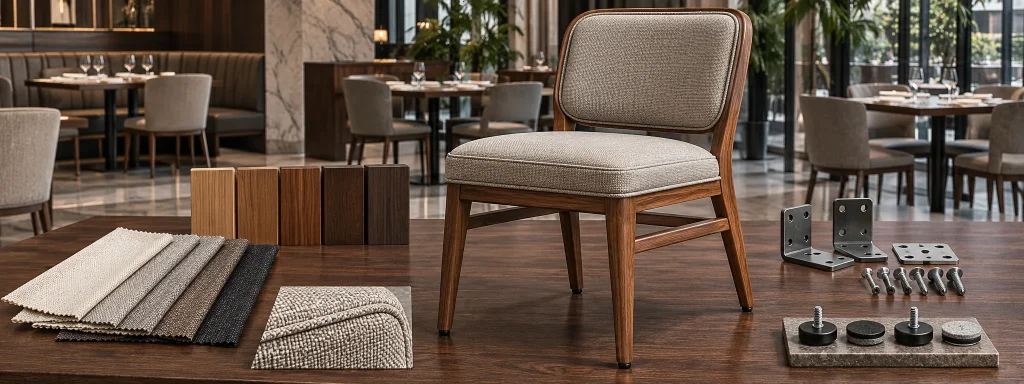
| Component | What the physical sample should show | What a photograph cannot reliably establish |
|---|---|---|
| Upholstery | Colour, texture, pile direction, pattern and hand-feel | Actual texture, stretch and appearance under different lighting |
| Wood | Substrate, veneer, grain, stain and surface sheen | Actual grain variation and finish feel |
| Metal frame | Coating colour, gloss, texture, weld and corner finishing | Surface texture and coating quality |
| Stitching | Seam construction, piping and thread colour | Seam tension and workmanship under use |
| Hardware and glides | Material, dimensions, fitting and floor contact | Actual fit and operating behaviour |
Some samples can serve multiple products. For example, the same approved wood finish may be used across dining chairs, table edges and restaurant booth details. However, the approval register must identify every item and component covered by that shared reference, because a similar colour name does not automatically mean two materials are interchangeable. Differences in substrate, coating system, supplier or production application may change the final appearance.
The useful question is not simply how many samples are required, but how many separate decisions each furniture item contains and whether one physical reference can demonstrate all of them. For a complete restaurant furniture package, a single chair sample may not be enough. A fabric swatch, metal finish sample and wood finish board may need to be approved independently before the complete furniture combination is confirmed.
4. Give Every Sample an ID
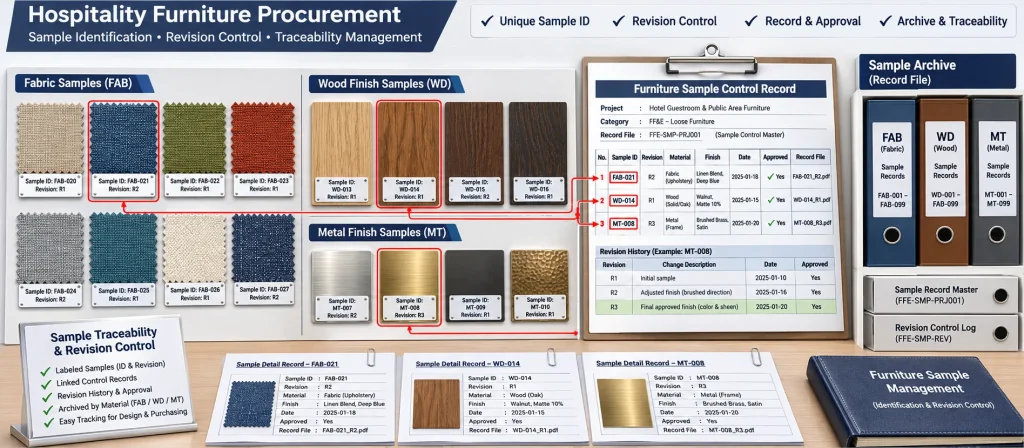
A sample ID connects the physical reference to the project documents. Without a consistent identification method, a supplier may receive several similar fabric swatches or finish samples and have difficulty determining which one belongs to each product. A practical sample ID can combine the project, zone, item code, component and revision, creating a reference that can be used consistently in emails, approval records, drawings and purchase orders.
Illustrative format:
PROJECT-ZONE-ITEM-COMPONENT-REVISION
For example, MM26-DIN-CH01-FAB-R01 identifies a fabric sample for a particular chair in a dining zone. The individual parts represent the project reference (MM26), zone (DIN), furniture item (CH01), component (FAB) and revision (R01). This is an illustrative code, not a real MingMeng project reference; the actual format can be adjusted to match the project’s document control system.
| Field | Required information |
|---|---|
| Project | Project name or reference |
| Zone | Dining, bar, booth, terrace or other area |
| Item code | Matching furniture schedule reference |
| Component | Fabric, wood, metal, hardware or complete item |
| Sample ID | Unique reference |
| Revision | Current sample version |
| Supplier | Material or furniture supplier |
| Date received | Date the sample entered the review process |
| Physical location | Where the reference sample is stored |
Photographs should show the sample label alongside the actual material or product. For larger samples, include photographs of the full item and relevant close-up details so the reference can be identified when several people participate in the approval process. The physical label and digital register should always use the same ID; otherwise, the identification system loses much of its value.
5. Who Can Sign, and What Does a Signature Cover?
One of the most common problems in furniture approval is assuming that every participant has the same approval authority. A designer, restaurant owner, contractor and supplier may all participate in sample review, but they do not necessarily approve the same things. A project should identify the decision-making roles before samples are submitted, particularly when appearance, operational suitability and production authorization involve different people.
| Participant | Typical review responsibility |
|---|---|
| Restaurant owner / buyer | Overall selection and commercial acceptance |
| Interior designer | Visual appearance, colour coordination and design intent |
| Restaurant operator | Practical use, cleaning and maintenance considerations |
| Contractor / project manager | Site coordination and relevant installation interfaces |
| Furniture supplier | Material identification, manufacturing feasibility and technical clarification |
| Qualified specialist | Applicable technical or regulatory review within their professional scope |
These are typical responsibilities, not a universal approval hierarchy. The contract and project documentation determine who has final authority. For example, the designer may confirm that a fabric matches the interior palette, but the restaurant operator may still need to review its cleaning requirements, while the buyer remains responsible for the relevant commercial decision.
The approval record should distinguish between appearance approval, technical or operational review and production authorization. Appearance approval confirms the visual characteristics of the sample, including colour, texture, grain, sheen and overall appearance. Technical or operational review concerns the relevant product information, construction details, use conditions and supporting evidence, while production authorization confirms that the responsible project authority permits the specified item and revision to proceed under the agreed order documents.
These decisions should not be combined into one vague signature. A designer may approve the fabric colour while the operator still needs to confirm cleaning requirements. The sample can therefore be visually accepted without being fully released for production, and the record should make that distinction explicit.
6. One Revision Log, One Live Version
Sample revisions are a normal part of custom furniture development. A fabric may be replaced because the original colour is unavailable, a wood stain may need adjustment after comparison with the flooring, or a metal coating may look different under the restaurant’s installed lighting. The important requirement is to ensure that each change has a recorded history rather than allowing a revised sample to silently replace an earlier reference.
A simple revision log can contain the following information:
| Revision | Change description | Requested by | Review status | Reference |
|---|---|---|---|---|
| R01 | Initial fabric selection | Designer | Under review | Sample ID |
| R02 | Revised colour option | Designer | Pending approval | Sample ID |
| R03 | Final accepted fabric | Buyer | Approved for stated scope | Sample ID |
The entries above are illustrative. When a new revision is accepted, identify the earlier revision it replaces, record the reason for the change, update the relevant material and drawing references, confirm which products and zones are affected, and inform the supplier and project reviewers. Superseded records should be archived rather than deleted, so the project retains a clear history of how the final selection was reached.
It is also important to distinguish a minor documented correction from a material change. A spelling correction in a sample description may not require another physical sample, while a different fabric article, wood substrate, coating system or construction detail may require renewed review. The project team should determine the required level of reapproval according to the nature and impact of the change.
There should be only one current approved reference for each controlled item and component. If an earlier version remains in circulation, the supplier and buyer may unknowingly work from different specifications, creating unnecessary disputes during production or inspection.
7. Approve Fabric, Wood and Metal Separately
Restaurant furniture often combines several materials within one product. A dining chair may include an upholstered seat, a wooden frame and metal fittings, while a booth may combine upholstery, plywood, decorative panels and metal trim. Approving the overall appearance without identifying these individual materials can leave important production details unresolved, particularly when the furniture package contains several models or finish combinations.
Upholstery and Fabric Approval
Fabric approval should identify the exact material rather than relying on a general description such as beige fabric or commercial upholstery. Record the fabric manufacturer and supplier, collection or article reference, colour name and code, material composition where provided, surface texture, pile direction, pattern repeat and intended furniture application. Seam construction, piping and upholstery details should also be documented when they affect the final appearance.
For patterned or directional fabrics, the intended orientation should be clear because a fabric may look different when applied vertically, horizontally or around a curved backrest. Where upholstery has an important visual role, review it on the actual furniture shape rather than relying exclusively on a flat swatch. Any available care and performance documentation relevant to the project should also be retained with the material record.Where flame performance is relevant, name the test method rather than assuming one: the National Fire Protection Association publishes NFPA 701 for textiles, but the applicable method and the required supporting evidence depend on the product and the destination market.
Wood Finish Approval
Wood finish approval should identify both the underlying material and the surface treatment. The record should specify the wood species or substrate, whether the construction uses solid wood, veneer or engineered board, the stain or finish reference, grain direction, visible grain characteristics, surface sheen, texture and edge treatment. Exposed sides should also be reviewed because differences between visible and concealed surfaces may affect the finished product.
A small colour chip may communicate the intended stain but may not represent the final appearance across a larger tabletop or chair frame. Where possible, use a representative sample of the actual substrate and finish system. The approved sample should be suitable for comparison with the finished furniture rather than serving only as a general colour reference.
Metal Finish Approval
Metal finish approval should identify the substrate and surface treatment, including pretreatment or surface preparation where relevant, powder coating, plating or other specified finish, colour reference, gloss and surface texture. Weld appearance, corner finishing, connection details and visible hardware should also be reviewed where they affect the final product. A colour name alone is not enough to identify the complete metal finish specification.
For mixed-material furniture, review the metal and wood samples together. A gold metal frame, for example, may look appropriate independently but appear too yellow or too reflective beside the selected wood stain. Reviewing the materials as a combination helps the project team judge the finished appearance in a way that isolated samples cannot always demonstrate.
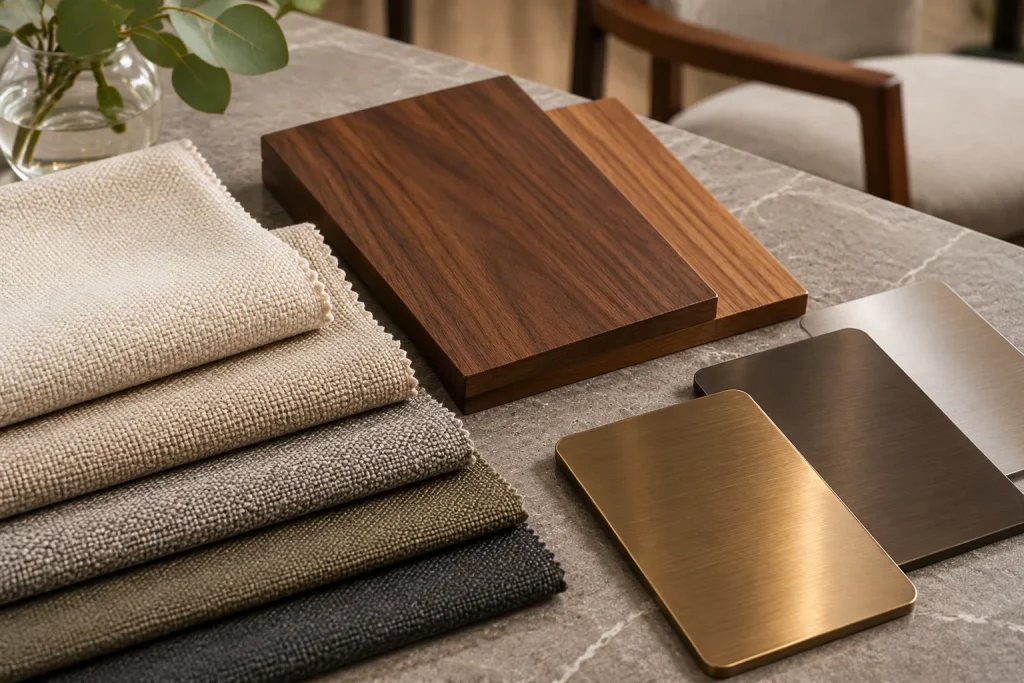
Review the Complete Material Combination
The final review should consider how the approved materials work together under conditions relevant to the restaurant project.
| Review condition | What to examine |
|---|---|
| Neutral lighting | Basic colour and surface appearance |
| Venue lighting | Appearance under the intended restaurant lighting |
| Combined material board | Relationships between upholstery, wood and metal |
| Actual furniture sample | Material application, seams, edges and proportions |
| Production reference | Whether the approved combination can be identified and repeated |
Photographs are useful for documenting what was reviewed, but they should not be treated as a complete replacement for physical samples where colour, texture or material application is critical. The approval record should state whether the decision was based on a physical sample, a complete prototype, a photograph or a combination of references.
8. COM: The Fields to Confirm in Writing
COM stands for Customer’s Own Material. It refers to upholstery material supplied or selected by the customer rather than chosen exclusively from the furniture manufacturer’s standard material collection. COM can provide additional design flexibility, especially when a restaurant project needs to coordinate seating with a specific interior palette or an existing brand standard. However, acceptance of customer-supplied material is not automatic, and different manufacturers may have different eligibility, testing, handling and ordering procedures.
The buyer should therefore obtain written confirmation from the actual furniture supplier before treating a fabric as approved. The following checklist identifies the fields that should be discussed; it does not establish a universal COM policy or prescribe MingMeng’s COM acceptance terms.
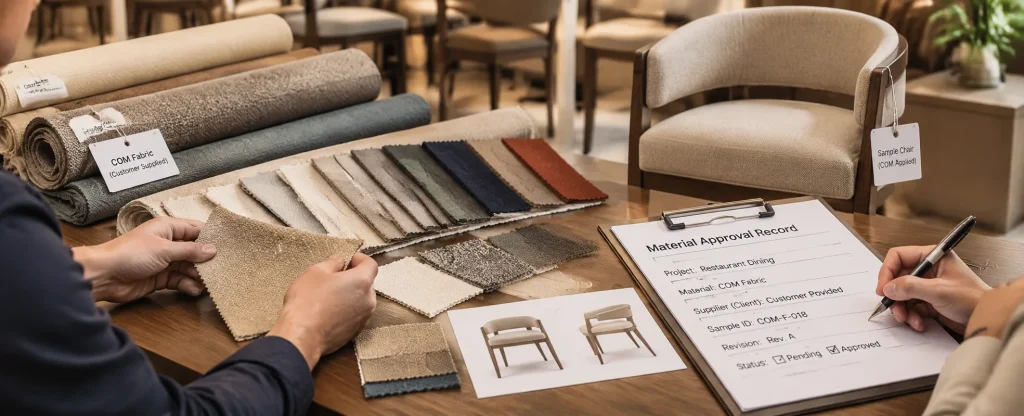
Material identity and application. Record the fabric manufacturer and supplier, collection, pattern and article number, colour name and reference, material composition where available, fabric width and relevant technical information. The intended furniture model and item code should be identified, together with the upholstery component involved, such as the seat, backrest or armrest. Pattern orientation, repeat or matching requirements, and any special sewing, piping or upholstery instructions should also be clarified.
Approval requirements. Confirm whether the selected fabric is eligible for the intended product and whether a physical swatch, additional material sample, testing or manufacturer review is required. The supplier should explain which characteristics its approval actually covers and whether additional review is needed if the material is used on another furniture model or application. Approval for one chair model should not automatically be interpreted as approval for every upholstered product in the project.
Material quantity and delivery. Establish who calculates and confirms the required fabric quantity, where the material must be delivered, who receives it and what identification should appear on the package. Shipping, receiving and material inspection responsibilities should be documented, along with the procedure for shortages, damage or incorrect material. The project should also clarify who is responsible for any remaining material after production.
Commercial and production conditions. Confirm any additional material handling or processing charges, whether customer-supplied material affects the production schedule, and how defects, shortages or substitutions will be handled. Warranty responsibilities for customer-supplied upholstery should also be stated in the supplier’s written terms. These details should be confirmed for the actual order because COM responsibilities can differ between suppliers and projects.
A fabric that works on a flat seat may require a separate application review when used on a curved or patterned backrest. This is why material identity, intended application and supplier acceptance should be documented together rather than treating COM approval as a simple colour-selection decision.
Important: This guide does not establish a universal COM quantity, MOQ, sample charge, approval period or warranty policy. Those details must come from the supplier’s written terms for the actual order.
9. Put the Approved Sample Into the Order
Sample approval is useful only when the production team can identify and follow the same reference. After approval, the sample ID and revision should be transferred into the purchasing and production documentation so that the approved material is not separated from the furniture item it belongs to. The purchase order or its supporting schedule should identify the furniture item code and description, approved sample ID and revision, fabric manufacturer and colour reference, wood and metal finish references, and applicable drawing and specification revisions.
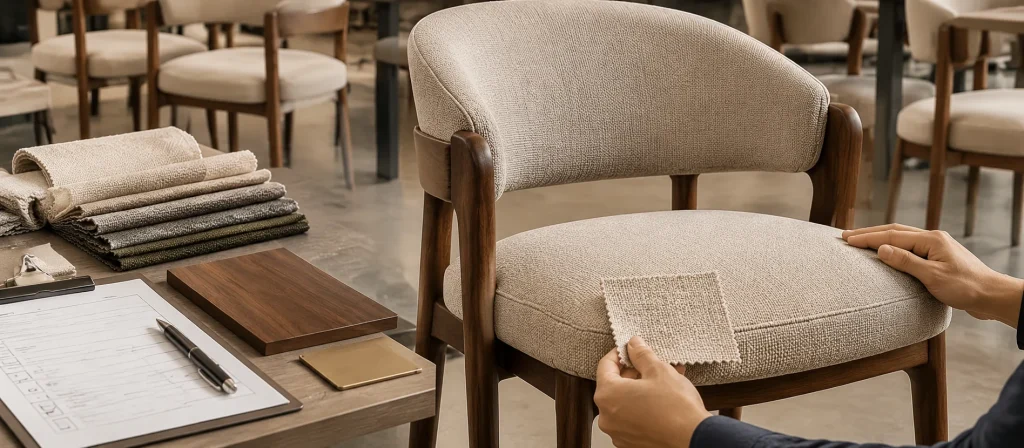
Any approved deviations or special instructions should be recorded, along with remaining items that are not yet approved and the person responsible for final production authorization. This is particularly important when the project contains several similar chairs or booth configurations. Two dining chairs may share the same frame design but use different upholstery colours, so their material references must remain distinguishable even if they appear under the same furniture category.
Separate Approval From Production Release
An approved fabric does not automatically mean the complete chair is ready for production. The drawing, dimensions, construction, hardware, other finishes and commercial conditions may still require confirmation. A practical release check should verify that the order references the correct sample ID, the drawing shows the current approved revision, the material and finish references are consistent, and all relevant approval conditions have been resolved.
Any substitutions must be documented and accepted, and the authorized person must confirm the production release. If an essential item remains unresolved, its status should remain visible. An informal email stating that a sample looks good should not become an unrestricted authorization for the entire furniture order.Where the order states a delivery term, name the rule and its edition rather than leaving it implicit. The International Chamber of Commerce publishes the Incoterms® rules; the current edition is Incoterms® 2020 (ICC, 2020).
10. One Register Across Every Zone
A restaurant project rarely contains only one furniture type. The same project may include dining chairs, bar stools, restaurant booths, communal restaurant tables, outdoor seating and lounge furniture, with each area using different materials and having different approval requirements. A single master approval register helps prevent the project team from managing unrelated samples through separate email conversations.
An illustrative register might look like this:
| Zone | Item code | Component | Approval reference |
|---|---|---|---|
| Dining | DIN-CH01 | Upholstery | FAB-R01 |
| Dining | DIN-CH01 | Wood frame | WD-R01 |
| Bar | BAR-ST01 | Upholstery | FAB-R02 |
| Bar | BAR-ST01 | Metal frame | MT-R01 |
| Booth | BOO-01 | Upholstery | FAB-R03 |
| Terrace | OUT-CH01 | Frame finish | MT-R02 |
All codes above are illustrative and should be replaced with the actual project references. A shared sample can cover multiple products when exactly the same material and application are used, but the register should explicitly list every covered item code. A shared colour name alone is not sufficient because the substrate, finish application, production process or intended use may differ.
Before reusing an approval, confirm that the same material supplier and article are involved, the substrate and finish application are compatible, the production process is consistent, and the intended use is within the reviewed scope. If a product-specific modification changes the result, the team should determine whether a separate sample or additional review is needed.
The master register should also show the current status of each approval, allowing buyers to identify which zones are ready for production and which still contain unresolved decisions. This is especially useful when a project includes several furniture categories and multiple reviewers working at different stages.
11. Five Comments That Are Not Approvals
Some of the most expensive sample mistakes begin with short comments that appear clear during a conversation but leave too much room for interpretation. Statements such as “looks good,” “match the photo” or “use the standard fabric” do not necessarily identify the exact product, material or scope being accepted. The following examples show how informal feedback can be turned into documented instructions.
| Informal comment | More useful written instruction |
|---|---|
| “Looks good.” | “The upholstery appearance is approved for item DIN-CH01 against sample FAB-R01. Technical and production approvals remain separate.” |
| “Match the photo.” | “Use the physical reference identified as WD-R01. The attached photograph is supporting identification only.” |
| “Use the standard fabric.” | “Confirm the manufacturer, collection, article and colour code of the proposed standard fabric before approval.” |
| “Same finish as the dining chairs.” | “Use the finish identified by the specified sample ID, subject to confirmation that the substrate and application are the same.” |
| “Proceed while we confirm the details.” | “Hold the affected production items until the outstanding material and revision questions receive written confirmation.” |
The objective is not to make every email unnecessarily formal, but to ensure that a supplier, buyer and production inspector interpret the same instruction in the same way. A short sentence that identifies the item, reference and approval scope is more valuable than a long conversation that never establishes what was actually accepted.
When the review is incomplete, the decision should remain pending or be marked as approved for a clearly limited scope. This prevents a visual comment from being mistaken for full technical acceptance or production authorization.
12. A Copy-and-Paste Approval Register
A structured approval record makes it easier to transfer sample decisions into purchasing and production documents. The following template can be used in an email, spreadsheet or project document. Replace the placeholders with actual project information and keep unresolved items visible rather than leaving them out of the record.
How to Use the Register
The template should be completed for each controlled sample or component. For example, a dining chair may require separate approval records for its upholstery and wood finish, while the complete chair may need an additional record confirming the assembled appearance and other attributes included in the review. This approach keeps individual material decisions distinguishable without losing the relationship between the components and the finished product.
Do not delete rejected or superseded records. Retain them as part of the revision history so the team can understand how the final selection was reached. When the approved sample is referenced in the purchase order, the corresponding record should be available to the supplier and the relevant inspection team. The objective is to maintain one consistent reference from sample selection through production.
13. Frequently Asked Questions
What is restaurant furniture sample approval?
Restaurant furniture sample approval is the documented review and acceptance of a physical furniture sample, material or finish before the relevant production decision. It identifies the exact reference, the attributes reviewed, the responsible approver and any remaining conditions. The purpose is to ensure that the buyer, designer and supplier share the same understanding of what has been accepted.
Do I need to approve every restaurant chair individually?
Not necessarily. A representative sample may cover multiple identical items when their construction, materials, finishes and intended application are the same. However, different models, materials, suppliers or upholstery applications may require separate approval references. The project register should identify every item covered by a shared approval rather than relying on a general product description.
Can a photograph replace a physical furniture sample?
Photographs are useful for documenting sample identity, appearance and review comments, but they cannot reliably establish actual hand-feel, texture, material thickness or colour under different lighting conditions. Physical review is particularly important when these characteristics are central to the design decision. Where a photograph is used as the review reference, the record should state exactly what was reviewed and what limitations remain.
What is the difference between sample approval and production approval?
Sample approval confirms the attributes that have been reviewed and accepted, such as fabric colour, wood stain or metal finish. Production approval is a separate authorization that allows the specified product and revision to proceed under the agreed project documents. The two decisions should not be treated as interchangeable because the complete furniture specification may still contain unresolved technical or commercial details after a material sample has been approved.
What should be included in a COM fabric approval?
A COM review should identify the fabric manufacturer, collection, article, colour, intended furniture application, fabric direction and supplier acceptance requirements. Material quantity, delivery responsibilities, inspection procedures and any relevant commercial conditions should also be confirmed in writing. The actual requirements depend on the furniture manufacturer and the project, so buyers should obtain the supplier’s specific terms rather than assuming that all COM arrangements are the same.
What happens if the approved fabric or finish changes?
The supplier should identify the proposed change and explain which products and components are affected. The project team should review the revised material, update the relevant sample ID and revision, and obtain written approval from the appropriate decision-maker before using the substitute. The previous approval should remain in the revision history so that the project retains a clear record of the change.
Who should keep the approved furniture sample?
The project should identify where the physical reference is stored and who is responsible for maintaining it. Where practical, the buyer and supplier should both retain access to the approved reference or its controlled documentation. The location and custody of the sample should be recorded so it can be retrieved during production and inspection, particularly when several furniture categories use similar materials or finishes.
14. Send the Approval Pack to MingMeng
A well-organized sample approval file helps restaurant owners, designers, contractors and furniture manufacturers work from the same material and product references. For a project involving dining chairs, restaurant booths, tables, bar stools or outdoor furniture, the approval process should connect the selected materials to the actual furniture items and the relevant order documents. This creates a clearer basis for production coordination and reduces the risk of misunderstandings when multiple finishes or product variations are involved.
MingMeng Furniture Co., Ltd. works with global restaurant, hotel, bar and café projects, providing factory-direct commercial furniture solutions with project-based product and material customization. When discussing a furniture project, prepare the project location and intended opening schedule, furniture item list and estimated quantities, floor plan or furniture layout where available, reference images and product requirements, preferred upholstery, wood and metal finishes, any COM material information, and outstanding design or specification questions. This information helps establish which furniture samples and material references need to be reviewed before the order proceeds.
MingMeng Furniture Co., Ltd.
Email: eiko@mingmeng07.com
Phone: +86 13632456645
WhatsApp: +86 15812400982
Contact MingMeng to discuss your restaurant furniture requirements and project-specific sample approval arrangements.
Important Notice: This checklist is a project documentation guide, not a substitute for contractual requirements, independent testing or professional compliance review. Fire safety, accessibility, material performance and other regulatory requirements vary by product and destination market. In the United States, the U.S. Access Board publishes the ADA Accessibility Standards; the Department of Justice 2010 Standards are the usual reference point for accessible design (U.S. Access Board, 2010).
Which requirements apply to a given product and market must still be confirmed with qualified professionals and the relevant authorities.Confirm applicable requirements and supporting evidence with qualified professionals and the relevant authorities before production and installation.