
 English
 Zulu
 Igbo
 Yoruba
 Xhosa
 Afrikaans
 Sesotho
 Thai
 Vietnamese
 Indonesian
 Malay
 Lao
 Myanmar
 Khmer
 Turkish
 Hausa
 Portuguese
 Hindi
 Arabic
 Russian
 Japanese
 Chinese
When we at Mingmeng Furniture customized wood booth seating for a Canadian restaurant chain, the buyer did not start by asking about price. Their first question was more practical: “Can your booth base be cleaned easily after dinner service?”
That question was smart.
In many restaurant projects, wood restaurant booths fail not because the surface looks bad, but because small design details are ignored. Crumbs collect under the base. Sauce leaks into the gap between the seat and backrest. Low-density foam collapses after months of lunch traffic. A beautiful wood finish starts to turn dull after repeated cleaning with alcohol-based disinfectants.
A booth is not just a seat. For cafés, diners, hotel restaurants, bars, and franchise dining spaces, it is part of the daily operating system. It affects cleaning time, seating density, guest comfort, maintenance cost, and even how quickly staff can reset a table.
This guide explains what B2B buyers should check before ordering commercial wood restaurant booths.
1. Start with the Frame, Not the Photo
A wood booth can look strong in a catalog photo and still be weak inside.
We have seen buyers compare booths only by exterior design: walnut color, channel back, curved profile, leather color, button tufting. Those things matter, but the real difference is usually hidden under the upholstery.
For commercial dining projects, the frame should be checked first.
Common Frame Options
| Frame Material | Best Use | Procurement Notes |
|---|---|---|
| Solid hardwood | Premium booths, exposed wood details, long-term projects | Strong and stable when kiln-dried properly, but cost is higher |
| Commercial plywood | Upholstered booth structures, chain restaurant projects | Stable, cost-effective, good for shaped booth frames |
| Softwood frame | Low-budget projects | Lower cost, but may loosen faster under heavy commercial use |
| Metal-reinforced wood frame | High-traffic restaurants, public dining areas | Useful for long benches, corner booths, and heavy-duty seating |
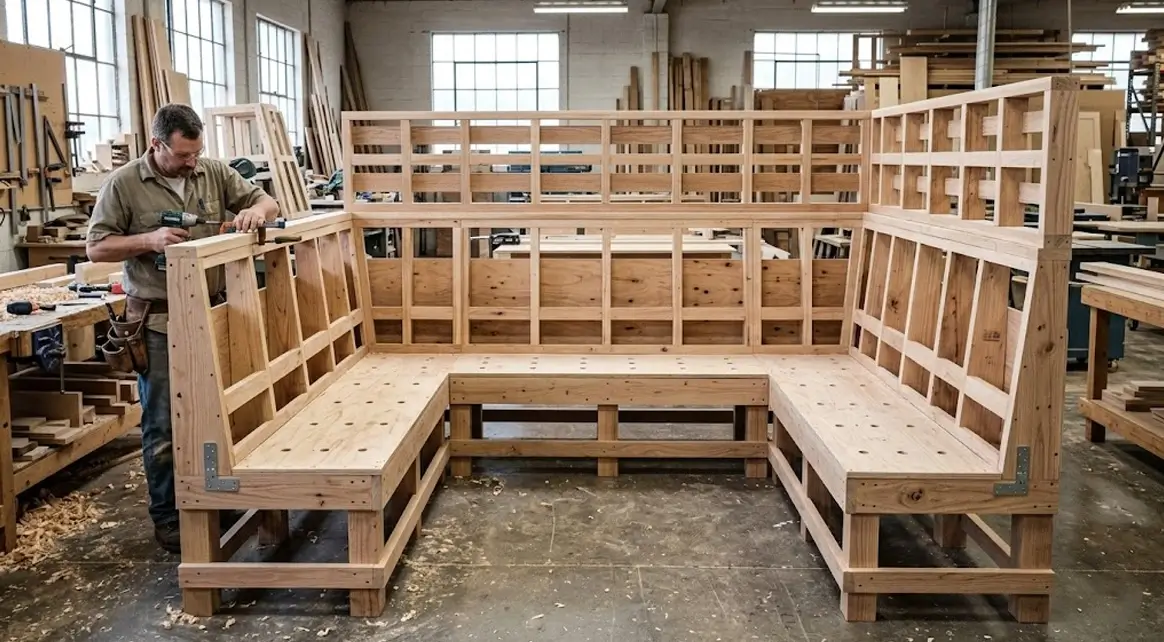
For most upholstered restaurant booths, we usually recommend a reinforced hardwood or commercial-grade plywood frame rather than a cheap softwood structure. Solid hardwood is not always necessary for every hidden frame, but weak softwood in load-bearing areas can cause wobbling, cracking, or loose backrests.
The seat-to-back joint deserves special attention. Guests lean back, slide sideways, and push against the backrest hundreds of times a day. If this joint only depends on shallow screws, it may feel fine during the sample stage but loosen after repeated use.
For higher-traffic projects, ask the manufacturer how the seat frame, back frame, and base are connected. A reliable booth manufacturer should be able to explain this clearly, not just send a pretty rendering.
2. Practical Booth Dimensions Buyers Should Confirm
Many booth problems come from wrong dimensions, not poor materials.
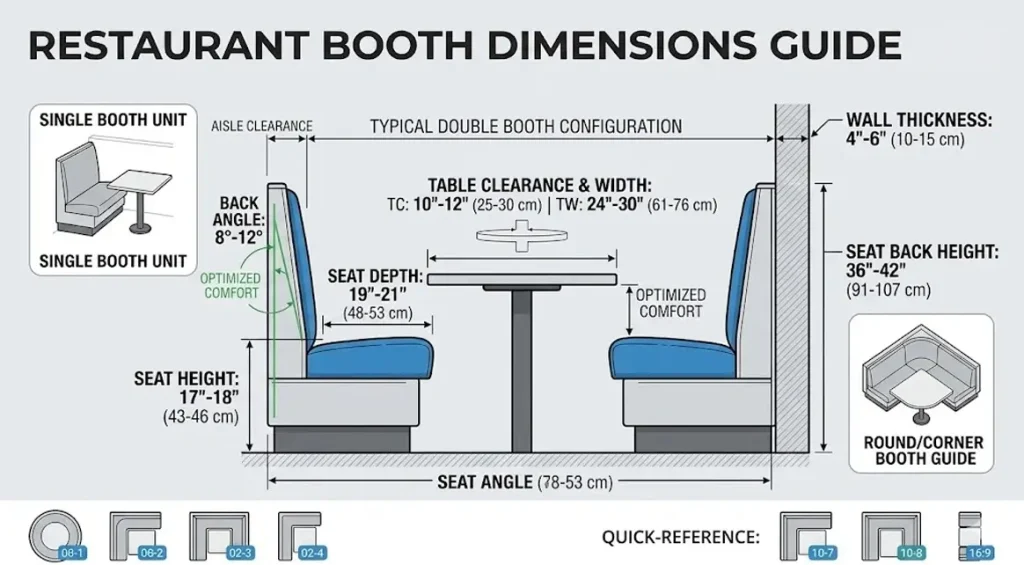
A booth can be well made but still uncomfortable if the seat is too deep, the backrest is too straight, or the table clearance is wrong. This is why we usually ask buyers for a floor plan before quoting a custom booth project.
Recommended Commercial Booth Dimensions
| Item | Common Recommendation | Notes |
|---|---|---|
| Seat height | 18 inches / 45–46 cm | Works with most standard dining tables |
| Seat depth | 18–20 inches / 46–51 cm | Too deep may feel awkward for shorter guests |
| Back height | 36–42 inches / 91–107 cm | Higher backs create more privacy |
| Back angle | 100–105° | More comfortable than a vertical back |
| Table height | 29–30 inches / 74–76 cm | Standard dining table height |
| Table clearance from seat | 10–12 inches / 25–30 cm | Helps guests sit and move comfortably |
| Aisle clearance | Around 36 inches / 91 cm where required | Important for service flow and accessibility planning |
| Toe-kick recess | 3–4 inches / 7.5–10 cm | Helps staff clean and allows foot space |
For the Canadian chain restaurant project, the original drawing showed a closed base that touched the floor completely. It looked clean in the rendering, but it would have trapped dust and food debris along the back edge.
We changed the design to a raised toe-kick base with easier mop access. It was not a dramatic visual change, but it made daily cleaning much easier for the restaurant team. This is the kind of detail that rarely appears in a product photo but matters every night after closing.
3. Foam Density: The Detail Guests Notice First
The frame keeps the booth stable. The foam decides whether guests still feel comfortable after months of use.
Low-density foam often feels soft at first. That is the trap. In a showroom, it may feel comfortable for five minutes. In a busy restaurant, after lunch rushes, dinner service, and weekend turnover, it can flatten quickly.
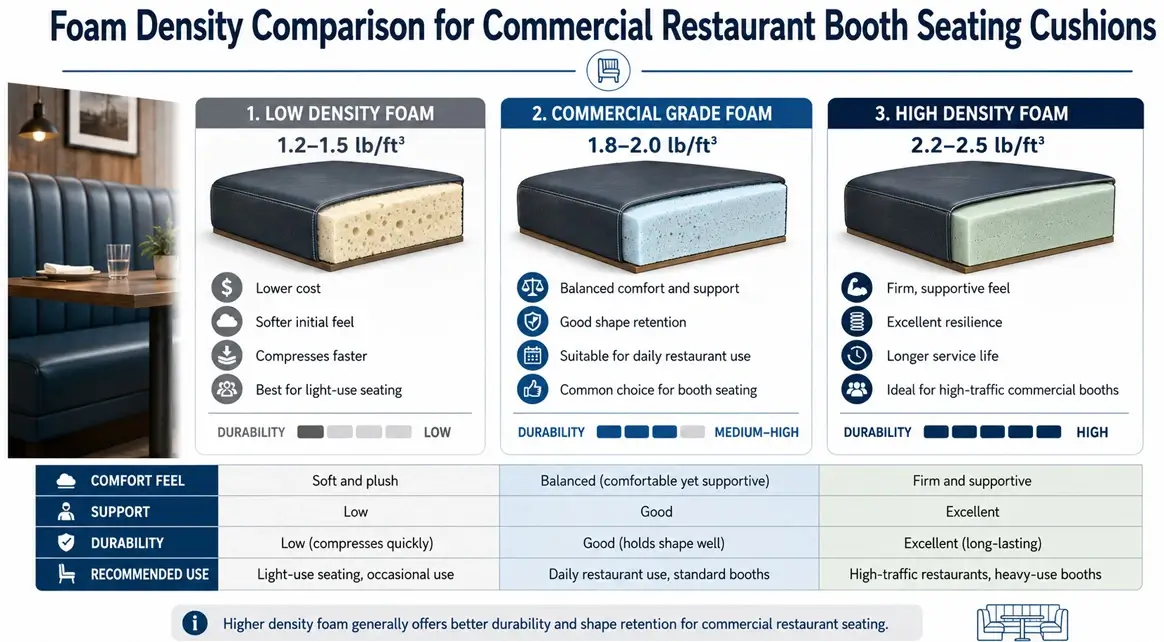
For commercial booth seating, buyers should ask for foam density and compression performance.
Foam Comparison for Restaurant Booths
| Foam Type | Typical Use | Commercial Performance |
|---|---|---|
| 1.2–1.5 lb/ft³ foam | Low-cost residential seating | Soft at first, higher risk of early sagging |
| 1.8 lb/ft³ foam | Light commercial back cushions | Better for backrests than heavy-use seats |
| 2.0–2.2 lb/ft³ foam | Commercial restaurant seats | Better support for daily use |
| High-resilience foam | Premium hospitality seating | Better rebound and comfort, higher cost |
For high-traffic restaurants, we normally suggest using firmer high-density foam for the seat and slightly softer foam for the back. A booth seat should not feel like a sofa. If it is too soft, guests sink too low, table clearance becomes awkward, and the cushion may lose shape faster.
A practical specification could look like this:
- seat cushion: around 2.0–2.2 lb/ft³ high-density polyurethane foam
- back cushion: around 1.8 lb/ft³ foam, depending on design
- seat firmness: medium-firm, not overly soft
- cushion edge: reinforced or shaped to reduce collapse at the front edge
For bulk projects, ask whether the sample foam and mass production foam will be the same. This sounds basic, but it is a real procurement issue. Some suppliers make a good sample, then quietly change the foam specification during batch production.
4. Fire-Rated Materials: Confirm Before You Pay the Deposit
Fire requirements are not the same in every market. A restaurant in Canada, a hotel lounge in the UK, and a café chain in the Middle East may have different requirements for upholstery and foam.
For North American projects, buyers may ask about California TB117-2013, commonly known as CAL117. It focuses on the smolder resistance of upholstered furniture components such as cover fabrics, barrier materials, resilient filling materials, and decking materials.
For UK hospitality projects, BS 5852 Crib 5 may be requested for contract upholstered seating in pubs, hotels, clubs, and public dining spaces.
The important point is simple: do not ask only whether the booth is “fireproof.” That word is too vague.
Ask these questions instead:
- Which fire standard does my project actually require?
- Is the report for the fabric only, or for the foam and fabric combination?
- Can the supplier provide batch documentation if needed?
- Will the same approved material be used in mass production?
- Does the project need fire labels on the finished booths?
For custom restaurant booths, fire compliance should be discussed before material approval. Waiting until the local inspection stage is too late.
5. Wood Finish: Good-Looking Is Not Enough
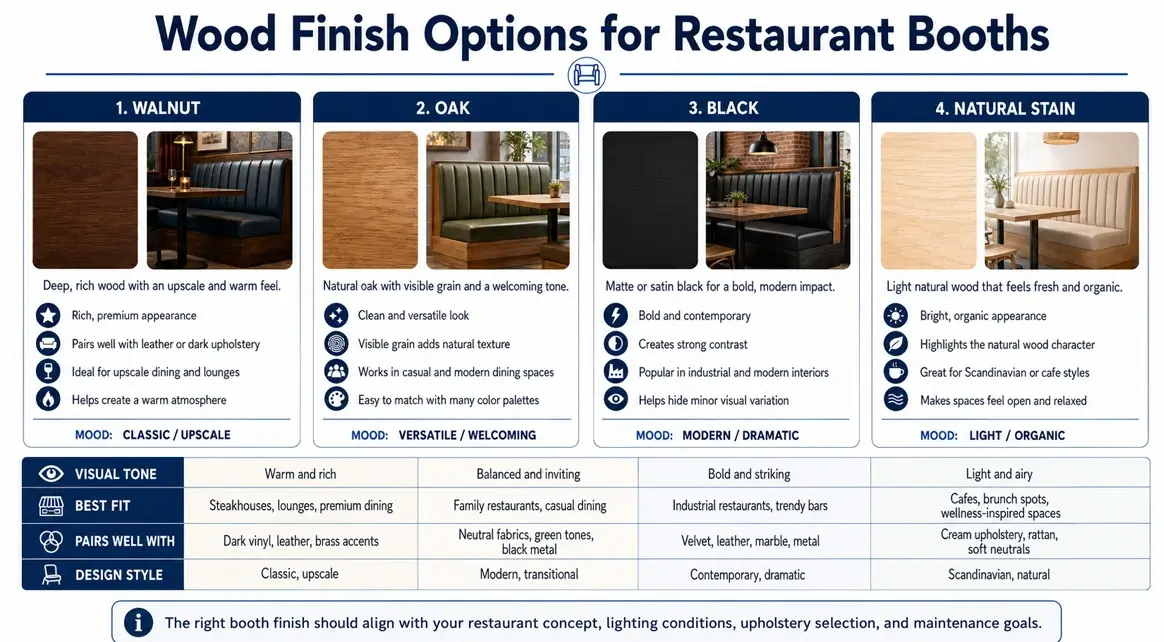
Wood restaurant booths need to look good, but they also need to survive cleaning.
In real restaurants, staff wipe booth surfaces quickly. They may use mild detergent, alcohol-based cleaners, or disinfectant wipes. Drinks spill. Children scratch the edge with cutlery. Bags and coats rub against the side panels.
A weak finish will show these problems early.
Common Finish Options
| Finish Type | Best Use | Buying Notes |
|---|---|---|
| Catalyzed conversion varnish | High-touch wood surfaces | Good durability when properly applied |
| 2K polyurethane finish | Higher-wear commercial areas | Stronger protection, useful for exposed wood edges |
| Water-based lacquer | Lower-VOC projects | Better for sustainability goals, but check durability |
| Custom stain | Brand-specific interiors | Always approve a physical sample |
Digital photos are not enough for wood finish approval. Walnut can look red in one lighting condition and dark brown in another. Oak can look warm, yellow, or grey depending on the stain and restaurant lighting.
For chain restaurants, we recommend keeping one approved master sample. Future repeat orders can then be matched more closely.
Another small but expensive issue is edge protection. Exposed booth corners and base edges take a lot of impact from shoes, mops, carts, and vacuum cleaners. If your booth design has exposed wood edges, ask whether those edges are rounded, sealed, and protected with a stronger finish system.
6. Cleanability: The Detail Restaurant Staff Care About
This is where many booth designs fail.
A booth can look beautiful in the dining room but become a cleaning problem after two weeks of service. The most common issue is the gap between the seat cushion and the backrest. Crumbs, sauce, napkins, and small trash fall into that space. Staff need extra time to clean it, and if the gap is deep, it becomes a hygiene problem.
For commercial wood restaurant booths, we usually review these cleaning details:
- Is there a deep gap between the seat and back?
- Can the cushion be removed for cleaning?
- Is the base raised enough for mop access?
- Are there exposed seams where liquid can enter?
- Is the bottom panel protected from wet mopping?
- Are the corners easy to wipe?
- Will floor cleaning equipment hit the base repeatedly?
For the Canadian chain restaurant project, the buyer originally wanted a fully boxed base because it looked more solid. After discussing cleaning routines, we adjusted the base with a recessed toe-kick and smoother lower edge. The visual effect stayed clean, but staff could reach the floor line more easily.
This is not a “luxury detail.” It saves labor every day.
7. Upholstery Choice: Fabric, Vinyl, or Faux Leather?
The upholstery should match the restaurant style, but it also needs to match the cleaning routine.
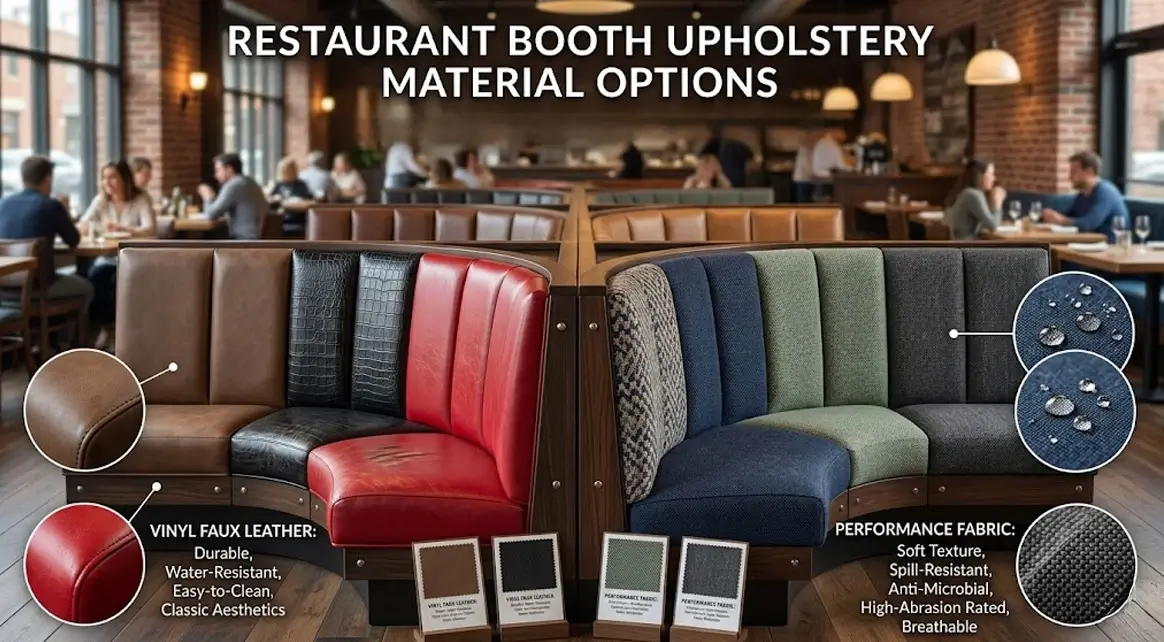
Upholstery Material Comparison
| Upholstery Material | Advantages | Watch Out For |
|---|---|---|
| Commercial vinyl | Easy to clean, good for diners and casual restaurants | Can feel less premium if texture is poor |
| Faux leather | Warm appearance, popular for booths | Needs good abrasion resistance and seam quality |
| Performance fabric | Softer, better for hotels and cafés | Must check stain resistance and cleaning method |
| Customer’s own material | Good for brand-specific projects | Must be tested for abrasion, stretching, and fire requirements |
For busy restaurants, vinyl and faux leather are often more practical than delicate woven fabric. For hotels and premium dining spaces, performance fabric may feel more refined, but it needs stronger stain protection.
Ask for abrasion data when possible, such as Martindale or Wyzenbeek testing. For commercial use, the exact requirement depends on the project, but the material should be selected for repeated sitting, cleaning, and friction—not just appearance.
8. Custom Manufacturing: Why Standard Booths Often Waste Space
Off-the-shelf booths may work for simple layouts, but many restaurants have columns, wall corners, uneven dimensions, banquette runs, window areas, or brand-specific seating requirements.
Custom manufacturing helps control:
- seat count
- wall fit
- booth height
- privacy level
- aisle width
- table alignment
- brand color matching
- future replacement consistency
- shipping method
- installation process
A typical custom booth process should include:
- Buyer provides floor plan, PDF, CAD drawing, or hand sketch.
- Manufacturer reviews wall length, table size, and aisle needs.
- Shop drawings are prepared.
- Seat height, depth, back angle, and base structure are confirmed.
- Wood finish and upholstery samples are approved.
- A first-off sample is made for larger projects when needed.
- Mass production starts after drawing and material approval.
- Packing photos are checked before shipment.
For restaurant chains, custom manufacturing is especially valuable because the same booth style may need to be repeated across different locations. If the manufacturer cannot control drawings, materials, and batch consistency, each location may look slightly different.
9. Export Packing: Do Not Wait Until Shipment to Discuss It
Wood restaurant booths are difficult to ship because they are large, heavy, and easy to damage at corners.
A good packing plan should protect:
- exposed wood edges
- upholstery surfaces
- booth corners
- base panels
- hardware
- loose parts
- moisture-sensitive areas
For export orders, we usually discuss whether the booth should be shipped fully assembled or knock-down.
Fully Assembled vs KD Booths
| Packing Type | Advantages | Disadvantages |
|---|---|---|
| Fully assembled | Easier installation, less on-site assembly | Higher shipping volume, more risk of bulky damage |
| Knock-down / KD | Saves container space, better for large orders | Requires clear assembly instructions and strong connectors |
KD packaging can reduce freight cost for large orders, but only if the structure is engineered properly. A weak KD booth may become unstable after assembly. Ask for assembly drawings, hardware lists, and packing photos before shipment.
For long sea freight routes, moisture protection also matters. Wood, foam, fabric, and cartons can all be affected by humidity. At minimum, buyers should ask how the supplier protects fabric surfaces, wood edges, and palletized goods during container loading.
10. How to Compare Restaurant Booth Manufacturers Before Ordering
Once you understand the frame, foam, finish, upholstery, dimensions, and packing method, the next step is choosing the right manufacturer.
Not every booth supplier has the same capability. Some only sell catalog products. Some outsource the frame. Some cannot provide shop drawings. Some are strong in design but weak in export packing.
For buyers comparing options in the U.S. market, our guide to custom restaurant booth manufacturers can help you benchmark suppliers based on customization ability, product range, lead time, project support, and commercial seating experience.
A reliable booth manufacturer should be able to answer these questions before production:
- Can you provide shop drawings?
- Can you customize booth dimensions?
- What frame material do you use?
- What foam density is used for the seat?
- Can you provide upholstery and wood samples?
- Can fire-rated materials be arranged if required?
- How do you pack booths for export?
- Can you support repeat orders with consistent materials?
If a supplier cannot answer these questions clearly, the risk usually appears later: wrong dimensions, inconsistent color, damaged shipment, or booths that feel different from the approved sample.
11. Buyer Checklist Before Ordering Wood Restaurant Booths
Before placing a bulk order, prepare this checklist:
- Confirm the booth layout with a floor plan.
- Check seat height, seat depth, back height, and back angle.
- Ask whether the frame is hardwood, plywood, softwood, or mixed construction.
- Confirm the seat foam density and firmness.
- Ask for upholstery abrasion and cleaning information.
- Confirm fire-rated material requirements for your market.
- Approve physical wood finish and upholstery samples.
- Check whether the base design is easy to clean.
- Confirm whether the booth is fixed, movable, fully assembled, or KD.
- Ask for packing photos before shipment.
- Clarify MOQ, lead time, sample cost, and replacement part support.
- Keep approved samples for future repeat orders.
A booth is easy to buy. A durable, cleanable, consistent, and project-ready booth takes more checking.
Frequently Asked Questions
Q:What are wood restaurant booths used for?
A:Wood restaurant booths are used in restaurants, cafés, hotels, diners, bars, bakeries, and commercial dining spaces where buyers need comfortable seating, better space use, and a warmer interior style.
Q:Are solid wood booths better than plywood booths?
A:Not always. Solid wood is useful for exposed wood parts and premium designs. Commercial plywood can work very well for upholstered booth structures because it is stable and easier to shape. The right choice depends on design, budget, and usage intensity.
Q:What is a good seat height for restaurant booths?
A:A common commercial seat height is around 18 inches, or 45–46 cm. This works with most dining tables around 29–30 inches high.
Q:How deep should a restaurant booth seat be?
A:Most restaurant booth seats are around 18–20 inches deep, or 46–51 cm. Very deep seats may look comfortable but can feel awkward for shorter guests.
A Practical Way to Buy Wood Restaurant Booths
Before asking for a quotation, prepare your floor plan, target booth style, seat quantity, wood finish preference, upholstery requirement, delivery location, and opening schedule.
That saves time. It also helps the manufacturer give you more than a catalog price. You can get proper drawings, better material suggestions, realistic lead time, and packing advice.
Mingmeng Furniture supports custom wood restaurant booth projects with shop drawings, material samples, production planning, quality inspection, and export packing for commercial dining spaces.